

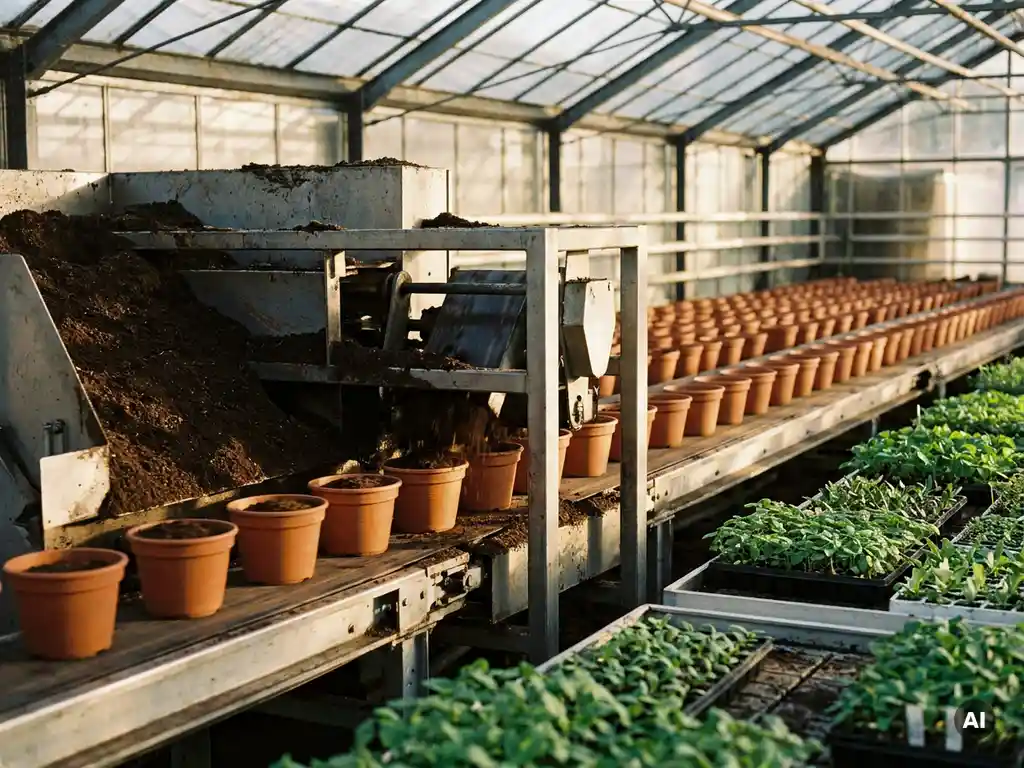
How many pots can a potting machine process during an eight-hour shift?
A professional potting machine can process between 3,000 and 8,000 pots per hour, which means a full eight-hour shift can yield anywhere from 24,000 to 64,000 pots. The actual number depends on pot size, soil mix, machine configuration, and how well the workflow around the machine is organized. The sections below break down each factor so you can estimate realistic output for your own operation.
What factors determine how many pots a machine can process per hour?
The number of pots a potting machine can handle per hour is shaped by four core variables: machine speed settings, pot diameter, soil mix consistency, and the efficiency of the surrounding workflow. A machine rated at 8,000 pots per hour will only reach that figure when all four factors are working in its favor at the same time.
Machine speed is the most obvious lever, but it is not the only one. If the conveyor feeding empty pots to the machine cannot keep pace, or if the outfeed belt backing up slows the cycle, throughput drops regardless of what the specifications say. Soil mix plays a surprisingly large role as well, a mix with large chunks, high moisture content, or inconsistent texture forces the machine to work harder and can trigger stoppages. Finally, the number of operators managing the line affects how quickly pots are placed, moved, and quality-checked.
In practice, most professional growers plan their shift output around 70 to 85 percent of the machine’s rated maximum, leaving room for normal variation without risking bottlenecks.
How does pot size affect total shift output?
Larger pots reduce total shift output significantly. A machine running 9 cm pots will fill far more units per hour than the same machine running 23 cm pots, because each larger pot requires more soil volume and more time per cycle. For machines with a rated range of 7 to 30 cm, the difference in daily output between the smallest and largest pot size can be threefold or more.
This matters when planning seasonal schedules. If your spring peak involves a mix of small starter pots and larger finishing pots, it is worth calculating expected output for each pot size separately rather than using a single average figure. Switching between pot sizes mid-shift also costs time, so batching by size is a practical way to protect daily throughput.
What is a realistic eight-hour output for a professional potting machine?
For a professional potting machine running a standard eight-hour shift with medium-sized pots and a well-organized line, a realistic daily output falls between 30,000 and 50,000 pots. Machines capable of up to 8,000 pots per hour can push closer to 60,000 under ideal conditions, but that requires consistent soil supply, experienced operators, and minimal changeovers.
A useful planning benchmark is to take the machine’s rated hourly capacity, multiply by eight, and then apply an efficiency factor of around 75 to 80 percent to account for brief stoppages, pot size transitions, and normal operational pauses. For a machine rated at 6,000 pots per hour, that calculation gives a realistic shift output of roughly 36,000 to 38,000 pots, a figure most professional growers find reliable for scheduling purposes.
How does a potting machine compare to manual potting in daily output?
A potting machine outperforms manual potting by a wide margin. An experienced worker potting by hand can typically process 300 to 500 pots per hour under sustained effort. A single potting machine running at modest speed produces ten to twenty times that volume, and it does so with consistent fill depth and soil density that manual work simply cannot match at scale.
Beyond raw speed, the quality argument is equally important. Manual potting introduces variation between workers, one person fills a pot tighter than another, leading to inconsistent plant development and unpredictable auction results. A machine fills every pot to the same programmed depth, every time. During peak season, when output volume and product consistency both matter most, that reliability has real commercial value.
The labor saving is also cumulative. Automating the potting step frees up staff for tasks that genuinely require human judgment, such as quality inspection, transplanting, and logistics, work that machines cannot replace.
What causes a potting machine to slow down or stop mid-shift?
The most common causes of mid-shift slowdowns are soil mix problems, feeding bottlenecks, and mechanical wear. Soil that is too wet clumps and blocks the filling mechanism. Soil that is too dry and airy does not compact properly, triggering refill cycles. Either way, the machine’s rhythm breaks and output drops.
Feeding and outfeed bottlenecks are the second major culprit. If empty pots are not arriving fast enough, or if filled pots are backing up on the outfeed belt, the machine has to pause even though it is functioning perfectly. This is why the conveyor system around the machine matters as much as the machine itself, a well-integrated transport line keeps the whole process moving without interruption.
Mechanical wear on older machines is the third factor. Worn chains, misaligned guides, and aging sensors cause unplanned stoppages that are hard to predict and time-consuming to fix mid-shift. Machines with fully guided chains and automatic soil detection reduce these risks considerably by maintaining consistent mechanical alignment and catching fill errors before they become jams.
Should you buy or rent a potting machine for peak season?
Whether to buy or rent depends on how many weeks per year you actually need the machine running at full capacity. If your operation has a concentrated peak of four to eight weeks and lower demand the rest of the year, renting gives you access to a professional machine without committing to the full purchase cost. If potting is a year-round activity or your volumes justify the investment, buying delivers a lower cost per pot over time and gives you full control over maintenance and scheduling.
Renting also makes sense when you are evaluating a machine for the first time. Running a rental unit through a full peak season tells you exactly how the machine performs in your specific conditions, with your soil mix, your pot sizes, and your team, before you commit to ownership. That real-world trial removes a significant amount of investment risk.
For operations in between, some suppliers offer a trial period as part of a purchase agreement, which combines the reassurance of a test run with the long-term economics of ownership.
How MartinStolze helps you maximize potting output
We design and build our potting machines entirely in-house, from the initial engineering through to assembly, installation, and operator training. That means every component is built to work together, and when something needs adjusting, our own technicians handle it, no third parties, no delays waiting for parts from an external supplier.
- Up to 8,000 pots per hour with the Stolze 3030 and Stolze 3030 PRO, suitable for pots from 7 to 30 cm
- Automatic soil detection on the 3030 PRO ensures consistent fill depth every cycle, reducing waste and improving product uniformity
- Touchscreen programming lets you save settings for different pot sizes, bore depths, and rotation speeds, switching between configurations takes minutes, not hours
- Seamless integration with our own transport belts, topping machines, and sorting lines for a complete, uninterrupted potting line
- Buy or rent, including trial options, so you can match the investment model to your operation’s actual needs
If you want to calculate realistic shift output for your specific pot sizes and soil mix, or if you are weighing the Stolze 3030 against the 3030 PRO for your setup, we are happy to think through the numbers with you. Get in touch with our team and we will help you find the right configuration for your peak season.
Frequently Asked Questions
How do I calculate the right potting machine capacity for my specific operation?
Start by estimating your peak-season daily demand — the number of pots you need to produce in a single shift at your busiest point. Divide that number by eight (hours per shift), then add 20–25% to account for the efficiency gap between rated and real-world output. That gives you the minimum hourly capacity you should be looking for in a machine. If your demand varies significantly by pot size, run the calculation separately for each size category rather than using a blended average.
What soil mix preparation steps can I take to avoid mid-shift slowdowns?
The most effective step is screening your soil mix before it reaches the machine to remove oversized chunks, debris, or clumps that can block the filling mechanism. Moisture content is equally important — aim for a consistent, slightly moist mix that holds its shape without sticking or clumping. Preparing and storing your soil in a sheltered area helps stabilize moisture levels, especially during warm or windy conditions. Batch-testing a small volume before each shift is a practical habit that catches problems before they interrupt production.
How long does it take to switch between pot sizes on a professional potting machine?
On machines with manual adjustment, switching between pot sizes typically takes 30 to 60 minutes depending on how different the configurations are. On machines with touchscreen programming and saved presets — like the Stolze 3030 PRO — the same changeover can take as little as a few minutes, since bore depth, rotation speed, and fill settings are recalled instantly. This difference becomes commercially significant during peak season, when mid-shift changeovers can otherwise eat into a meaningful portion of your daily output.
How many operators does a professional potting machine line typically require?
A standard potting machine line generally runs efficiently with two to four operators, depending on the level of automation integrated around the machine. One operator typically manages pot infeed, one monitors the machine and soil supply, and one or two handle outfeed, stacking, or quality checks. Highly integrated lines with automated transport belts and sorting systems can reduce staffing needs further, freeing workers for tasks that require human judgment such as transplanting or quality inspection.
What is the difference between the Stolze 3030 and the Stolze 3030 PRO, and which one is right for my operation?
Both machines reach up to 8,000 pots per hour and handle pot sizes from 7 to 30 cm, but the 3030 PRO adds automatic soil detection, which continuously monitors and corrects fill depth in real time. This is particularly valuable for operations running high volumes of a single pot size where fill consistency directly affects product uniformity and auction results. If you run frequent changeovers across many pot sizes or have strict quality requirements, the PRO's automated detection and programmable presets offer a clear advantage. For operations with more straightforward, lower-variation workflows, the standard 3030 delivers strong performance at a lower investment level.
What maintenance routine should I follow to prevent unplanned stoppages during peak season?
The most effective approach is a pre-season service check covering chain tension and wear, sensor calibration, guide alignment, and lubrication of all moving parts — ideally completed two to three weeks before your peak begins so there is time to source any parts needed. During the season, a brief daily inspection at the start of each shift to check chain alignment, clean soil residue from sensors, and verify belt tension takes less than 15 minutes and catches the majority of issues before they cause a mid-shift stoppage. Keeping a small stock of high-wear consumables on site, such as chains and sensor components, significantly reduces downtime if something does need replacing.
Is it possible to integrate a potting machine into an existing greenhouse workflow without redesigning the entire line?
In most cases, yes — a professional potting machine can be introduced as a standalone unit and gradually integrated with transport belts and outfeed systems over time. The key is ensuring that the infeed and outfeed areas around the machine have enough physical space and operator capacity to keep pace with the machine's cycle speed, since a bottleneck on either side will limit throughput regardless of the machine's rated capacity. Suppliers who manufacture their own transport and sorting equipment alongside their potting machines can assess your existing layout and recommend an integration path that improves output without requiring a full line redesign.
Related Articles
- Where should a topping machine be positioned in a production line?
- Which production step determines your actual pots per hour?
- How do you calculate line capacity around a potting machine?
- How do you scale up pot plant production without hiring more staff?
- What is the difference between a conveyor belt and a roller conveyor in horticulture?