

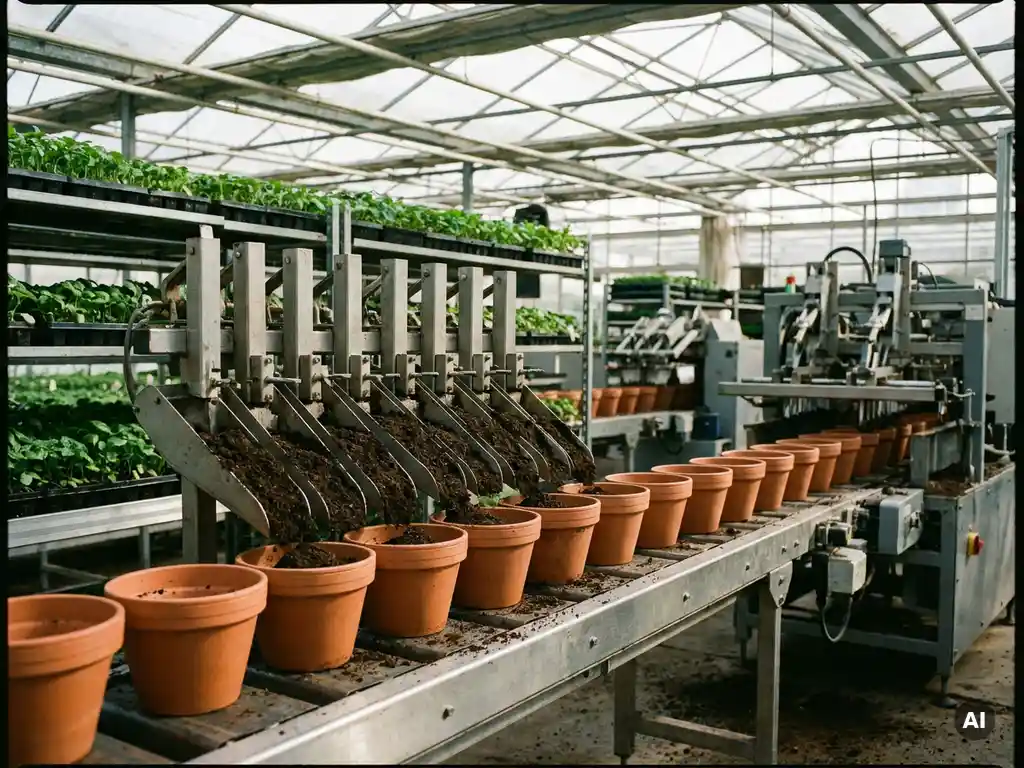
How many pots per employee per hour can an automated line produce?
An automated potting line can realistically produce between 3,000 and 8,000 pots per hour with as few as two to four employees, depending on the machine configuration and level of integration. That translates to a dramatic increase in pots per employee per hour compared to manual work, where a skilled worker typically manages a few hundred pots per hour at most. The sections below break down the key questions growers ask when evaluating automated potting lines.
What output can a single automated potting line realistically achieve?
A single automated potting line can realistically achieve between 3,000 and 8,000 pots per hour, depending on pot size, soil mix, machine model, and how the line is configured. At the upper end, a fully integrated line running continuously with minimal manual intervention reaches that 8,000-pot benchmark. Smaller or simpler setups typically operate in the 3,000 to 5,000 range.
The key variable is integration. A potting machine running on its own, without upstream soil feeding and downstream transport conveyors, will be throttled by the manual steps around it. When the entire line works as a system, from soil delivery through potting to sorting and transport, the machine can run at its rated capacity without stoppages caused by bottlenecks at either end.
Pot size also plays a significant role. Smaller pots (7 to 9 cm) cycle faster than larger containers (25 to 30 cm), so a line running 7 cm pots will hit higher hourly totals than the same machine handling 25 cm pots. Growers who work across multiple pot sizes benefit from machines that allow quick changeover and pre-programmed settings for each size, keeping downtime between runs to a minimum.
How does automation change the number of employees needed per line?
Automation typically reduces the workforce needed per potting line from six to ten manual workers down to two to four employees. Those remaining team members shift from repetitive physical potting tasks to supervisory, quality-checking, and logistics roles, work that is less physically demanding and easier to sustain over a full shift.
In a fully manual operation, every step requires hands: filling pots with soil, pressing the soil to the right density, placing cuttings or plugs, and moving pots along. Each of those steps is a labour cost and a potential inconsistency. Automation handles the repetitive core tasks at a consistent rate, meaning the people on the line are there to manage exceptions rather than to keep up with the pace.
For growers facing seasonal labour shortages, a real pressure point during peak planting periods, this reduction in headcount per line also means that available staff can cover more lines or more shifts. The same team that previously ran one manual operation can often oversee two automated lines, effectively doubling output without doubling the workforce.
What factors affect pots per employee per hour on an automated line?
The main factors that affect pots per employee per hour are machine throughput, line integration, pot size, soil mix consistency, and operator experience. Each factor can either amplify or limit the productivity gains that automation makes possible.
- Machine throughput: The rated capacity of the potting machine sets the ceiling. A machine rated at 8,000 pots per hour cannot exceed that figure, regardless of how well the rest of the line is optimised.
- Line integration: Gaps between the potting machine and upstream or downstream equipment create idle time. A fully integrated line with matched conveyor speeds eliminates these gaps.
- Pot size and changeover time: Frequent size changes slow a line down. Pre-programmed settings for each pot size reduce changeover time significantly.
- Soil mix: Coarse, fibrous, or inconsistent mixes can cause feeding problems on less capable machines. A machine designed to handle demanding soil types maintains throughput where others stall.
- Operator experience: A well-trained operator who can quickly identify and resolve minor issues keeps the line running at full capacity. Training and familiarity with the machine’s controls directly affect real-world output.
How does a potting machine compare to manual potting in speed and consistency?
A potting machine outperforms manual potting on both speed and consistency by a wide margin. While a skilled manual worker pots a few hundred pots per hour, a machine handles thousands, and does so with uniform soil density in every pot, every time. That consistency is something manual work simply cannot guarantee at volume.
Speed is the obvious advantage, but consistency may matter more in the long run. Inconsistent soil density leads to uneven plant growth, which creates problems at the auction or in the retail chain. When every pot leaves the machine with the same fill level and compaction, the entire batch behaves predictably: better germination rates, more uniform growth, and fewer rejects.
Manual potting also carries ergonomic costs. Repetitive bending, lifting, and pressing takes a physical toll on workers over the course of a shift, which affects both output quality and employee wellbeing. An automated line removes that physical burden, allowing staff to work more sustainably over longer periods without the fatigue-related drop-off in quality that affects manual operations.
When does investing in an automated potting line pay off?
An investment in an automated potting line typically pays off when a grower is producing consistently high volumes, facing recurring labour shortages, or experiencing quality inconsistencies that affect their end product. The higher the volume and the tighter the labour market, the faster the return on investment.
For smaller operations running low volumes intermittently, the economics may not yet favour full automation. But for growers who run multiple shifts during peak season, who rely on seasonal workers who are increasingly hard to find, or who have lost sales due to inconsistent pot quality, the case for automation becomes compelling quickly.
It is also worth considering the cost of not automating: overtime wages during peaks, quality complaints, and the hidden cost of high employee turnover in physically demanding roles all add up. Automation shifts those variable, unpredictable costs into a fixed, manageable investment.
Rental options lower the barrier further. Trying an automated line during a peak season before committing to a purchase gives growers direct evidence of the productivity gain in their own facility, with their own soil mix and pot sizes, before making a long-term decision.
How MartinStolze helps you maximise output per employee
We have been building and supplying automated potting solutions for professional growers since 1991, and we understand that the right line looks different for every operation. Here is what we bring to the table:
- High-capacity potting machines – the Stolze 3030 and Stolze 3030 PRO handle pot sizes from 7 to 30 cm at up to 8,000 pots per hour, with PLC control and touchscreen programming for fast, repeatable changeovers.
- Automatic soil detection (3030 PRO) – ensures consistent fill levels even with demanding soil mixes, reducing stoppages and maintaining output quality across the full shift.
- Full line integration – our potting machines connect seamlessly with our own conveyors, topping machines, tray fillers, and sorting lines, so the entire system runs at matched capacity without manual bottlenecks.
- In-house production and support – we design, build, install, and maintain every machine ourselves, so there is one point of contact when you need help fast.
- Buy or rent – including trial periods, so you can validate the output gains before committing to a purchase.
If you want to know exactly how many pots per hour your specific operation could achieve with an automated line, get in touch with us and we will work through the numbers with you.
Frequently Asked Questions
What is a realistic payback period for an automated potting line investment?
Payback periods vary depending on volume, labour costs, and line configuration, but many professional growers see a return on investment within two to four years. High-volume operations running multiple shifts during peak season often recover costs faster, particularly when factoring in savings on overtime wages, reduced reject rates, and lower employee turnover. Running a rental trial during peak season is a practical way to calculate your specific ROI before committing to a purchase.
Can an automated potting line handle different soil mixes, including peat-free or fibrous substrates?
Yes, but not all machines handle demanding mixes equally well. Coarse, fibrous, or peat-free substrates can cause feeding inconsistencies on basic machines, leading to stoppages and uneven fill levels. Higher-end machines like the Stolze 3030 PRO include automatic soil detection specifically designed to maintain consistent output across challenging mix types, making them a better fit for growers working with non-standard or peat-reduced substrates.
How long does it take to switch between pot sizes on an automated line?
On a well-configured automated line with pre-programmed PLC settings, changeovers between pot sizes can take as little as a few minutes. The key is having each pot size saved as a named programme in the machine's touchscreen controller, so operators simply select the correct profile rather than manually adjusting settings each time. Without pre-programmed settings, changeovers can stretch to 20–30 minutes or more, which significantly erodes hourly output on lines that run multiple sizes in a day.
What kind of maintenance does an automated potting line require, and how does it affect uptime?
Routine maintenance on an automated potting line typically includes daily cleaning of soil residue from conveyor belts and potting heads, periodic lubrication of moving parts, and regular inspection of wear components such as filling cups and belts. Most planned maintenance can be carried out during shift changeovers or scheduled downtime, minimising impact on production. Choosing a supplier who designs, builds, and services their own machines — with a single point of contact for support — significantly reduces the risk of extended unplanned downtime.
How do I know whether my current volume justifies a full automated line versus a semi-automated setup?
A useful rule of thumb is to look at your peak-season output requirements: if you are consistently running more than 2,000 to 3,000 pots per day and struggling to staff those peaks reliably, a full automated line is worth serious evaluation. Semi-automated setups — where one or two machines assist manual work — can be a stepping stone for smaller operations, but they still require significant manual input and do not deliver the same labour efficiency gains. Discussing your specific volumes, pot sizes, and shift patterns with a specialist will give you a clearer picture of which configuration makes financial sense.
What happens to staff when a grower transitions from manual to automated potting?
In most cases, staff are not simply replaced — their roles shift from physically demanding, repetitive potting tasks to supervisory, quality-control, and logistics functions. This transition is generally positive for employee wellbeing, as it removes the ergonomic strain of bending, lifting, and pressing over a full shift. Many growers find that retaining experienced team members in these oversight roles actually improves line performance, since familiarity with the crop and the process helps operators catch and resolve issues quickly.
Is it possible to expand or upgrade an automated potting line as the business grows?
Yes, and modular line design makes this significantly easier. A potting machine that integrates with standardised conveyor systems, topping machines, and sorting lines can be expanded incrementally — adding upstream soil feeding capacity or downstream transport as volumes increase — without replacing the core machine. When evaluating suppliers, it is worth confirming that their equipment is designed for this kind of scalability, so your initial investment does not become a bottleneck as your operation grows.
Related Articles
- Can a topping machine automatically detect whether a pot is present?
- How do sensors help control an automatic topping machine?
- Can fewer operators maintain the same pots-per-hour output with automation?
- How do conveyor belts handle moisture and soil in horticulture?
- How do you create a smooth workflow in a packing center?