

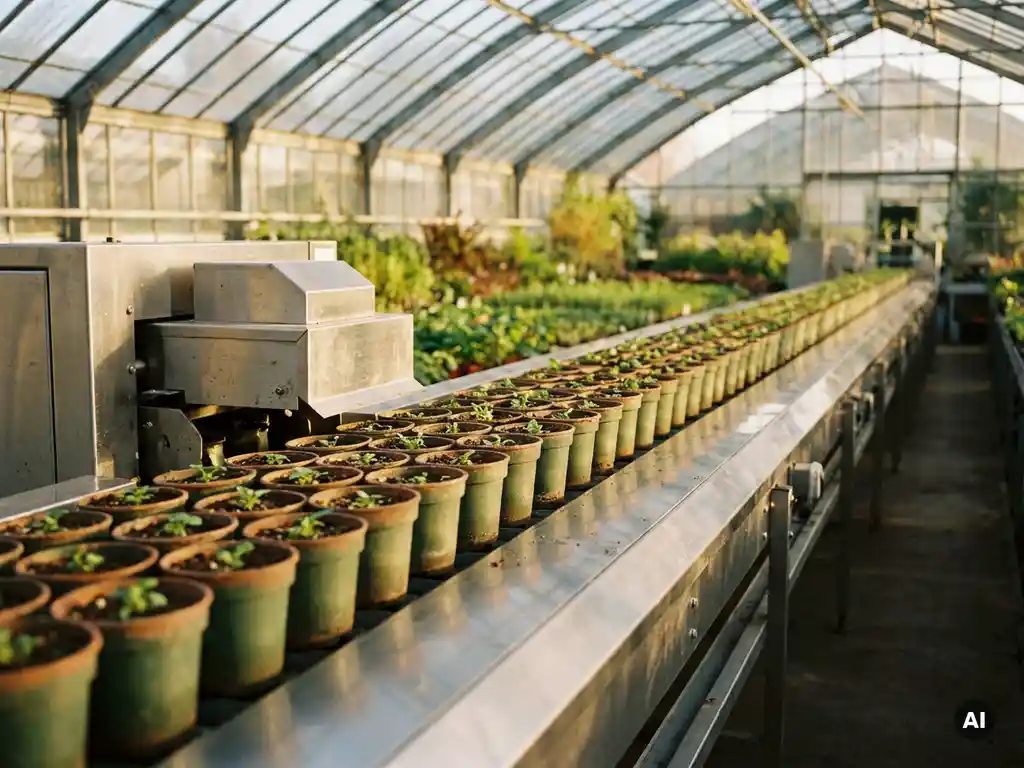
How much additional production can you achieve by increasing output by 1,000 pots per hour?
Adding 1,000 pots per hour to your potting machine’s output translates directly into thousands of additional pots per working day, often between 4,000 and 8,000 extra units depending on your shift length and operational efficiency. For growers working at scale, that difference compounds quickly across a full season, turning a modest speed upgrade into a meaningful production gain. The sections below break down exactly how that math works, what drives it, and when the investment makes sense.
How does potting speed translate into daily production volume?
Every additional 1,000 pots per hour your potting machine produces adds roughly 4,000 to 8,000 pots per working day, depending on your shift length. At a 6-hour active production window, 1,000 extra pots per hour means 6,000 more pots per day. Across a five-day week, that is 30,000 additional pots, before accounting for seasonal peaks when days run longer.
The relationship between speed and daily volume is straightforward in principle, but real-world output is shaped by how consistently the machine runs. A machine rated at 6,000 pots per hour that requires frequent stops for soil refills, pot jams, or manual adjustments may deliver less actual throughput than a machine rated at 5,000 pots per hour that runs cleanly without interruption. Net production volume is always the figure that matters, not the headline speed alone.
For growers who supply auction clocks or fulfill large retail orders, the cumulative effect of higher throughput is significant. A gain of 6,000 pots per day over a 10-week peak season adds up to 420,000 additional pots, product that would otherwise require overtime, extra staff, or simply go unplanted.
What factors determine how many pots a machine can produce per hour?
The actual pots-per-hour output of a potting machine is determined by a combination of mechanical speed, pot size, soil mix consistency, and operator setup. No single factor controls throughput in isolation, all of them interact.
- Pot size: Smaller pots cycle faster. A machine running 9 cm pots will reach higher hourly counts than the same machine running 17 cm pots, simply because each cycle fills a smaller volume.
- Soil mix: Coarse or fibrous mixes slow filling and increase the risk of bridging in the hopper. Machines with robust soil handling cope better and maintain speed across different substrate types.
- Machine configuration: Single, double, or alternating pot placement modes affect how many pots move through the chain per cycle.
- Downtime and adjustments: Manual adjustments between pot sizes, soil refill interruptions, and mechanical stoppages all reduce net hourly output below the machine’s rated capacity.
- Operator experience: A well-trained operator who pre-programs settings and anticipates soil levels keeps the line running at peak efficiency.
Understanding these variables helps you evaluate machine specifications honestly. When comparing models, ask not just what the maximum pots-per-hour rating is, but under what conditions that figure is achieved.
How much labour cost can a higher-output potting machine save?
A higher-output potting machine reduces labour costs by allowing fewer workers to produce the same volume, or the same team to produce significantly more. The saving is most visible during peak periods when growers would otherwise rely on temporary staff to meet demand.
Manual potting is labour-intensive and inconsistent. A team of workers potting by hand will vary in speed and fill density throughout the day, particularly during long shifts. A machine running at 6,000 to 8,000 pots per hour replaces the equivalent output of multiple manual workers while delivering uniform pot density every cycle.
The labour saving is not only about headcount. It also reduces the management overhead of coordinating seasonal workers, eliminates the quality variation that comes from fatigue, and lowers the ergonomic strain that leads to absenteeism. For many growers, the labour cost reduction alone justifies the investment within one or two growing seasons, depending on the volume they operate at.
What’s the difference between a standard and a PRO potting machine in terms of output?
The key output difference between a standard potting machine and a PRO model is not raw speed, both can reach up to 8,000 pots per hour, but consistency and uptime. The PRO model maintains that speed more reliably across a full production day through features that reduce manual intervention and mechanical interruption.
Our Stolze 3030 PRO includes automatic soil detection, which ensures every pot receives a precise, consistent fill without requiring operator monitoring. This prevents underfilled pots that waste space on benches and overfilled pots that waste substrate. The fully guided chain system adds mechanical stability at higher speeds, reducing vibration and wear. A programmable touchscreen lets operators pre-set configurations for different pot sizes, drilling depths, and rotation speeds, switching between jobs takes seconds rather than minutes.
In practice, the PRO’s advantage shows up most clearly during long production runs and when switching between pot sizes. A standard machine running at 7,000 pots per hour with frequent manual adjustments may deliver less net output than a PRO running at 6,500 pots per hour without interruption. The PRO also runs quieter and requires less maintenance, which reduces unplanned downtime over the course of a season.
When does investing in higher potting capacity actually pay off?
Investing in higher potting capacity pays off when your current machine is the bottleneck in your production line, when demand consistently exceeds what your setup can deliver, or when you are absorbing the cost of that gap through overtime, extra staff, or lost orders.
The payoff point depends on three practical factors:
- Volume threshold: If you are potting at or near your machine’s maximum rated capacity during peak weeks, any additional demand has no room to be absorbed. A higher-output machine creates headroom.
- Labour dependency: If you rely on seasonal or temporary workers to compensate for machine limitations, the wage cost of those workers should be weighed directly against the cost of a faster machine.
- Product consistency requirements: If your buyers or auction channels require uniform pot quality, inconsistent manual or machine output carries a hidden cost in rejected product and reputation.
For growers who are scaling up, adding new pot sizes, or replacing an ageing machine that causes frequent stoppages, the investment case is typically straightforward. For those who are not yet at capacity, the question is whether the efficiency and labour savings justify the upgrade ahead of volume growth.
How MartinStolze helps you get more out of every potting hour
We design and manufacture our potting machines entirely in-house, from engineering and programming through to assembly and installation. That means we control every aspect of performance, and we can configure a machine precisely to your soil mix, pot range, and production targets.
- Machines available in standard and PRO configurations, both capable of up to 8,000 pots per hour
- Seamless integration with conveyor systems and sorting lines for a complete, efficient potting line
- Both purchase and rental options available, including trial periods for growers evaluating the investment
- Training and support provided through our own demo and instruction facility in De Lier
- Our own engineers handle installation, commissioning, and ongoing service
If you want to understand exactly how much additional output a higher-capacity machine would deliver in your specific situation, get in touch with us and we will work through the numbers with you.
Frequently Asked Questions
How do I know if my current potting machine is actually the bottleneck in my production line?
Look for signs like a growing backlog of unplanted trays, overtime hours concentrated specifically around the potting stage, or staff waiting on pots rather than working ahead. If your machine is running at or near its rated capacity during peak weeks while other parts of your operation have idle capacity, the potting machine is almost certainly your constraint. Tracking net pots per hour over a full production day, rather than peak bursts, will give you the clearest picture.
What is a realistic efficiency rate to expect from a potting machine versus its rated maximum speed?
In real-world production, most growers achieve between 70% and 85% of a machine's rated maximum speed when accounting for soil refills, brief stoppages, and size changeovers. A machine rated at 8,000 pots per hour might realistically deliver 5,600 to 6,800 net pots per hour across a full shift. Machines with automated features like automatic soil detection and programmable presets, such as the PRO models, consistently push toward the higher end of that efficiency range by minimising manual intervention.
Can one potting machine handle multiple pot sizes in the same production day without losing significant time?
Yes, but the time lost during changeovers depends heavily on whether the machine supports programmable presets. On a machine with a touchscreen control panel where pot size, drilling depth, and rotation speed are pre-saved, switching between sizes can take under a minute. On machines requiring manual mechanical adjustments for each changeover, the same switch can cost 15 to 30 minutes of production time, which adds up significantly if you run several different pot sizes in a single day.
What soil mix characteristics cause the most problems for potting machine speed and consistency?
Coarse, fibrous, or very dry mixes are the most common causes of speed loss, as they tend to bridge in the hopper rather than flowing freely into pots. Mixes with high bark content or long peat fibres are particularly prone to this. Keeping your substrate at the right moisture level and ensuring it is well-mixed before loading significantly reduces bridging. If your operation regularly uses challenging substrates, it is worth asking specifically how a machine's soil handling system performs with those mixes before purchasing.
Is renting a potting machine a viable option before committing to a purchase?
Renting is a practical way to validate the output gains and labour savings in your own operation before making a capital investment. It allows you to run the machine through a real peak season, measure actual net throughput against your current setup, and assess how well it integrates with your conveyor and sorting lines. Some manufacturers, including MartinStolze, offer rental options and trial periods specifically for growers who want to make a data-backed decision rather than projecting from specifications alone.
How much operator training is typically needed to run a modern potting machine at full efficiency?
Most operators reach a competent working level within one to two days when proper training is provided. The learning curve is steeper when operators need to manage manual adjustments frequently, as each variable introduces more room for error. On machines with programmable presets and automated soil detection, the operator's role shifts toward monitoring and topping up soil rather than continuous adjustment, which shortens the training period and reduces the impact of staff turnover on daily output.
What maintenance routine should I follow to keep my potting machine running at peak output throughout the season?
Daily cleaning of the soil hopper, chain, and filling cups prevents substrate buildup that causes jams and uneven fills. Lubrication of the chain and moving parts should follow the manufacturer's schedule, typically weekly during heavy use. Before and after peak season, a more thorough inspection of wear parts, including filling cups, chain links, and drive components, helps catch issues before they cause unplanned downtime. Machines serviced by the manufacturer's own engineers tend to have fewer mid-season failures, as technicians are familiar with the specific tolerances of each model.
Related Articles
- How does a topping machine work in a pot plant production line?
- What are the benefits of using a topping machine after potting?
- How do you choose a topping machine for a high-volume nursery?
- How often should a topping machine be cleaned during production?
- How does operator organization affect potting machine pots per hour?