

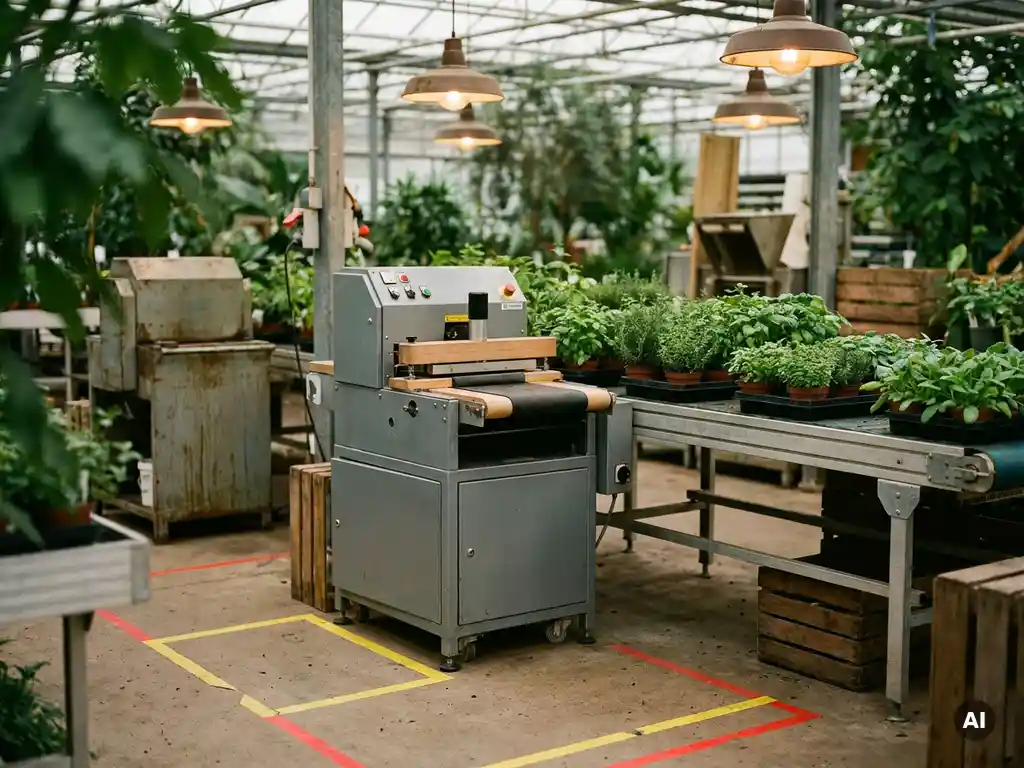
How much space do you need to install a topping machine?
Most potting machines require a footprint of roughly 1.5 to 3 metres in length and 0.8 to 1.5 metres in width for the machine itself. However, the total space you need for a working installation is considerably larger once you account for soil supply, conveyor lines, operator movement, and pot handling on either side. For most professional growers, a realistic working area of 6 to 12 metres in length and at least 3 metres in width is a practical starting point. The sections below break down every dimension and factor you need to plan your installation accurately.
What dimensions does a potting machine typically have?
A standard professional potting machine has a machine body that is roughly 1.5 to 2.5 metres long and 0.8 to 1.2 metres wide, with a working height of around 0.9 to 1.1 metres at the pot-filling station. These are the core machine dimensions, not the full installation footprint.
The machine itself is designed to be compact enough to fit through standard greenhouse or shed doorways, which typically measure around 2 to 2.5 metres wide. This is intentional: most manufacturers, including ourselves, design potting machines with transport and retrofit installation in mind. The height of the machine is kept low enough that it can be moved through standard agricultural buildings without dismantling.
Keep in mind that these dimensions refer to the potting unit alone. The soil hopper or conveyor feeding soil into the machine adds length on one end, and the outfeed conveyor carrying filled pots away adds length on the other. These elements are not optional in a production environment; they are essential to keeping the line flowing.
How much total floor space does a potting machine installation require?
A complete potting machine installation typically requires a working area of 6 to 15 metres in length and a minimum of 3 metres in width. The exact size depends on the configuration of your infeed, outfeed, and any additional stations such as topping machines or labelling units integrated into the line.
Here is a practical breakdown of the space components in a typical installation:
- Soil supply and infeed conveyor: 2 to 4 metres, depending on whether soil is fed manually or via an automated ground conveyor
- Potting machine unit itself: 1.5 to 2.5 metres
- Outfeed conveyor to trolley or transport system: 2 to 5 metres
- Operator working space on each side: at least 0.8 metres clear on both sides for safe movement
- Buffer space at start and end of line: 1 to 2 metres for pot trays and logistics
In a compact setup with manual soil loading and a short outfeed, you can work within roughly 6 to 8 metres. A fully automated line with a transport conveyor system integrated from soil to trolley loading will need closer to 12 to 15 metres of clear floor length.
What factors affect the space needed for a potting machine?
The space required for a potting machine installation is primarily determined by your production volume, the degree of automation, and the layout of your existing building. A single-operator manual setup needs far less room than a fully integrated automated potting line running at several thousand pots per hour.
The most important factors to consider are:
- Soil supply method: Manual filling of the hopper needs less space than an automated ground conveyor bringing soil from a central mixing point
- Pot size range: Larger pots require wider conveyors and more buffer space between stations
- Output capacity: Higher-capacity machines run faster and need longer outfeed conveyors to avoid bottlenecks
- Additional line stations: A topping machine, tray filler, or labelling station each adds 1 to 2 metres to the total line length
- Operator positions: Every manual station on the line needs clear working space of at least 0.8 metres on the operator side
- Turning and logistics space: Trolleys and carts need room to manoeuvre at the end of the line; often 2 to 3 metres of open floor beyond the last station
The shape of your building matters as much as the total square metres. A long, narrow greenhouse corridor suits a straight-line configuration well. An irregularly shaped packing shed may require an L-shaped or U-shaped conveyor layout, which changes the spatial requirements significantly.
Can a potting machine fit in an existing greenhouse or shed?
Yes, a potting machine can fit in most existing greenhouses or agricultural sheds, provided the floor length is at least 6 metres, the width is at least 3 metres clear, and the doorway is wide enough for the machine to be brought in during installation. Most professional potting machines are designed with exactly this constraint in mind.
Practical points to check before installation:
- Door and access width: The machine body and conveyors typically need a minimum door width of 1.2 to 1.5 metres for entry
- Floor surface: A level, solid concrete floor is strongly recommended; uneven floors cause alignment issues that affect pot-filling consistency
- Overhead clearance: Most machines have a low profile, but soil hoppers and elevated conveyors may require 2.5 metres or more of clear ceiling height
- Power supply: A three-phase electrical connection is standard for professional potting machines; check that this is available in the building
- Drainage: Soil and water runoff during cleaning needs somewhere to go; a floor drain near the machine is practical
Many growers successfully install potting machines in existing structures without major building work. A site visit or floor plan review before purchase is the most reliable way to confirm fit.
How does the Stolze 3030 compare to the 3030 PRO in terms of space?
The Stolze 3030 and the Stolze 3030 PRO have a very similar physical footprint; the machine bodies are comparable in length and width. The space difference between the two models is minimal. The more meaningful differences are in how each machine fits into your workflow and what surrounding equipment they work best with.
Both machines are designed for pots from 7 to 30 centimetres and achieve a capacity of up to 8,000 pots per hour. From a floor-planning perspective, the base installation space requirements are essentially the same. Where the 3030 PRO changes your space planning is in the automation it brings:
- Automatic soil detection: The 3030 PRO fills each pot accurately without manual adjustment, which reduces the need for a dedicated operator at the fill station and can free up space along the line
- Fully guided chain system: Offers greater stability at high speeds, meaning the outfeed conveyor can run faster without requiring additional buffer length
- Touchscreen programming: Pot size changes and settings are handled at the machine panel rather than requiring manual mechanical adjustment, which saves time during changeovers rather than saving floor space
- Quieter operation: Relevant for enclosed spaces where noise levels matter to staff working nearby
In short, both machines fit in the same physical space. The 3030 PRO is the better fit when you want to reduce manual intervention along the line and run a more autonomous operation, not because it takes up less room, but because it allows you to do more within the same footprint.
How we help you plan your potting machine installation
At MartinStolze, we guide you through every step of planning a potting machine installation that fits your specific building, production volume, and crop type. We do not sell a machine and leave you to figure out the rest. Here is what we offer:
- Site assessment and floor plan review to confirm that your building suits the installation before anything is ordered
- Custom line configurations combining the Stolze 3030 or 3030 PRO with transport conveyors, topping machines, and sortation lines, all designed to fit your available space
- Full in-house production from design to assembly, so we can adapt dimensions and layouts where standard configurations do not fit
- Installation and commissioning by our own engineers, with training in your own facility
- Rental options including a trial period, so you can test the machine in your own space before committing to a purchase
Whether you are planning a new potting line from scratch or fitting a machine into an existing building, we are happy to think along with you. Get in touch with our team and we will help you find the right configuration for your situation.
Frequently Asked Questions
Can I run a potting machine in a building without a three-phase power supply?
Most professional potting machines, including the Stolze 3030 and 3030 PRO, are designed to run on a three-phase electrical connection, which is standard in most agricultural and horticultural buildings. If your building only has single-phase power, you would need to have a three-phase supply installed before commissioning the machine — this is worth confirming with your electrician early in the planning process. It is one of the most commonly overlooked requirements during site preparation, so checking it before purchase will save you delays at installation.
What is the minimum ceiling height I need for a potting machine installation?
The machine body itself has a low profile and rarely causes ceiling height issues, but the soil hopper and any elevated infeed conveyors can require 2.5 metres or more of clear overhead clearance. If you are working in an older greenhouse or shed with a lower roof pitch, measure the clearance at the exact position where the hopper will sit, not just at the centre of the building. If ceiling height is a concern, discuss it during your site assessment so the line can be configured with a lower-profile soil supply solution if needed.
How much space do I need to allow for trolley handling at the end of the potting line?
Beyond the last station on your outfeed conveyor, you should plan for at least 2 to 3 metres of open floor space to allow trolleys and transport carts to be manoeuvred, swapped out, and moved away without disrupting the flow of the line. This buffer zone is easy to underestimate on a floor plan but becomes a real bottleneck in daily operation if it is too tight. If your building narrows at one end or has a wall close to the outfeed, an L-shaped conveyor layout may be a more practical solution.
Can I add extra stations like a topping machine or labeller to my line later, or does it need to be planned from the start?
Additional stations such as topping machines, tray fillers, and labelling units can often be integrated into an existing line after initial installation, but it is significantly easier and more cost-effective to plan for them from the outset. Each additional station adds 1 to 2 metres to your total line length, so if you know you may want to expand, it is worth reserving that floor space now rather than having to reconfigure or relocate the entire line later. Discuss your medium-term production plans during your site review so the initial layout can accommodate future growth.
What is the best floor surface for a potting machine installation, and can I install on an uneven floor?
A level, solid concrete floor is strongly recommended for any professional potting machine installation. Uneven floors cause alignment problems across the conveyor line, which leads to inconsistent pot filling, increased wear on mechanical components, and potential safety issues for operators. If your existing floor has significant variation, levelling compounds or adjustable machine feet can help, but severe unevenness should be addressed before installation — this is something a site visit will identify before it becomes a problem.
How long does a typical potting machine installation take, and do I need to shut down my operation during the process?
A standard potting machine installation typically takes one to two days for the machine and conveyor line to be set up and commissioned, depending on the complexity of the configuration and the condition of the site. In most cases, the installation can be planned around your production schedule to minimise disruption, particularly if the machine is being placed in a dedicated area of your facility. Your installation team will walk you through the commissioning process and provide hands-on training in your own facility before leaving, so your operators are confident from day one.
Is it worth renting a potting machine before buying to check whether it fits my space and workflow?
Renting before buying is an excellent way to validate both the physical fit of the machine in your building and whether the output capacity and workflow match your production needs in practice. A trial period lets you identify any adjustments needed to your line layout, operator positions, or soil supply setup under real working conditions, rather than discovering them after a full purchase. MartinStolze offers rental options including a trial period specifically for this reason, so you can make your investment decision with confidence based on real-world results in your own facility.
Related Articles
- What should you look for when comparing professional topping machines?
- How do you balance labor capacity with machine capacity?
- How can you identify what is limiting your potting line output?
- How do soil mix properties affect potting machine performance?
- How do you move plants efficiently in a greenhouse?