

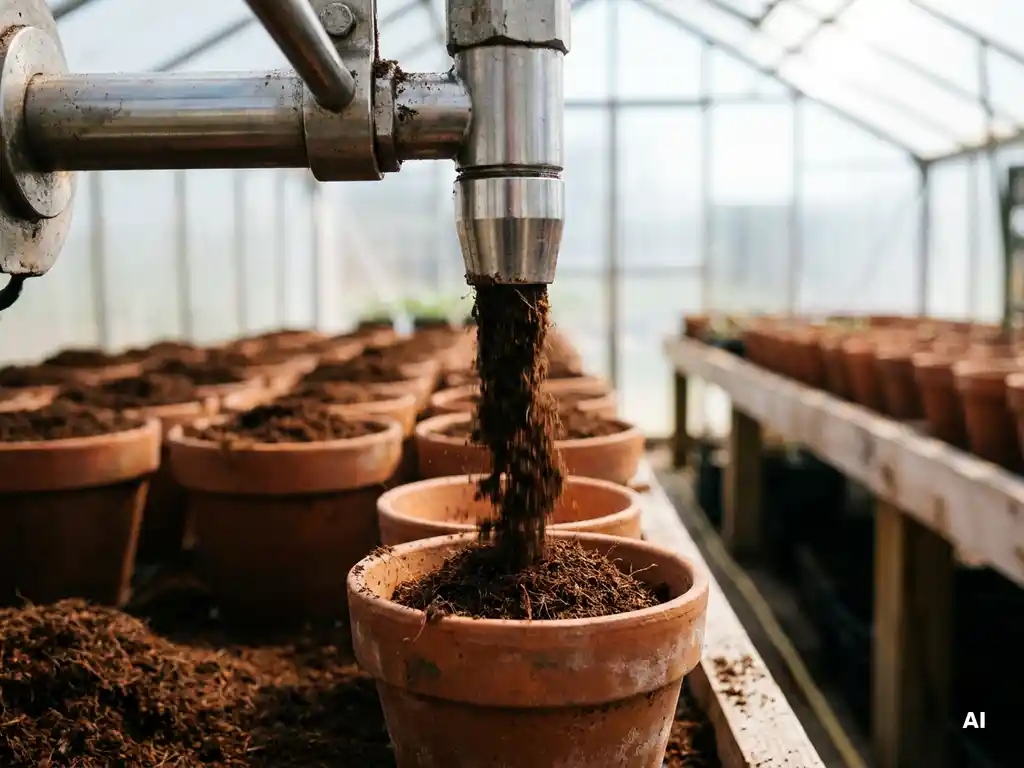
How much topping material does an automatic topping machine use per pot?
An automatic topping machine typically uses between 0.3 and 1.5 liters of topping material per pot, depending on pot size, substrate density, and machine settings. The exact volume is controlled by the machine’s fill mechanism and can be fine-tuned to match your specific pot dimensions and growing medium. The sections below break down every factor that influences material consumption and how to get the most out of your setup.
How is soil volume per pot measured on a potting machine?
On an automatic potting machine, soil volume per pot is measured volumetrically rather than by weight. The machine uses a rotating drum, a filling wheel, or a belt-and-cell mechanism that scoops a fixed volume of substrate and deposits it into each pot. The target volume is set by adjusting the fill depth and cell size on the machine, giving you consistent output pot after pot.
Most modern potting machines allow operators to pre-program settings for different pot sizes. On machines like the Stolze 3030, the touchscreen interface lets you store configurations for each pot diameter, so switching between a 9 cm and a 17 cm pot does not require manual recalibration from scratch. The machine reads the programmed fill parameters and adjusts the feed accordingly.
It is worth noting that volumetric measurement is an approximation of actual soil volume delivered. Because substrate is rarely perfectly uniform, small variations in how the growing medium flows through the machine can cause minor differences between pots. This is why consistency of the substrate itself plays such an important role in achieving reliable fill volumes.
What factors affect how much soil a potting machine uses?
Several variables determine how much substrate a potting machine deposits per pot. The most significant are pot size, substrate type, machine fill settings, and the moisture content of the growing medium. Each factor interacts with the others, so changing one often requires a small adjustment elsewhere to maintain consistent fill quality.
- Pot size and shape: Larger pots require more volume. A 7 cm pot may need as little as 0.3 liters, while a 25 cm pot can require well over a liter of substrate per fill cycle.
- Substrate composition: Mixes with coarse bark, perlite, or fibrous coir behave differently than fine peat-based mixes. Coarser materials tend to flow less predictably and can leave air pockets that reduce effective fill volume.
- Moisture content: Wet substrate is heavier and more compact, meaning a fixed volume setting will deliver more dry matter than the same setting with a drier mix. Overly dry substrate can bridge or clump, causing underfills.
- Machine speed: Running a potting machine at maximum throughput can reduce fill consistency if the substrate feed cannot keep pace. Matching machine speed to substrate flow rate is essential.
- Bore depth setting: The depth to which the filling head penetrates the pot affects how much substrate is compacted into the container before the surface is leveled.
How does soil mix density change the amount used per pot?
Soil mix density directly affects how much material a potting machine delivers per pot in practical terms. A denser, heavier substrate fills the same volumetric cell with more dry matter, while a light, airy mix delivers less actual growing medium per cycle. This means two substrates with identical volume settings can produce pots with very different weights and root environments.
Bulk density is the key measurement here. A standard peat-based mix might have a bulk density of around 200 to 300 grams per liter when moist, while a bark-heavy or perlite-rich mix can be considerably lighter. If you switch substrate suppliers or change your mix recipe, the effective amount of growing medium per pot will shift even if the machine settings stay the same.
For growers who supply to auction or retail, this matters beyond plant quality. Inconsistent pot weight can affect how plants present on the bench and how they perform during transport. Machines with automatic soil detection, such as the Stolze 3030 PRO, compensate for these variations by monitoring fill levels in real time and adjusting the feed to maintain consistent pot density across the entire production run.
Can you reduce soil waste by adjusting potting machine settings?
Yes, adjusting potting machine settings is one of the most effective ways to reduce substrate waste. Overfill is the primary source of waste on a potting line: substrate that spills over the rim of the pot, falls onto the conveyor, or is scraped off by the leveling bar all represent material that was purchased but never used productively. Precise calibration of fill volume, bore depth, and machine speed minimizes this loss.
The following adjustments typically have the greatest impact on reducing waste:
- Fine-tune the fill volume setting for each pot size rather than using a single default setting across your entire range.
- Calibrate for your specific substrate batch at the start of each production run, since density can vary between deliveries.
- Reduce machine speed if you notice inconsistent fills or excessive spillage – throughput is only valuable when fill quality is maintained.
- Check the leveling bar alignment regularly, as a misaligned bar scrapes off more substrate than necessary.
- Store substrate correctly to maintain consistent moisture content, which directly affects how the material flows through the machine.
Growers who document their settings for each pot and substrate combination can reproduce optimal configurations instantly, eliminating the trial-and-error waste that often occurs at the start of a new season or after a substrate change.
How much soil does a potting machine use compared to manual potting?
A potting machine typically uses less substrate per pot than manual potting when settings are properly calibrated. Manual potting tends to produce inconsistent fill volumes: some workers overfill to avoid complaints, others underfill when working quickly under time pressure. A machine delivers the same volume every single cycle, which eliminates the overfill buffer that many workers add instinctively.
Industry experience among professional growers consistently shows that switching from manual to automated potting reduces substrate consumption per pot, simply because the machine does not compensate for uncertainty the way a person does. Over a production run of tens of thousands of pots, even a small reduction in average fill volume per pot translates into meaningful savings on substrate costs.
Manual potting also generates more physical waste through spillage and inconsistent leveling. A potting machine with a well-adjusted leveling mechanism and a return conveyor for recaptured substrate keeps waste to a minimum throughout the entire shift, not just when workers are fresh and attentive.
The consistency advantage extends to plant quality as well. Uniform pot density means uniform water distribution and root development, which reduces the variation in finished plant quality that manual potting almost always introduces.
How MartinStolze helps you get consistent, efficient fills every run
We design and build our potting machines entirely in-house, which means every detail of the fill mechanism, the substrate feed, and the control interface is engineered with consistent volume delivery in mind. Our machines are built to handle a wide range of substrate types without compromising on fill accuracy.
- Programmable settings per pot size: Store and recall configurations for every pot in your range, eliminating recalibration time between runs.
- Automatic soil detection (Stolze 3030 PRO): Real-time monitoring adjusts the feed to compensate for substrate variation, keeping every pot consistently filled.
- Touchscreen control: Adjust fill depth, rotation speed, and soil feed from a single interface, without tools or manual adjustments to mechanical components.
- Integration with your full potting line: Our machines connect seamlessly with conveyor systems and topping machines, so substrate flow is managed across the entire line.
- Support from our own technicians: From installation to ongoing maintenance, our team is available to help you dial in your settings for your specific substrate and pot range.
Whether you are looking to reduce substrate costs, improve plant consistency, or scale up your production capacity, we are ready to help you find the right configuration. Get in touch with us to discuss your specific situation and discover which machine fits your operation best.
Frequently Asked Questions
How do I know if my potting machine is calibrated correctly for a new substrate?
The quickest way to verify calibration is to run a sample batch of 10–20 pots, then weigh them individually and compare the results. If pot weights vary by more than 5–10%, your substrate feed rate or fill volume setting likely needs adjustment. It's also worth checking moisture content before the run starts, as a new substrate delivery can differ noticeably from your previous batch even when ordered from the same supplier.
What is the most common mistake growers make when setting up a potting machine for a new pot size?
The most common mistake is using the fill volume setting from the closest pot size rather than recalibrating from scratch for the new dimensions. Even a 2–3 cm difference in pot diameter can significantly change the required fill volume, and a carried-over setting almost always results in either overfill and waste or underfill and poor plant performance. Always run a calibration batch with the actual pot you will be using and confirm the result before starting full production.
Can I use the same machine settings for different substrate suppliers, even if the mix looks similar?
Not reliably. Even substrates with a similar recipe can differ in bulk density, moisture content, and particle size distribution depending on the supplier and the time of year the raw materials were harvested. These differences affect how the substrate flows through the fill mechanism and how much dry matter is actually delivered per cycle. Always perform a quick calibration check at the start of each new delivery, especially if you notice changes in how the material flows or clumps.
How much substrate waste can a well-calibrated potting machine realistically save compared to a poorly calibrated one?
In practice, poor calibration — through overfill, leveling bar misalignment, or mismatched machine speed — can waste 10–20% of substrate per production run. On a run of 50,000 pots, that represents a significant cost in both material and disposal. A properly calibrated machine with settings documented per pot size and substrate batch can bring waste down to under 5%, with most of that recaptured by a return conveyor and fed back into the line.
What should I do if my potting machine produces inconsistent fill levels mid-run, even though settings haven't changed?
Inconsistent fills mid-run are most often caused by a change in substrate condition rather than a machine fault. Check whether the substrate in the hopper has dried out, bridged, or compacted, as all three reduce the flow rate into the fill mechanism. If the substrate condition looks consistent, inspect the fill wheel or drum for buildup of compacted material, which can gradually reduce the effective cell volume over the course of a long production run.
Is it worth investing in automatic soil detection, or can manual calibration achieve the same results?
Manual calibration works well when your substrate is highly consistent and your production runs are relatively short. However, over long runs or when working with substrates that vary in density across a single delivery, manual calibration cannot respond to real-time changes the way automatic soil detection can. Features like those on the Stolze 3030 PRO continuously monitor fill levels and adjust the feed on the fly, which is particularly valuable for high-volume operations where stopping to recalibrate mid-run is not practical.
How often should potting machine settings be reviewed and updated during a growing season?
As a baseline, settings should be reviewed at the start of every new substrate delivery, whenever you switch pot sizes, and at the beginning of each new growing season. Beyond those checkpoints, it's good practice to do a quick spot-check — weighing a sample of filled pots — every few weeks during active production. Seasonal changes in ambient humidity can subtly affect substrate moisture content and flow behavior, which means settings that were optimal in spring may need minor tweaking by midsummer.
Related Articles
- How much production time can an automatic topping machine save?
- How do you prevent wasting substrate when topping thousands of pots?
- How long does it take to pot 25,000 plants with an automated potting machine?
- Should you choose a potting machine based on average or peak production volume?
- Does running pots in multiple rows increase hourly production?