

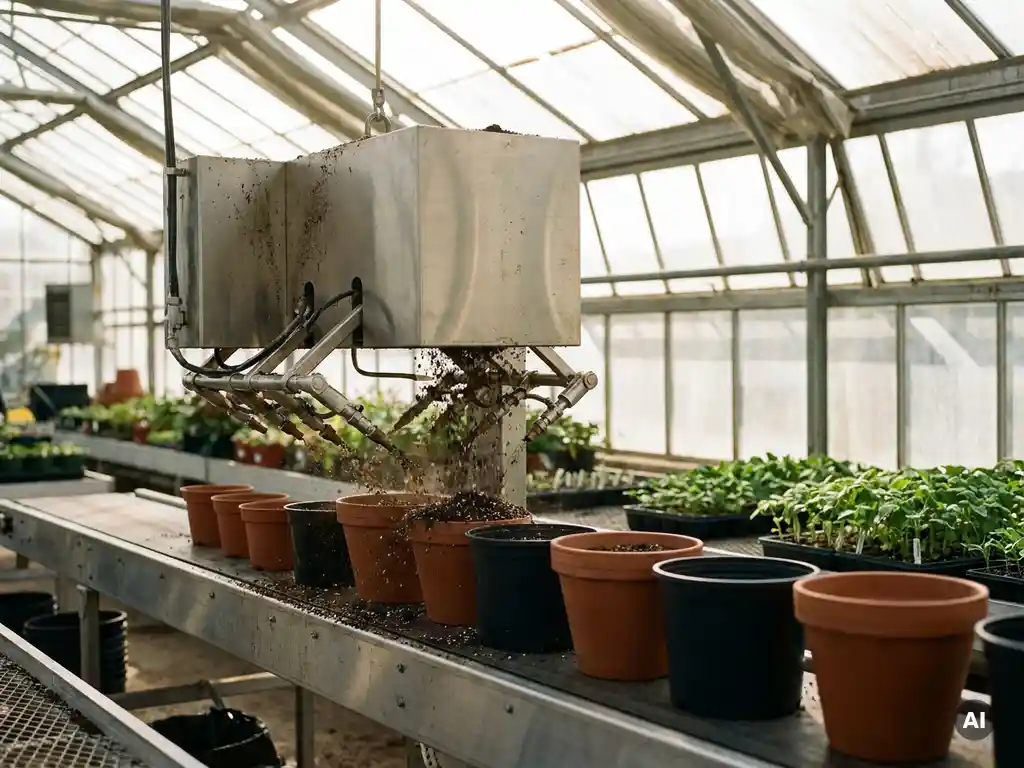
How quickly can a topping machine switch between different pot sizes?
Most potting machines can switch between pot sizes in 5 to 15 minutes, depending on the machine model and how many components need adjusting. Machines with programmable touchscreen controls and quick-release fittings sit at the faster end of that range, while older or more manual setups take longer. The sections below walk through everything that affects changeover time, from the parts involved to how machine features and your workflow decisions all play a role.
How long does a pot size changeover actually take?
A pot size changeover on a modern potting machine typically takes between 5 and 15 minutes. Machines equipped with a touchscreen and programmable memory can recall saved settings almost instantly, reducing the physical adjustment time to a matter of minutes. On machines without preset programs, operators need to manually adjust fill depth, conveyor width, and chain guides, which takes closer to 15 minutes or more.
The biggest variable is operator experience. A trained operator who runs multiple pot sizes regularly will move through a changeover far faster than someone doing it for the first time. Standardizing the changeover sequence and keeping replacement parts within arm’s reach also cuts downtime significantly. For high-volume growers who switch sizes multiple times per day, investing in a machine with programmable presets is not a luxury, it is a practical necessity.
What pot size range can a potting machine handle?
Most professional potting machines are designed to handle pots ranging from roughly 7 cm to 30 cm in diameter. This covers the vast majority of pot sizes used in ornamental horticulture and potted plant cultivation, from small seedling pots through to larger decorative containers. Some machines can be extended beyond this range with additional tooling, but the 7 to 30 cm window covers most commercial growing operations.
It is worth checking the specific range of any machine you are evaluating, because the physical construction of the chain, the filling head, and the conveyor all set hard limits on what sizes are mechanically possible. A machine that handles your current pot range comfortably but has no room to grow will become a bottleneck if your product mix expands.
What parts need to be changed when switching pot sizes?
When switching between pot sizes, the components that typically require adjustment or replacement include the boring head depth, the chain or guide width, the conveyor spacing, and the soil fill volume settings. On some machines, the pot holders or cradles themselves need to be swapped out if the size difference is significant.
- Boring depth: The drill or boring head needs to be set to the correct depth for the new pot size to ensure consistent soil fill without overflow or underfill.
- Chain and guide width: The transport chain must be adjusted to cradle the new pot diameter securely without tipping or jamming.
- Conveyor spacing: Infeed and outfeed conveyor lanes often need repositioning to match the new pot footprint.
- Soil volume and rotation speed: The amount of soil dispensed per cycle and the rotation speed of the filling mechanism both need calibrating to the new pot volume.
Machines with a fully guided chain, rather than a partially open track, require fewer manual width adjustments because the chain holds pots more precisely across a wider size range. This design detail has a real impact on how fast and reliably a changeover goes in practice.
Does a touchscreen or programmable memory speed up size switching?
Yes, significantly. A touchscreen with programmable memory allows operators to save settings for each pot size and recall them with a few taps, eliminating the need to manually recalibrate boring depth, soil volume, and rotation speed every time. What would otherwise take 10 to 15 minutes of manual adjustment can be reduced to under 5 minutes of physical part swaps, with the machine parameters already dialled in.
Programmable presets are especially valuable for growers who run three or more pot sizes regularly. Instead of relying on an operator’s memory or written notes, every setting is stored precisely in the machine’s memory. This also reduces the risk of human error: inconsistent boring depth or soil volume caused by a slightly wrong manual setting is one of the most common sources of quality variation during production runs.
Automatic soil detection adds another layer of reliability. Rather than relying solely on preset values, the machine detects the actual soil level in each pot and adjusts fill in real time, which is particularly useful when switching between pot sizes that have different internal volumes despite similar external dimensions.
How does frequent pot size switching affect machine output and uptime?
Frequent pot size switching reduces effective daily output because every changeover is unproductive time: the machine is not potting while it is being reconfigured. On a machine running at 6,000 to 8,000 pots per hour, even a 15-minute changeover represents a meaningful loss of capacity, especially if it happens multiple times per day.
Beyond lost time, frequent switching also increases wear on adjustable components. Guide rails, chain tension mechanisms, and depth-setting hardware all experience more movement and stress when they are regularly repositioned. Machines built with heavy-duty construction and precision-machined parts handle this better than lighter-built alternatives.
The practical implication for growers running multiple sizes is to batch production runs by pot size wherever possible, grouping all work in one size before switching to the next. Combined with a machine that has fast, repeatable changeover settings, this approach keeps uptime high and changeover-related losses to a minimum.
Should you buy or rent a potting machine when running multiple pot sizes?
If you run multiple pot sizes regularly throughout the year, buying is almost always the better long-term decision. A purchased machine can be configured precisely to your pot range, programmed with your specific size presets, and integrated into your production line. The per-hour cost over the machine’s lifespan is substantially lower than rental rates when the machine is in regular use.
Renting makes more sense in specific situations: if you are trialling a machine before committing to a purchase, covering a seasonal peak without the capital outlay of a full investment, or testing whether a particular model handles your soil mix and pot range reliably. A trial rental period is a practical way to verify that the changeover process works smoothly for your specific combination of sizes before making a long-term commitment.
The key question to ask yourself is how many hours per year the machine will actually run. If that number is high and spread across multiple pot sizes, a purchased machine with programmable presets will pay for itself through efficiency gains and reduced labour costs far faster than most growers expect.
How MartinStolze helps with fast, reliable pot size switching
We design and build our potting machines in-house at our facility in De Lier, which means every component, from the chain to the control software, is engineered to work together. For growers who regularly switch between pot sizes, our machines offer practical advantages that directly reduce changeover time and protect output quality:
- Pot range of 7 to 30 cm covered by a single machine, without the need for major tooling changes across the full range
- Programmable touchscreen with saved presets for each pot size, so operators can recall boring depth, soil volume, and rotation speed in seconds
- Automatic soil detection (Stolze 3030 PRO) that adjusts fill in real time, reducing quality variation during and after a size switch
- Fully guided chain for stable pot transport across different diameters, with fewer manual width adjustments between runs
- Both purchase and rental options, including trial periods, so you can verify performance with your specific pot sizes before committing
- Training and support from our own technicians, including hands-on instruction in our demo facility in De Lier
Whether you are scaling up an existing operation or evaluating your first automated potting line, we are happy to help you find the right configuration for your pot range and production schedule. Get in touch with our team to discuss your situation and see how our potting machine solutions can fit your workflow.
Frequently Asked Questions
How can I reduce changeover time if my machine doesn't have programmable presets?
The most effective approach is to create a standardised changeover checklist that documents the exact settings — boring depth, chain width, conveyor spacing, and soil volume — for each pot size you run. Keep this printed and laminated at the machine, and store any replacement parts or tools needed for the swap in a dedicated kit nearby. With a consistent routine and everything within arm’s reach, experienced operators can get close to the efficiency of a preset-equipped machine through disciplined process management alone.
Can one potting machine handle both very small seedling pots and larger decorative containers without major modifications?
Most professional potting machines cover the 7 to 30 cm range as a standard design specification, so switching between seedling pots and mid-sized decorative containers typically requires only the routine adjustments described above — no major tooling overhauls needed. However, the further apart your two target sizes are within that range, the more components will need repositioning during each changeover. If you regularly jump between the extremes of the range, a machine with a fully guided chain and programmable presets will handle those larger transitions far more reliably than one requiring fully manual adjustment.
What's the most common mistake operators make during a pot size changeover?
The most frequent error is adjusting the chain or conveyor width without recalibrating the soil fill volume and boring depth to match the new pot’s internal dimensions. Operators often focus on getting the pot to move through the machine correctly and overlook that a pot with the same external diameter as another can have a significantly different internal volume, leading to consistent underfill or overflow. Always treat the changeover as a complete recalibration of all settings, not just the mechanical transport components.
How do I know if my current potting machine is slowing down my operation due to slow changeovers?
A straightforward way to assess this is to track your total daily changeover minutes versus your total potting hours over a typical week. If changeover time accounts for more than 5–10% of your scheduled machine hours, it is actively limiting your output capacity. Also watch for signs like operators skipping full recalibration to save time, inconsistent fill quality at the start of new runs, or production schedules being built around avoiding size switches — all of these indicate that changeover inefficiency is already shaping your workflow in a costly way.
Is it worth training multiple operators on the changeover process, or should one dedicated person handle it?
Training multiple operators is strongly recommended, even if one person handles most changeovers in practice. Single-operator dependency creates a bottleneck whenever that person is absent, and it also means the changeover process is never independently verified or improved. Cross-training at least two or three team members ensures consistent execution, reduces downtime risk, and gives you the flexibility to run changeovers in parallel with other tasks during busy production periods.
How does soil type or mix consistency affect the changeover process when switching pot sizes?
Soil mix properties — particularly moisture content, particle size, and bulk density — directly affect how the filling mechanism performs after a size switch. A drier or coarser mix may not fill a larger pot evenly at the same rotation speed calibrated for a smaller pot, even if the volume setting is correct. If you use different soil mixes for different pot types, factor in a short test run after each changeover to confirm fill consistency before committing to a full production batch, and consider machines with automatic soil detection to compensate for these variations in real time.
At what production volume does it make financial sense to upgrade to a machine with faster changeover capabilities?
A useful threshold to consider is whether you are switching pot sizes more than once per day or running more than three distinct pot sizes per week on a regular basis. At that frequency, the cumulative downtime from slow changeovers — combined with the quality variation risk of manual recalibration — typically justifies the investment in a machine with programmable presets within one to two growing seasons. Running the numbers on your current changeover minutes per week multiplied by your machine’s hourly output rate will give you a concrete figure for how much production capacity you are currently leaving on the table.