
How rollers and conveyors improve greenhouse efficiency in daily operations
Walk through any busy greenhouse on a Tuesday morning and you will see it: people pushing carts, carrying trays, and shuffling pots from one corner to the next. None of this movement adds value to the plant, yet it eats up a large share of the working day. Greenhouse efficiency rarely suffers from one big problem. It leaks away in hundreds of small trips.
Rollers and conveyors tackle exactly that leak. By automating internal transport, growers free up hands for work that actually needs a human eye and a skilled touch. Here is how it works in daily practice, and how to start without a massive upfront investment.
Where Daily Greenhouse Hours Quietly Disappear
The biggest time drain in most greenhouses is not the growing itself, but the handling around it: moving trays, carts, and pots between the greenhouse, the potting line, and the dispatch area.
Because these tasks are repetitive and spread across the day, they rarely show up as a line item. A worker carrying trays for twenty minutes here and pushing a cart for thirty minutes there does not feel like a problem. Add it up across a team and a whole season, and it becomes one of the largest hidden labor costs at the nursery.
The physical strain matters too. Lifting and carrying all day leads to fatigue, absenteeism, and turnover, which are hard to absorb when vacancies already stay open for months. Seasonal peaks make it worse, since extra hands are needed exactly when they are hardest to find and most expensive to hire.
How Conveyors and Rollers Streamline Internal Transport
Conveyors and roller tracks move products along a fixed, predictable route, so people no longer have to carry them. The result is a steady flow instead of stop-and-go transport.
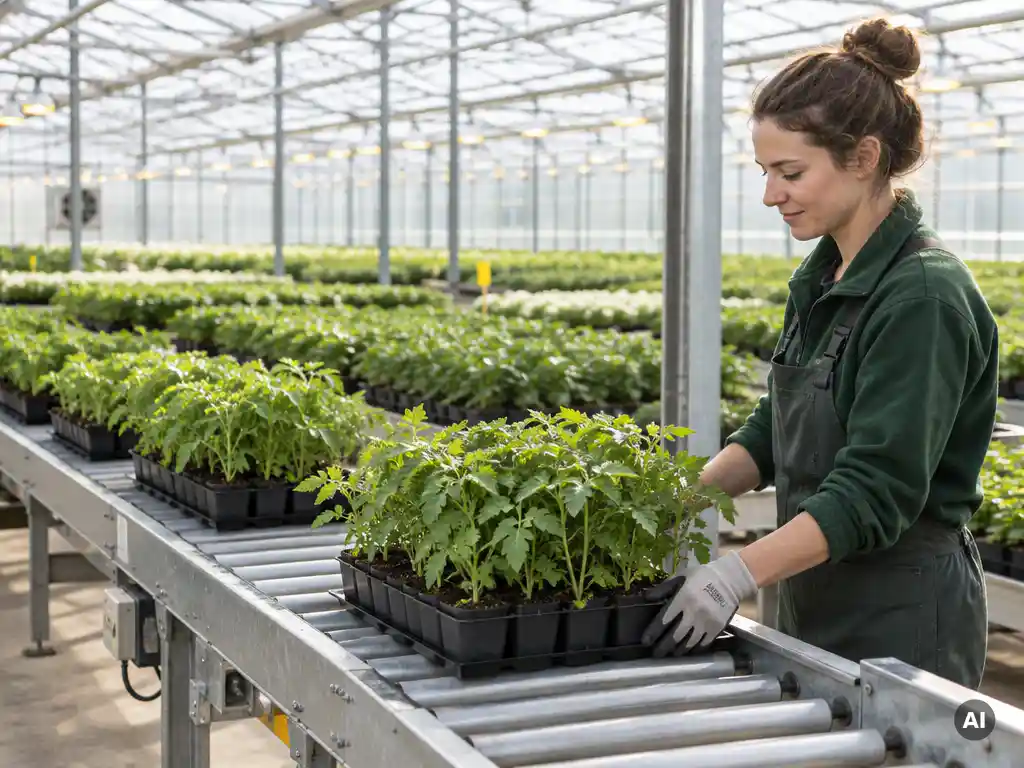
A conveyor belt carries pots, trays, or crates from one workstation to the next at a consistent pace. Roller tracks do the same for heavier or stackable loads such as trolleys and containers, letting gravity or light pushing do the work. Both cut walking distance, reduce lifting, and keep products moving without waiting for someone to be free.
The effect goes beyond speed. When the flow is steady, a team can work in a rhythm: potting, inspecting, weighing, and packing happen along one line rather than in scattered pockets. Work tables, scales, and lighting can be added along the route, which turns a simple belt into a complete processing line. That kind of setup improves greenhouse efficiency because fewer people are needed for the same output, and the work that remains is more ergonomic.
Choosing Between Conveyors, Rollers and Buffer Tables
The right choice depends on what you move, how far, and how steady the flow is. Belts suit lighter, continuous product flows, rollers suit heavier loads and trolleys, and buffer tables absorb the differences in pace between steps.
Conveyor belts
Belts are the all-rounder for pots, trays, and crates. They are ideal when products need to travel a set route between stations, and they combine well with other equipment. Our range of transport belts covers both fixed and flexible setups.
Roller tracks and buffer tables
Roller tracks handle heavier loads with little effort, which makes them a good fit for trolleys, containers, and dispatch areas. Buffer tables act as a pressure valve. When one step runs faster than the next, products wait on the table instead of piling up or forcing workers to stop. Without a buffer, a single slow station can stall the whole line.
In practice, most nurseries end up with a combination. The products are designed to connect, so a belt can feed a buffer table, which feeds a potting machine, which feeds a roller track toward dispatch. Mapping the product flow first makes it much easier to see where each element belongs.
Starting Small With Mobile Belts and Rental Options
You do not have to automate the whole nursery at once. The most practical entry point is a mobile conveyor belt, which you can place where the pressure is highest and move when needs change.
This step-by-step approach lowers the risk. A mobile belt shows quickly how much time and effort it saves on a real task, in your own greenhouse, with your own people. Many growers begin during a peak period, learn from the experience, and then add more elements over time.
Renting makes the first step even easier. We offer rental equipment so growers can experience the benefits before committing to a purchase. If the belt proves its worth, the next step might be a fixed system that becomes the backbone of the production process. If you are unsure where to start, our team is happy to think along with you about the best first move for your situation.
Real Results: From 26 to 6 FTE
Automating internal transport can change staffing needs dramatically. One of our customers went from 26 to 6 FTE for the same output, a clear example of what a fully connected line can achieve.
That kind of result does not come from a single machine. It comes from linking steps that used to be separate, so products flow from start to finish with minimal manual handling. Fewer people are needed, errors drop, and the remaining team does more skilled, less strenuous work. Every nursery is different, so results will vary, but the principle holds: the more manual transport you remove, the more labor you free up.
Looking ahead to the rest of 2026, labor shortages and rising wage costs show no sign of easing. Growers who start automating now, even with one mobile belt, build experience and flexibility while others are still searching for staff. The smartest next step is simple: pick the busiest transport route in your greenhouse, measure how many hours it takes each week, and see what a single belt or roller track could give back.
Frequently Asked Questions
How do I figure out which transport route in my greenhouse to automate first?
Start by tracking the busiest internal route for one typical week: note how many people are involved, how many trips are made, and how many hours it takes. The route with the highest hours, the most repetitive lifting, or the most frequent bottlenecks is usually the best candidate. Sketching a simple product-flow map from greenhouse to potting line to dispatch will make these pressure points easier to spot.
What should I measure to know whether a conveyor or roller track is paying off?
Compare a before-and-after baseline on the same task: labor hours per week, number of people needed, trays or pots handled per hour, and error or damage rates. Also track softer indicators such as sick leave and how easily you can cover peak periods. Even a simple spreadsheet over four to six weeks will show whether the time saved justifies a permanent system.
What if my greenhouse layout is tight or has uneven floors and narrow paths?
This is where mobile and flexible belts are especially useful, since they can be positioned exactly where needed and moved when the layout changes. Measure your aisle widths, turning radius for carts, and any thresholds or slopes before choosing equipment. If you are unsure, a short on-site discussion with a supplier can help determine whether belts, rollers, or a combination will fit.
How do I prevent one slow workstation from stalling the whole line?
Add a buffer table between steps that run at different speeds, so products can wait there instead of piling up or forcing workers to stop. It also helps to balance staffing across stations, putting an extra person on the slowest step during busy periods. Reviewing the line after a few days of real use will reveal where the bottleneck actually sits, which is not always where you expect.
Is renting a conveyor belt really a good way to test automation?
Yes, renting lets you test a belt on a real task with your own team and products before committing to a purchase. The best approach is to rent during a peak period, since that is when the time savings and reduced strain are easiest to see. If the results are positive, you already know where a permanent system would add the most value.
Will my team resist automation, and how can I get them on board?
Resistance is often lower than expected when workers see that the belt removes the heavy, repetitive part of the job rather than their role. Involve the team in choosing where to place the first belt, and let them give feedback on ergonomics and workflow. Emphasizing that the remaining work becomes more skilled and less physically demanding helps build buy-in.
What are common mistakes when introducing conveyors and roller tracks in a nursery?
The most common mistakes are automating without mapping the flow first, buying a single machine that creates a new bottleneck further down the line, and choosing a system that cannot be extended later. Another is ignoring the ergonomics of the workstations along the belt, such as table height and lighting. Starting small, choosing equipment designed to connect with other elements, and adjusting step by step avoids most of these pitfalls.