

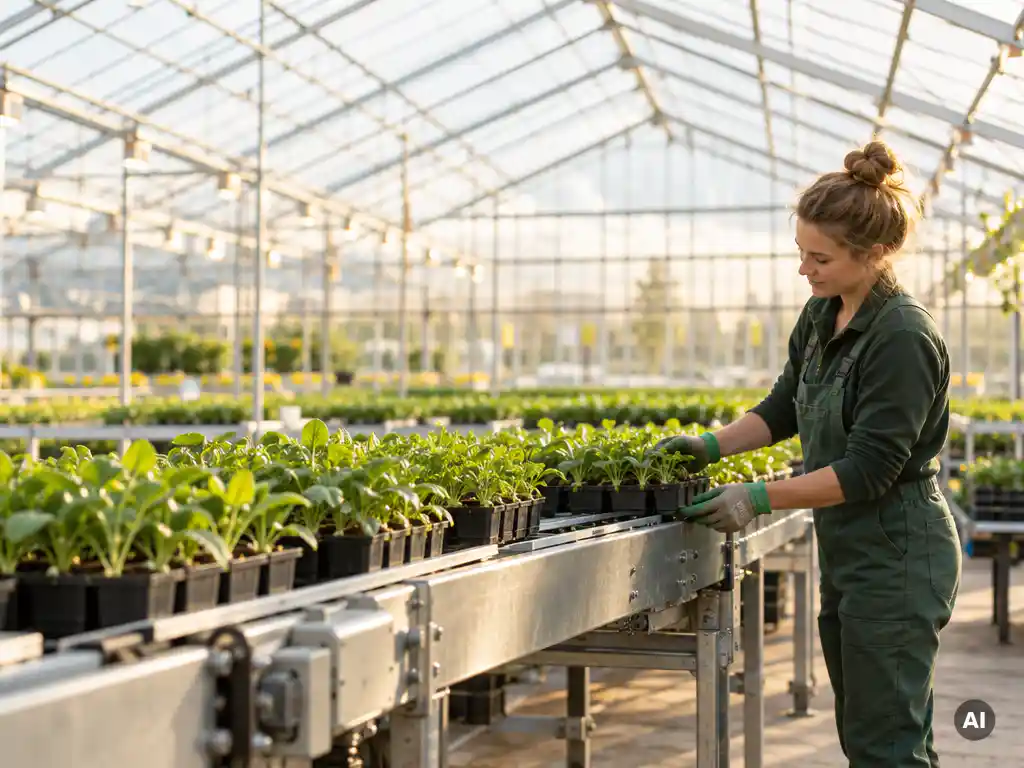
How to improve greenhouse efficiency and protect shrinking margins
Every grower knows the feeling: orders are up, the greenhouse is full, and yet the margin at the end of the month looks thinner than last year. Wages climb, vacancies stay open for months, and seasonal peaks force a scramble for temporary workers. Improving greenhouse efficiency is no longer a nice-to-have. It is the most practical way to protect profitability when costs keep rising and the labor market refuses to cooperate.
The good news is that the biggest gains often hide in plain sight, in the way plants, trays, and pots move from one point to another. Here is where the hours disappear, and how to win them back.
Where Labor Hours Quietly Drain Your Margins
Most lost margin in a greenhouse operation comes from repetitive manual handling, such as carrying, pushing, lifting, and repositioning product, rather than from the skilled work of growing itself.
Walk through a typical day and count how many times a plant gets touched by hand between potting and dispatch. Each touch costs seconds, and those seconds multiply across thousands of plants, dozens of employees, and an entire season. Because the work is spread out and feels routine, it rarely shows up as a line item. It simply lands in the payroll total.
Physically demanding tasks add a second layer of cost. Heavy lifting and constant walking lead to absenteeism, injuries, and high turnover, which means constantly recruiting and training new people. Seasonal peaks make it worse, since temporary staff are expensive and need time to reach full speed. Together, these factors push up the cost of every plant that leaves the greenhouse.
Automating Internal Transport for Faster Throughput
Automating internal transport moves product through the greenhouse without people carrying it, which raises throughput while reducing the number of hands needed.
Internal transport is the connective tissue of any horticultural operation. When it relies on trolleys and muscle power, every stage waits on the one before it. Conveyor belts, roller tracks, and buffer tables change that dynamic by creating a steady, predictable flow. Plants arrive at the next workstation when they are needed, not when someone finds the time to bring them.
The effect on greenhouse efficiency goes beyond speed. Staff can focus on tasks that actually require judgment, such as quality control, sorting, and plant care, while the system handles the moving. Ergonomics improve because heavy and repetitive movements disappear, which supports healthier employees and fewer sick days. Weighing scales, work tables, and lighting can be added to the same line, so one connected setup covers several steps at once.
Water and soil handling benefit too. Automated watering stations and soil conveyors take over tasks that traditionally tie up several people for hours. The result is a more consistent process with fewer errors and less variation between shifts.
Start Small With Mobile Conveyors, Then Scale Up
The easiest way to begin automating is with a mobile conveyor belt, then expanding to fixed systems as the benefits become clear.
Many growers hesitate because automation sounds like a large, risky investment. It does not have to be. A flexible, mobile belt can be placed where the bottleneck is worst, and it can be moved as the season or the crop changes. It delivers visible results within days, which makes it a low-risk first step.
Renting is an even gentler entry point. Bringing in equipment for a single peak period lets a team experience the difference firsthand before committing to a purchase. We see many customers start exactly this way, then build step by step toward a fully integrated line once they know what works for their layout and crop. Our range of conveyor belts is designed to combine easily, so each addition fits what is already in place.
This gradual path also helps the team. People get used to new ways of working at a comfortable pace, and the business can spread investment over time instead of taking one large leap.
Real Savings: From 26 to 6 FTE
Automating internal transport can cut the workforce needed for the same output dramatically, and one of our customers went from 26 to 6 FTE.
That figure is worth pausing on. The output stayed the same, but the number of people needed to achieve it dropped by more than three quarters. For a business struggling to fill vacancies and paying a premium for temporary labor, the impact on margins is immediate and lasting.
Savings like these come from combining several improvements rather than a single machine. Transport is automated, buffering smooths out the flow, potting and watering are mechanized, and workstations are positioned so product arrives exactly where it is needed. Each step removes a small amount of manual work, and together they reshape the entire process.
Results naturally vary by operation, depending on crop, layout, and starting point. What holds true across the board is that the less a business depends on scarce labor, the more control it has over costs, planning, and growth. Fewer people on the floor also mean less stress around recruitment and fewer disruptions when the market tightens again in 2026 and beyond.
Choosing a Partner Who Understands Horticulture
The right automation partner knows the realities of the greenhouse and delivers hardware, installation, and advice from a single source.
Generic industrial suppliers often miss the details that matter in horticulture: humidity, uneven floors, fragile products, tight seasonal windows, and the need for flexibility. A partner with deep sector experience designs around these realities from the start. Since 1991, we have built and installed solutions for greenhouse, distribution, and packaging operations from our own workshop in De Lier, which means we understand the work floor without needing it explained.
A single point of contact matters as well. Coordinating between multiple suppliers costs time and increases the risk of compatibility problems. When machines, software, and installation come from one source, implementation runs more smoothly and issues get solved faster.
If you are wondering where to begin, a conversation about your current process is often the most useful first step. Our team is happy to think through your layout and bottlenecks with you, and you can get in touch to talk through the options. Protecting margins starts with seeing where the hours go, and the sooner that picture is clear, the sooner the savings begin.
Frequently Asked Questions
How do I figure out where the biggest labor bottleneck is in my greenhouse?
Start by mapping the journey of a single plant from potting to dispatch and count every manual touch, then time each handling step over a normal day and a peak day. The stages with the most carrying, waiting, or repositioning are your best automation candidates. Ask your team too, since the people doing the work usually know exactly where time is lost.
What is the best first step if I have never automated internal transport before?
Begin with a single mobile conveyor belt placed at your worst bottleneck, such as the potting or packing area. It requires little installation, delivers visible results within days, and can be moved as your crop or season changes. Once you see which steps benefit most, you can expand with additional belts, buffer tables, or fixed lines.
Is it worth renting equipment before buying?
Yes, especially if you are unsure about your layout or the return on investment. Renting a conveyor for one peak period lets your team test the workflow, gather real data on time saved, and adjust the setup before committing capital. Many growers use the rental results to build a clear business case for a permanent system.
How can I calculate the return on investment of automation?
Compare your current labor hours per 1,000 plants (including temporary staff, training, and absenteeism) with the expected hours after automation, then multiply by your hourly labor cost. Subtract the equipment cost, spread over its expected lifespan, plus maintenance. Remember to include softer gains like fewer errors, less injury-related downtime, and reduced recruitment effort.
What if my greenhouse has uneven floors, high humidity, or limited space?
These are common challenges in horticulture and should be discussed with your supplier before installation. Equipment designed for greenhouse use can be adjusted for uneven surfaces and moisture, and modular or mobile conveyors can be configured to fit tight layouts. A site visit is the best way to confirm what will work in your specific situation.
Will automation mean my staff lose their jobs or resist the change?
Automation mainly removes heavy, repetitive tasks, allowing employees to shift to higher-value work like quality control, sorting, and plant care. Involve your team early, introduce changes gradually, and let them test the equipment so they see the ergonomic benefits firsthand. Starting small also gives everyone time to adapt at a comfortable pace.
What common mistakes should I avoid when automating my greenhouse?
The most frequent mistakes are automating one step in isolation without considering the flow before and after it, buying from multiple suppliers whose systems do not fit together, and skipping buffering, which leaves bottlenecks in place. Plan the whole process first, choose combinable components, and work with a partner who understands horticulture and can provide hardware, installation, and advice from a single source.