
How to improve greenhouse efficiency step by step with mobile conveyors
Spotting Labor Bottlenecks in Internal Transport
A labor bottleneck is any point in your process where people spend their time carrying, pushing, or waiting instead of doing skilled work. In most nurseries, these bottlenecks sit in internal transport: moving plants from the potting line to the growing area, from the greenhouse to the packing station, or between buffer points.
The easiest way to find them is to watch the flow for a day. Follow a single batch of plants from start to finish and note where people stand idle, where trays pile up, and where the heaviest manual work happens. Repetitive lifting, long walking distances, and handoffs between teams are classic warning signs.
Pay attention to seasonal peaks as well. If you rely on temporary staff every spring or autumn mainly to move product around, that is a strong signal. These are the tasks that automation handles best, because the work is predictable, repetitive, and physically demanding.
Why Mobile Conveyors Are the Easiest First Step
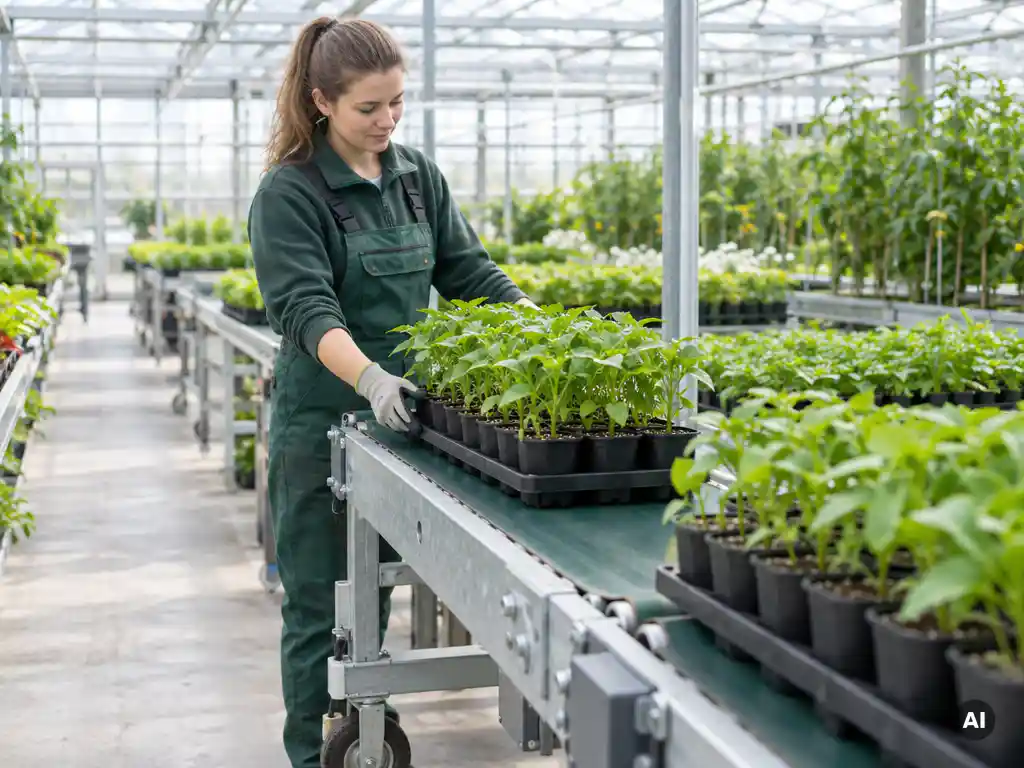
Mobile conveyors are the easiest first step because they require no structural changes or large upfront commitment, and they can be moved wherever the work is. Instead of redesigning your greenhouse, you add flexibility to the layout you already have.
A mobile conveyor can be placed in a greenhouse aisle one week and at the packing line the next. That adaptability makes it ideal for growers who are not yet sure where automation will pay off most. You learn from real use rather than from a spreadsheet.
The benefits show up quickly:
- Less physical strain: plants travel on the belt instead of in people’s arms, which supports healthier, more ergonomic work.
- Faster throughput: a steady flow replaces start-and-stop carrying.
- Fewer hands needed: the same output with a smaller team, or the same team handling more volume.
For many nurseries, this combination makes mobile conveyors the most practical way to raise greenhouse efficiency without disrupting daily operations.
Setting Up Your First Mobile Conveyor Line
The best first line targets the single busiest transport route in your operation. Start where manual handling is heaviest, rather than trying to automate everything at once.
Choose the right spot
Look back at the bottlenecks you identified. A short, well-chosen line between two work points, such as the potting station and the greenhouse entrance, often delivers more benefit than a long line in a low-traffic area. Measure the distance, check the available floor space, and make sure paths stay clear for people and carts.
Think about the whole workflow
A conveyor works best when the work around it is organized too. Consider adding a work table, lighting, or a scale where plants are sorted or checked. Because our conveyor belts can be combined with these extras, the line can grow into a complete processing station rather than just a moving belt.
Keep the first setup simple, then observe. Note how the team adapts, where plants still queue up, and what could move faster. These observations guide every next decision.
Trying Before Buying With Conveyor Rental
Renting a conveyor lets you test automation in your own greenhouse before you commit to buying. It turns a big decision into a small, reversible one.
Rental is especially useful during a peak period. Instead of hiring extra temporary staff for a few weeks, you can bring in a conveyor, see how much time it saves, and measure the effect on your team. If it clearly pays off, you have the proof you need. If a different layout would work better, you learn that cheaply.
This approach also builds confidence within the team. Employees who have tried the equipment and felt the physical relief are far more likely to welcome further automation. We often see growers start with a rental during a busy season and then decide to keep going once the results speak for themselves.
Scaling Up From Mobile to Fixed Systems
Once a mobile line proves its value, scaling up means gradually replacing the busiest mobile setups with fixed systems and linking them into a continuous flow. The move is a progression, not a leap.
Fixed systems make sense where the route is stable and the volume is high. Think of a permanent line from the potting machine through a buffer table to the growing area, or a rolling track that connects greenhouse sections. Combined with buffer tables, potting machines, and watering stations, these systems can form the backbone of your production process.
Mobile and fixed elements can also work side by side. Keep mobile conveyors for flexible, seasonal tasks and use fixed lines for the daily core flow. Growers who follow this path have reduced their workforce dramatically for the same output, in one case from 26 to 6 FTE.
Where should you begin? Start with a short walk-through of your own internal transport, pick the one route that costs the most effort, and test it. If you would like a second pair of eyes, we are happy to think along with you and help you choose the first step that fits your nursery.
Frequently Asked Questions
How do I calculate whether a mobile conveyor will pay off in my nursery?
Start by measuring the labor hours currently spent on one specific transport route, including walking, carrying, and waiting time. Multiply that by your hourly labor cost, then compare it to the rental or purchase cost of the conveyor over the same period. A rental trial during a peak week is the easiest way to get real numbers instead of estimates.
How long should I rent a conveyor to get a reliable result?
Aim for at least one full work cycle on the route you are testing, ideally during a busy period such as spring or autumn. This gives you enough data on throughput, team handling, and layout issues. Record the number of people involved and the time spent before and during the trial so you can compare them directly.
What are the most common mistakes when introducing a first conveyor line?
The most common mistakes are trying to automate too much at once, placing the line on a low-traffic route, and blocking walkways for people and carts. Another frequent issue is ignoring the workflow around the belt, such as where plants are loaded, checked, or stacked. Keep the first setup short and simple, then adjust based on what you observe.
How can I get my team on board with automation?
Involve employees from the start by asking where they feel the most physical strain and letting them test the equipment. Emphasize that the goal is to reduce heavy, repetitive work so people can focus on skilled tasks. A rental trial helps, because team members experience the relief themselves rather than hearing about it.
What should I do if plants still queue up after installing a conveyor?
A queue usually means the bottleneck has simply moved to the next step. Check whether loading, sorting, or unloading is now the slowest point, and consider adding a buffer table, an extra work station, or repositioning the line. Observing the flow for a day after installation will show you exactly where to adjust.
When is it the right time to move from mobile to fixed conveyor systems?
Consider a fixed system when a route is stable, the volume is consistently high, and a mobile conveyor is being used in the same place day after day. At that point a permanent line, possibly linked to buffer tables or a potting machine, offers a smoother continuous flow. You can keep mobile conveyors for seasonal or flexible tasks alongside it.
Do I need to redesign my greenhouse before adding conveyors?
No, that is the main advantage of starting with mobile conveyors. They fit into your existing layout, so you only need to check available floor space and keep paths clear. Larger layout changes can wait until you have seen where automation delivers the most value.