

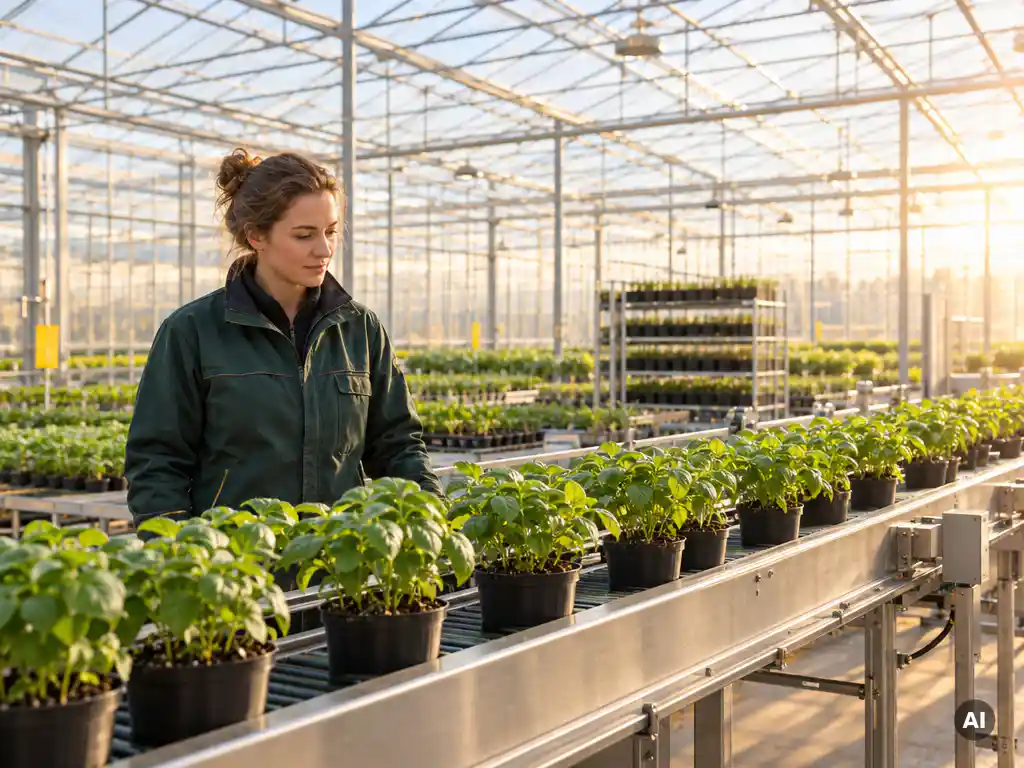
How to improve greenhouse efficiency when wage costs rise every year
Every grower knows the feeling: you plan the season, order the plants, and then wonder who will actually do the work. Wage costs climb year after year, vacancies stay open for months, and seasonal peaks force you into expensive temporary labor. Improving greenhouse efficiency in 2026 means looking beyond working harder and asking where your hours really go.
The good news is that the biggest gains rarely come from the plants themselves. They come from the movement around them, the carrying, pushing, stacking and sorting that fills a surprising share of every shift. Here is how to find those hours and win them back, one step at a time.
Where Labor Hours Quietly Disappear in Your Nursery
Most lost hours hide in small, repetitive tasks that nobody tracks: moving trays, waiting for the next trolley, walking back and forth between the greenhouse and the packing area. Because each action takes only seconds, the total rarely shows up in any report.
A simple exercise makes this visible. Pick one product line and follow it from potting to shipping, noting every time a person touches it without adding value to the plant. Walking, lifting, repositioning and waiting are all candidates, and together they often take up more of the working day than the actual growing tasks.
These hidden hours matter because they are the most expensive kind. They are paid at full wage rates, they cause physical strain that leads to sick leave, and they keep skilled people busy with work that does not need skill. Once you see them, the question shifts from “how do we find more people?” to “how do we need fewer?”
Internal Transport as the Biggest Efficiency Lever
Automating internal transport is usually the fastest way to cut labor in a nursery, because it removes the repetitive handling that fills most of the day without changing how you grow.
Think of the flow of plants through your business as a chain: potting, buffering, watering, sorting, packing. Between each link, someone is carrying or pushing product. A well-designed line replaces that manual shuttling with a steady, controlled flow, so the same team handles far more volume with less effort.
The ergonomic benefits are just as important as the savings. Less lifting means fewer injuries, lower absenteeism and a workplace that is easier to recruit for. Equipment such as conveyor belts, buffer tables, potting machines and watering stations can be combined into one connected line, which means each addition strengthens the whole. That combinability is what turns separate machines into a real efficiency gain for the greenhouse.
A Step-by-Step Path to Automation
The most reliable way to automate is to start small and grow, beginning with a mobile conveyor in the busiest spot and expanding toward a fixed system as the benefits prove themselves.
Many growers hesitate because the choice feels overwhelming. There are too many machines, too many options and too little time to compare them. A staged approach removes that pressure. You solve your most painful bottleneck first, learn how the equipment fits your routines, and only then decide what comes next.
Start with one bottleneck
Look at where the queue forms or where people spend the most time carrying. A single mobile conveyor in that spot can already change the rhythm of a whole shift, and it requires little rebuilding of your existing layout.
Grow toward a fixed system
Once the first step works, you can add buffer tables, work tables with scales and lighting, or a potting machine, and eventually connect everything into a fixed line. Because hardware, software and installation come from one source, the pieces fit together without you having to coordinate between suppliers. If you want to think through the right order for your own nursery, we are happy to talk it through with you.
Trying Before Buying With Rental Options
Renting equipment lets you test automation during a real peak period before committing to a purchase, which takes most of the risk out of the decision.
Investing in machinery is a big step for a family business, and it is fair to want proof first. A rental gives you that proof. You see how the equipment handles your plants, your pots and your people, and you learn what it actually saves in hours rather than relying on a brochure.
Rental also suits the seasonal nature of horticulture. If your workload spikes in spring or before the holidays, bringing in a conveyor for that period can replace extra temporary staff at a predictable cost. Many growers who start this way later decide to buy, because by then the results speak for themselves.
Real Results: From 26 to 6 FTE
The potential is larger than most growers expect: some of our customers have gone from 26 to 6 FTE while keeping the same output.
That kind of change does not happen through one machine. It comes from rethinking the whole internal flow, removing manual handling at every step, and letting a connected line carry what people used to carry. The remaining team shifts toward supervision, quality control and the work that genuinely needs human judgment.
Of course, every nursery is different, and your own numbers will depend on your crop, layout and volume. But the direction is clear: when wage costs rise every year, the most durable answer is to need fewer hours for the same result. A good first move is simple. Map where your hours go, pick one bottleneck, and try a solution on rental. Visit our website to see what that first step could look like for your greenhouse.
Frequently Asked Questions
How do I measure where labor hours are being lost in my nursery before investing in automation?
Pick one product line and follow it from potting to shipping, logging every non-value-adding touch such as walking, lifting, repositioning and waiting. Use a simple stopwatch or a shared spreadsheet over a few typical shifts, and multiply the totals by your hourly wage cost. This gives you a baseline in hours and euros, so you can later prove what any machine actually saves.
What size of nursery is needed to make internal transport automation worthwhile?
There is no strict minimum, because automation can start small with a single mobile conveyor in your busiest spot. What matters more than size is how much repetitive carrying and pushing happens in a shift. If several people spend a large share of their day moving trays, even a smaller operation can see a quick return.
What if my greenhouse layout is cramped or irregular? Can automation still work?
Yes. A staged approach starts with mobile equipment that needs little rebuilding, so you can test how it fits your space without changing your layout. Once you see where the flow works best, a fixed line can be designed around your existing structure, with conveyors, buffer tables and work stations placed to suit your greenhouse.
How do I decide which machine to add first?
Look for the place where queues form or where people spend the most time carrying plants. That bottleneck is usually the best first investment because its effect is felt across the whole shift. Choose equipment that can be combined later, such as conveyors or buffer tables, so every new step strengthens the line you already have.
How should I test rented equipment so I get reliable results?
Rent it during a genuine peak period, not a quiet week, so you see how it performs under real pressure. Record hours worked, volume handled and the number of temporary staff needed before and during the rental. Comparing those figures gives you a concrete basis for deciding whether to buy.
What happens to my employees when handling tasks are automated?
Automation mainly removes repetitive, physically demanding work, not the need for skilled people. Your team can shift toward supervision, quality control, crop care and other tasks that require human judgment. Reduced lifting also lowers strain and sick leave, which makes the workplace easier to recruit for.
What are common mistakes growers make when automating internal transport?
The most common mistake is buying separate machines from different suppliers that do not work well together. Another is automating without first mapping the whole flow, which just moves the bottleneck elsewhere. Avoid both by starting with one clear problem, choosing combinable equipment, and planning how each step will connect to the next.