

How to improve greenhouse efficiency when you cannot find staff
Where Greenhouse Labor Is Quietly Wasted
The biggest labor drain in most greenhouses is not the skilled work itself, but the walking, carrying, and waiting around it. Moving trays, pots, and crates from one point to another rarely adds value to the plant, yet it often takes up a large share of the working day.
Look at a typical day with fresh eyes. People push trolleys across long distances, lift crates by hand, wait for the previous step to finish, or stop one task to cover another. Each of these moments looks small, but across a team and a full season they add up to hours that no one budgeted for.
A simple exercise helps. Follow one product from the moment it arrives to the moment it leaves, and note every time a person touches it only to move it. Those touchpoints are your best candidates for improving greenhouse efficiency, because they cost labor without improving the product.
Automating Internal Transport First
Internal transport is the best place to start automating, because it removes repetitive, physically demanding handling without changing how you grow. Machines take over the moving, and your people focus on the work that actually needs human judgment.
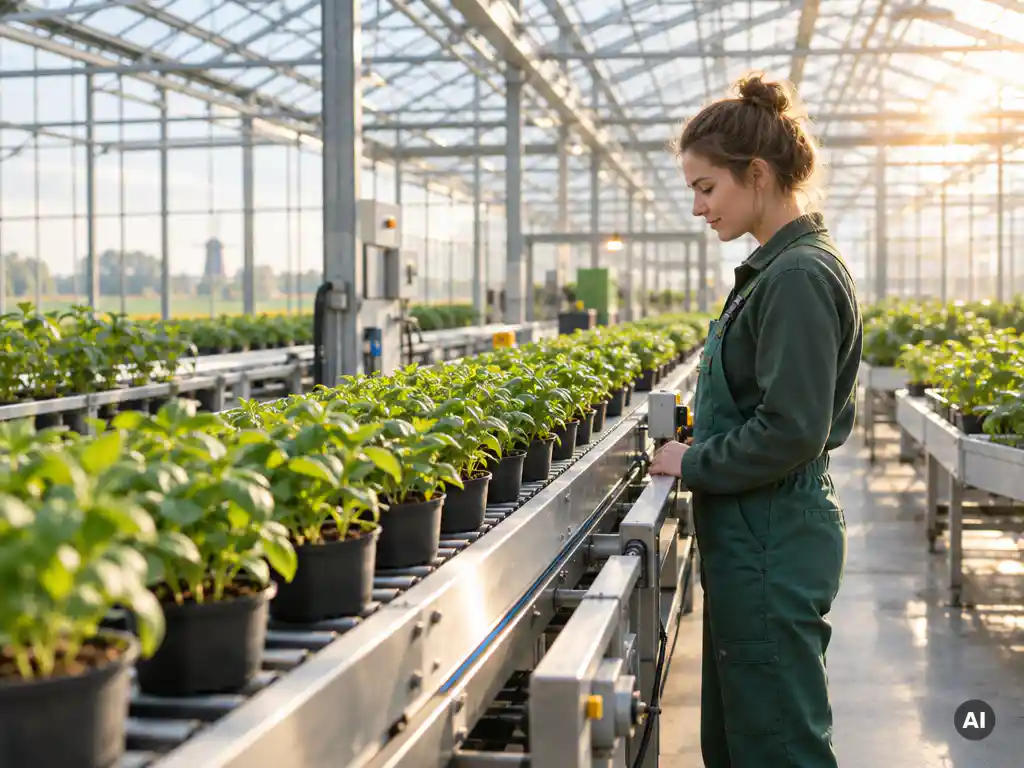
Conveyor belts, roller tracks, and buffer tables create a steady flow of product between workstations. Instead of a person carrying plants to the potting area, a belt delivers them at an even pace. Buffer tables absorb the differences in speed between steps, so one slow stage no longer holds up the entire line.
The ergonomic benefit matters just as much as the time saved. Less lifting and carrying means fewer strained backs and less sick leave, which makes the work more attractive for the staff you do have. Our range of conveyor belts can also be combined with work tables, scales, and lighting, so one line can handle transport, sorting, and checking in a single flow.
Starting Small With Mobile Conveyors and Rental
You do not have to invest in a full fixed system on day one. A mobile conveyor is a low-risk first step that lets you test automation in your own greenhouse before committing to anything bigger.
Many growers begin by renting equipment during a peak period. That gives you a real feel for how a belt changes your daily routine, where it saves the most time, and how your team responds to it. If it works, you can add more units or move toward fixed installations, building up step by step as your confidence and needs grow.
This gradual approach also protects your cash flow. Rather than one large upfront decision, you expand in stages, each one backed by what you learned from the last. Because our systems are designed to be combined, nothing you start with becomes redundant as you grow.
Real Results: From 26 to 6 FTE
Automating internal transport can change staffing needs dramatically. One of our customers went from 26 to 6 FTE for the same output, which shows what is possible when handling, buffering, and transport are rethought as one connected process.
It is worth being clear about what that number means. The result did not come from a single machine, but from a well-thought-out line in which each step feeds the next without manual carrying in between. Results like this depend on the starting situation, the crop, and the layout, so every operation will look different.
Still, the principle holds for growers of any size. When fewer people are needed for the same volume, you become less exposed to open vacancies, expensive temporary labor, and rising wage costs, and your margins improve as a result.
Avoiding Common Automation Pitfalls
The most common mistake is automating without first understanding the process. Buying a machine for one bottleneck often just moves the bottleneck to the next step, so the overall gain stays small.
A few pitfalls come up again and again:
- Automating in isolation: A single machine that does not connect to the steps before and after it creates new waiting points.
- Going too big, too fast: Large investments made before testing can lead to a layout that does not fit how your team actually works.
- Juggling multiple suppliers: When hardware, software, and installation come from different parties, problems tend to fall between the cracks.
- Ignoring the team: Staff who are involved early adopt new equipment faster and spot improvements you might miss.
Working with a partner who looks at the whole process helps you avoid these traps. We handle design, production, and installation from our own workshop in De Lier, and we think about the flow before a single belt is placed.
If staffing is holding your business back, the next step is a simple one: map where your hours go, then pick the one transport step that costs the most. Whether you start with a rental belt or a full line, we are happy to help you find the right starting point. Get in touch and let’s look at your greenhouse together.
Frequently Asked Questions
How do I start mapping where labor hours are being lost in my greenhouse?
Pick one product or crop and follow it from arrival to dispatch, writing down every time someone handles it only to move it. Add a simple tally of walking distances, waiting times, and task switches over a few typical days. A stopwatch, a floor plan, and a short daily log are usually enough to reveal which transport step costs the most hours.
How do I know which transport step to automate first?
Choose the step that combines the highest number of manual touchpoints with the heaviest physical load, such as carrying trays to the potting area or moving crates to packing. Rank your steps by hours per week and by how often they cause waiting further down the line. Automating the top item first gives the quickest payback and shows your team what automation can do.
What if my greenhouse layout is tight or irregular? Can conveyors still work?
Yes, in most cases. Mobile conveyors, roller tracks, and modular buffer tables can be arranged to fit narrow paths, corners, and uneven spaces, and they can be repositioned as your needs change. Sharing a floor plan or photos with your supplier early on helps them design a flow that fits your actual space instead of forcing a standard layout.
How can I measure whether renting a mobile conveyor is paying off?
Record a baseline before the trial: hours spent on the chosen task, number of people involved, and output per day. Repeat the same measurements during the rental period and compare them, also noting feedback on physical strain and sick leave. If you see consistent time savings or smoother flow between steps, that is a strong case for adding units or moving toward a fixed installation.
How do I get my team on board with new automation?
Involve staff from the start by asking where they lose the most time or feel the most strain, and let them test the equipment during a rental or trial phase. Emphasize that machines take over heavy, repetitive handling so people can focus on skilled plant work, not replace them. Teams that help shape the setup usually adopt it faster and often suggest practical improvements.
Do I need to automate the whole process to see a real benefit?
No, but you do need to think about the whole flow. A single well-chosen step can already reduce physical strain and save hours, as long as it connects smoothly to the steps before and after it. Plan the full line on paper first, then implement it in stages so each addition solves a real bottleneck instead of just moving it.
How can I reduce dependence on temporary labor during seasonal peaks?
Look at which peak-time tasks rely mostly on extra hands for carrying and moving product, since these are the easiest to automate. Renting conveyors or buffer tables for the peak period lets you absorb the extra volume without hiring and training as many temporary workers. Over time, you can use the results to decide which parts of the line are worth making permanent.