

How to improve greenhouse efficiency with fewer people and higher output
Where Greenhouse Labor Hours Quietly Disappear
Most lost labor hours in a greenhouse come from handling and walking, not from the skilled work that actually grows the crop. Moving trays, carrying pots, lifting boxes and shuttling plants between stations eat up a surprising share of the working day.
These hours rarely show up as a line item. A worker who spends the morning carrying trays from the potting area to the growing area is technically “busy”, yet none of that time adds value to the plant. Multiply that by a dozen employees and a full season, and the cost becomes substantial.
Several patterns tend to repeat across nurseries:
- Manual transport between stations: carrying or trolleying product from potting to watering to sorting to packing.
- Waiting time: one station stands idle because the previous step has not delivered enough product yet.
- Repetitive lifting: heavy, awkward loads that lead to fatigue, injury and sick leave.
- Peak-season inefficiency: temporary staff who need training and work at a slower pace.
Once these hidden hours are visible, the question shifts from “how do we find more people?” to “how do we need fewer people to move the same volume?” That is where automating internal transport comes in.
Automating Internal Transport for Maximum Impact
Automating internal transport removes the walking, carrying and waiting that consume so many labor hours, so the remaining staff can focus on work that actually needs human skill. It is usually the fastest route to better greenhouse efficiency because it touches every step of the process.
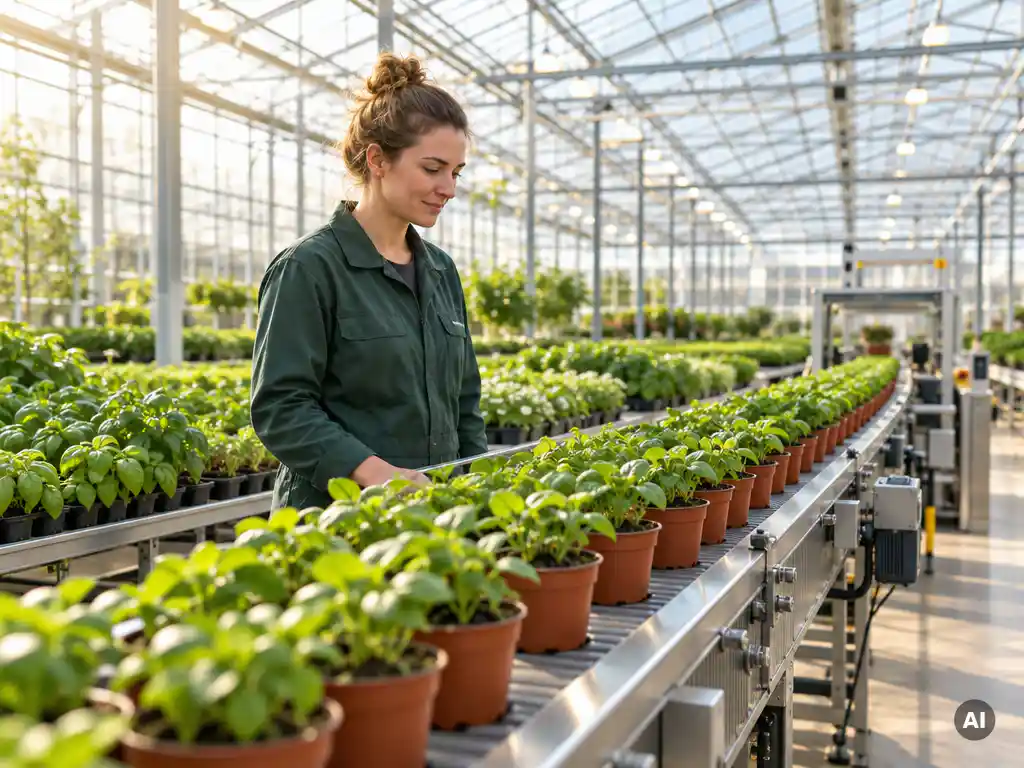
Think of the nursery as a production line. Conveyor belts, buffer tables, roller conveyors, potting machines and watering stations each take over a specific handling task, and because they connect to one another, product flows continuously instead of in stop-start batches. Add work tables, scales or lighting along the line, and a single belt can double as a sorting, weighing or packing station.
The ergonomic gains matter just as much as the time savings. When employees stand at a comfortable height and no longer lift heavy trays all day, fatigue drops and the work becomes more attractive, which helps with both absenteeism and recruitment. Our range of conveyor belts is built for exactly this kind of continuous, ergonomic flow, and every component can be combined with others as the operation grows.
A Step-by-Step Path From Mobile to Fixed
The most practical way to automate is to start small with mobile equipment and grow toward fixed systems as the benefits become clear. This lowers the risk, spreads the investment and lets the team get comfortable with the new way of working.
A typical path looks like this:
- Start with a mobile conveyor belt. Place it where the most manual transport happens, often during a seasonal peak.
- Try before you commit. Renting equipment for a busy period shows the real effect on your own crop and layout, without a large upfront purchase.
- Add connecting modules. Buffer tables, roller conveyors and potting machines link the separate steps into one flow.
- Move to a fixed, integrated line. Once the concept has proven itself, a permanent system becomes the backbone of the production process.
This approach is also forgiving. Because components are designed to be combined, nothing you buy in step one becomes obsolete in step four. The system grows with the business rather than forcing a big-bang investment up front.
What 26 to 6 FTE Looks Like in Practice
In practice, a well-designed automated line can take a team from 26 FTE down to 6 FTE for the same output. This result comes from our own customer projects, and it shows what happens when transport, handling and processing are designed as one connected system rather than a set of separate tasks.
The reduction does not come from a single machine. It comes from removing the manual links between steps: no more carrying trays to the potting machine, no more hand-feeding the watering station, no more staff waiting for the line ahead. Each of those small gains adds up, and the people who remain take on more skilled, supervisory work.
The financial picture shifts accordingly. Lower payroll, fewer temporary workers, less absenteeism and faster throughput all strengthen the margin, and the business becomes far less exposed to a tight labor market. Results will always depend on crop, layout and volume, which is why a tailored look at your own process is worth more than any average.
Avoiding Common Automation Mistakes in Greenhouses
The most common mistakes are automating too much at once, choosing equipment in isolation, and ignoring how the whole process fits together. Avoiding these pitfalls matters as much as choosing the right machines.
Watch out for these traps:
- Buying separate machines from separate suppliers. Hardware, software and installation that do not work together create coordination headaches and downtime.
- Skipping the trial phase. Testing a mobile belt or rented equipment first reveals problems while they are still cheap to fix.
- Automating a bottleneck in the wrong place. Speeding up one step only moves the queue to the next one if the flow is not considered end to end.
- Overlooking the people. Staff who understand and help shape the new setup adopt it faster and spot improvements early.
A single partner who delivers the machines, the control and the installation removes most of these risks. If you are unsure where to begin, the best next step is a conversation about your current process and where the labor hours go. We are happy to think along, and you can get in touch to talk through the options for your nursery in 2026.
Frequently Asked Questions
How do I figure out where my nursery is losing the most labor hours?
Start by spending a few days mapping how product physically moves, from potting to growing area, watering, sorting and packing. Note how long staff spend carrying, walking, lifting or waiting for the previous station. Even a simple stopwatch and a floor plan will usually reveal one or two transport routes that account for a disproportionate share of the hours, and those are your best candidates for automation.
What is the best first piece of equipment to buy if I'm new to greenhouse automation?
A mobile conveyor belt is usually the safest starting point because it is flexible, affordable and can be placed exactly where the most manual transport happens. It lets you measure the real effect on your crop and layout before investing in a fixed line. Because components are designed to be combined, it can later be linked to buffer tables, roller conveyors or potting machines.
Is it worth renting equipment during a seasonal peak instead of buying?
Yes, renting is a low-risk way to test automation under real working conditions. It lets you compare labor hours, throughput and staff feedback during your busiest period without a large upfront commitment. If the results are good, you can move on to a purchase or a fixed system with real data from your own nursery rather than averages.
What if my team is hesitant about new automation?
Involve employees early by asking where the heaviest, most tedious tasks are and letting them help decide where the first machine goes. Automation that removes lifting and walking makes the job more comfortable, which is an easy benefit to demonstrate during a trial. Staff who remain often move into more skilled, supervisory roles, so it helps to communicate that clearly from the start.
How can I avoid simply moving the bottleneck to another step in the process?
Look at the full flow from end to end before automating any single step, and check the capacity of the stations before and after it. Buffer tables are a practical way to absorb differences in speed between steps. Planning the line as one connected system, ideally with a single partner, prevents a fast new machine from just creating a queue at the next station.
Will automation really reduce my need for temporary seasonal workers?
In most cases it reduces the need considerably, because continuous flow and less manual handling mean fewer people are required to move the same volume at peak times. The 26 to 6 FTE example from our customer projects shows what is possible when the whole line is designed as one system. Actual results depend on your crop, layout and volume, so a tailored review of your own process is the best way to estimate your savings.
How do I prepare for a conversation with an automation supplier?
Bring a rough layout of your nursery, your typical volumes per day and per season, the crops and pot or tray sizes you handle, and a list of the tasks that take the most labor. Knowing how many people work at each station and where product waits also helps. With this information, a supplier can suggest a realistic step-by-step path from mobile equipment to a fixed, integrated line.