

How to plan greenhouse efficiency improvements for a 10 to 200 hectare nursery
Every nursery owner knows the feeling: the plants are ready, the orders are in, and there simply are not enough hands to get everything moving. Improving greenhouse efficiency is rarely about one big technical fix. It is about planning carefully, choosing the right order of improvements, and making sure each step pays for itself before the next one begins.
For nurseries between 10 and 200 hectares, the biggest efficiency gains usually hide in internal transport and repetitive handling work. This guide walks through a practical planning approach, from spotting bottlenecks to calculating returns, so the decisions feel less overwhelming and far more manageable.
Mapping Labor Bottlenecks Across Your Nursery
Start by tracking where people spend their time, because labor bottlenecks show up in movement and waiting, not in the places you might expect. A simple walk-through of one full production cycle, from potting to shipping, usually reveals where trays, carts, and employees pile up.
Count the touches. Every time a plant is lifted, carried, stacked, or pushed to the next station, that is labor that adds no value to the plant itself. Note how many people are involved at each step, how heavy the work is, and which tasks cause sick leave or high turnover. Physically demanding jobs deserve special attention, since they tend to be the hardest to staff.
Also look at your seasonal peaks. If you hire temporary workers every spring just to keep goods moving, that is a strong signal that the process, not the headcount, is the real problem. Writing these findings down in a simple list of tasks, hours, and headcount gives you a baseline for every decision that follows.
Prioritizing Quick Wins Versus Long-Term Investments
Quick wins are changes that remove the most manual handling with the lowest commitment, while long-term investments reshape the flow of the entire nursery. Sorting your list into these two groups prevents the common trap of waiting for the perfect master plan while the labor problem keeps growing.
Quick wins often involve mobile or flexible equipment that can be deployed within days. A movable conveyor between the potting area and the growing zone, for example, can cut walking and carrying time right away, without any construction work. Renting equipment during a peak period is another low-risk way to test whether a solution fits your daily routine before you buy anything.
Long-term investments, such as fixed conveyor systems, integrated buffer tables, or automated watering stations, make sense once you know where the real flow runs. They require more planning and capital, but they also deliver the largest and most lasting reduction in labor needs. The key is to treat quick wins as the testing ground for these bigger moves.
Building a Step-by-Step Automation Roadmap
A good automation roadmap starts small and flexible, then grows into fixed systems as your confidence and data increase. Think in phases rather than projects, with each phase solving one clear bottleneck.
Phase one: flexible and mobile
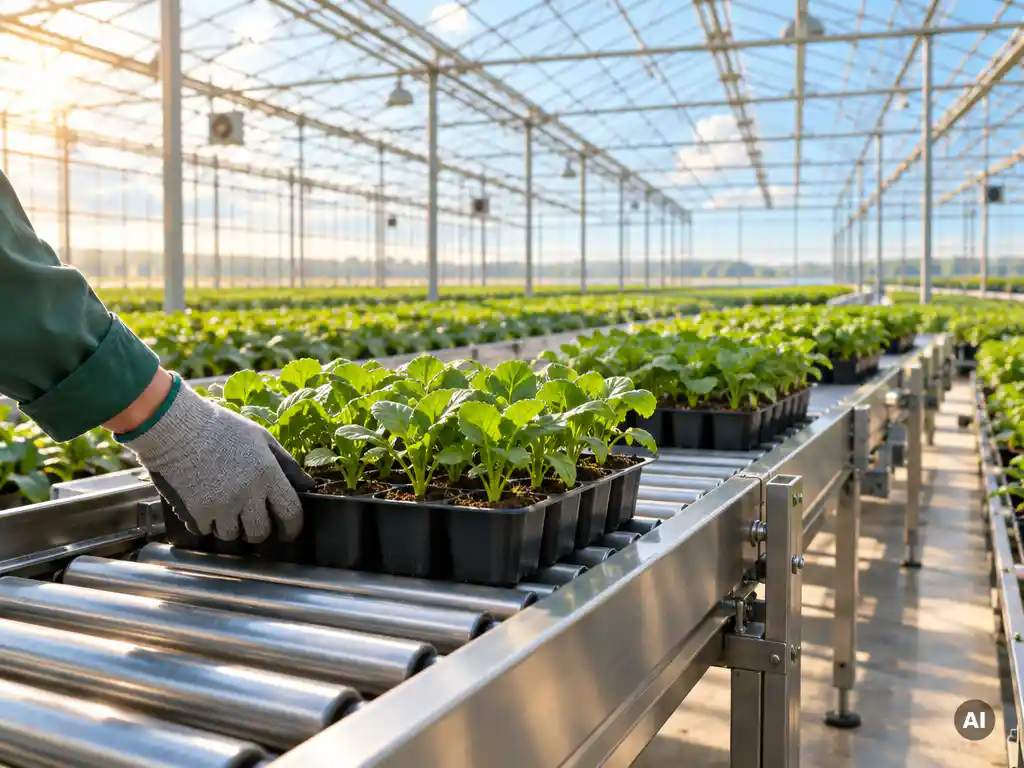
Begin with the most labor-intensive transport route and automate only that. Mobile equipment lets you adjust the layout as you learn how products actually flow. This is where conveyor belts are often the most logical first step, because they are easy to position and immediately reduce carrying and walking.
Phase two: connecting the links
Once the first route works, connect it to neighboring processes. Add buffer tables to smooth out differences in speed between stations, and consider work tables, scales, or lighting where employees handle products along the line. Combinable components make this step far simpler, since new modules slot into what already exists.
Phase three: fixed and integrated
With real experience behind you, move to fixed systems that form the backbone of the production process. At this stage, having hardware, software, and installation coordinated by one partner saves a lot of friction. We build and install complete solutions from our own workshop, so there is one point of contact from design to commissioning.
Calculating Savings and Return on Investment
The return on automation is calculated by comparing total labor cost before and after the change, set against the full cost of the equipment and its installation. The cleanest way to do this is with your own baseline from the first section, rather than with generic industry averages.
Include more than wages. Add temporary staffing premiums, recruitment effort, training time, sick leave linked to heavy work, and the cost of errors or damaged product. Then estimate how many hours the new setup removes per week and per season. Multiply that by your actual hourly cost, and compare it with the investment spread over the expected lifetime of the equipment.
Do not forget the less visible gains, such as higher output from the same floor space, more consistent quality, and more attractive jobs for the people who stay. Some nurseries have reduced their workforce dramatically for the same output, for example from 26 to 6 full-time equivalents, but your own numbers will depend on your layout and product mix. Test your assumptions with a pilot phase and adjust the model with real results.
Common Planning Mistakes and How to Avoid Them
The most common planning mistakes come from automating too much at once, ignoring the existing flow, or choosing equipment before understanding the process. Each of them is avoidable with a little patience at the start.
- Automating the wrong step first. Fixing a minor task while the main bottleneck remains only shifts the pile-up elsewhere. Always begin where the most labor is tied up.
- Skipping the pilot. Buying a large fixed system without testing the flow first can lock in a layout that does not suit your daily routine.
- Using several unconnected suppliers. Mismatched equipment and software lead to delays and finger-pointing during installation.
- Forgetting your team. Employees who understand why changes are happening, and who are trained on the new setup, make the difference between a smooth rollout and a stalled one.
- Ignoring growth. A layout that works today but cannot expand will need to be rebuilt in a few years.
Planning greenhouse efficiency in 2026 is as much about sequence as it is about technology. If you want to talk through where your nursery should start, we are happy to think along, so feel free to get in touch with us for practical advice based on more than 30 years in horticulture.
Frequently Asked Questions
How do I get started if I have no data on my current labor costs and handling times?
Begin with a simple one-week time study of your busiest production route, from potting to shipping. Note the tasks, the number of people involved, the hours spent, and how many times each product is touched. A basic spreadsheet or even a paper checklist is enough to create the baseline you need to compare options and calculate return on investment later.
How can I test automation without committing to a large investment?
Start with mobile or flexible equipment, such as a movable conveyor between two work areas, and run it for one or two production cycles. Renting equipment during a seasonal peak is another low-risk option. Compare hours worked, physical strain, and throughput against your baseline, and only then decide whether to scale up to fixed systems.
What if my employees are worried that automation will replace their jobs?
Involve your team early and be open about the goals: removing heavy, repetitive work and making it easier to staff peak seasons, not simply cutting jobs. Ask employees where they experience the biggest physical strain, as their input often identifies the best first project. Provide hands-on training and give people the chance to move into more skilled roles, such as operating, monitoring, and quality control.
How long does it typically take for an automation investment to pay for itself?
The payback period depends on your hourly labor cost, the number of hours removed, and the cost of the equipment and installation. Nurseries that automate their most labor-intensive transport routes first often see the fastest returns, because those routes tie up the most people. Calculate it using your own baseline, include costs like temporary staffing, training, and sick leave, and validate the figures with a pilot phase before making larger commitments.
How do I design a layout that can still grow with my nursery?
Choose modular, combinable components so you can add conveyors, buffer tables, or work stations later without rebuilding what already exists. Leave free space and access routes around the main flow, and map out where a future expansion would connect. Reviewing your layout with a supplier who can design and install the full system helps ensure that today’s choices do not block tomorrow’s growth.
Should I buy from one supplier or combine equipment from several?
A single partner that handles hardware, software, and installation usually makes projects smoother, because compatibility and responsibility are clearly defined. Using several unconnected suppliers can lead to mismatched interfaces, delays, and disputes when something does not work. If you do combine suppliers, agree in advance on interfaces, who coordinates the installation, and who is responsible for commissioning.
How do I know which bottleneck to tackle first?
Rank your tasks by total hours spent per week, physical intensity, and how often they cause delays elsewhere in the process. The step where the most labor is tied up, or where products regularly wait or pile up, is typically the best candidate. Fixing a smaller, less critical task first only moves the pile-up to another point in your workflow.