
How to raise greenhouse efficiency with a smarter potting line
Every grower knows the feeling: the potting season is in full swing, orders keep coming, and the line is only as fast as the people standing at it. Raising greenhouse efficiency rarely starts with a bigger greenhouse. More often, it starts with the way plants, pots, and trays move between the potting machine, the buffer, and the growing area.
A smarter potting line connects those steps so that fewer hands are needed and less time is lost between them. At Martin Stolze, we have spent more than three decades building these kinds of solutions for horticulture, and the same patterns show up again and again. Here is where time disappears, what a better line looks like, and how to get there without betting the whole business on one big investment.
Where Manual Potting Lines Lose Time and Money
Manual potting lines lose time mainly in the gaps: waiting for pots, carrying trays, and moving finished plants by hand. The potting action itself is usually quick, but everything around it is slow.
Consider what happens when a team works without connected transport. People walk back and forth with trays, stack and unstack carts, and wait whenever one station runs faster than the next. Each of those small pauses looks harmless on its own, yet over a full season they add up to a significant share of paid hours.
Physical strain adds another hidden cost. Repetitive lifting and carrying lead to sick leave and high turnover, which means constantly training new people during an already tight labor market. Seasonal peaks then force growers to hire temporary workers at premium rates, often with less experience and a higher error rate.
Together, these factors push up the cost per pot while holding output back. That is why the biggest gains in greenhouse efficiency often come from removing manual handling rather than speeding up the people who do it.
The Building Blocks of a Smarter Potting Line
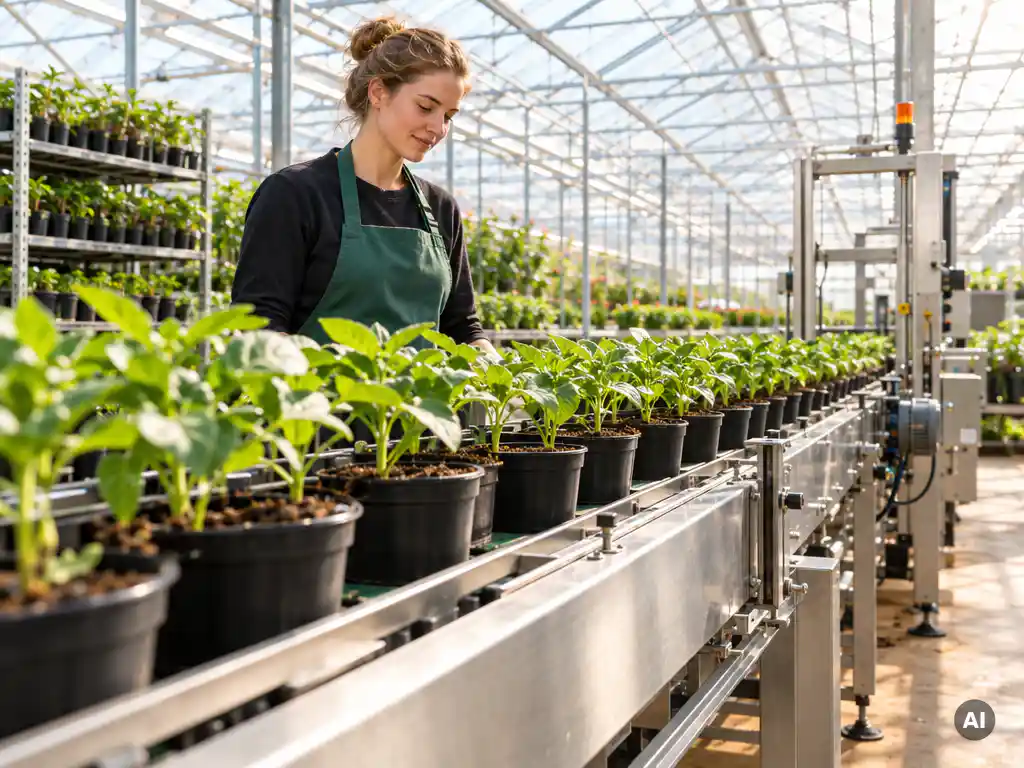
A smarter potting line is a chain of connected machines that move plants automatically from one step to the next. Each component removes a specific bottleneck, and together they create a continuous flow.
The core elements typically include:
- Conveyor belts that carry pots, trays, and plants between stations without anyone lifting them. Our range of transport belts covers both flexible and fixed setups.
- Buffer tables that absorb differences in speed between machines, so one slow step does not stall the whole line.
- Potting machines that fill, plant, and place pots at a steady pace.
- Roller conveyors for moving trays and carts smoothly over longer distances.
- Watering stations that give plants their first water as part of the flow instead of a separate manual task.
These components can be combined with work tables, scales, and lighting, which makes it possible to build a line that fits the crop and the layout of the greenhouse. Because they are designed to work together, the line can be extended later without starting over.
How Automation Cuts Labor and Raises Output
Automation raises output by keeping plants moving continuously while taking repetitive carrying work away from people. Fewer workers are needed on the line, and those who remain focus on tasks that actually need judgment, such as quality checks.
The effect is easy to understand once the flow is steady. A buffer table keeps the potting machine supplied, belts carry finished plants away, and nobody has to stop to move a tray. The line runs at the pace of the machine rather than the pace of the slowest manual step.
What this means in practice
The results can be dramatic. Some of our customers went from 26 to 6 FTE for the same output after automating their internal transport. Results like this depend on the crop, the layout, and the starting situation, but they show how much of the workload comes from moving plants rather than working with them.
Ergonomics improve at the same time. When lifting and carrying disappear, the work becomes lighter, absenteeism tends to drop, and the job becomes more attractive in a market where good people are hard to find. Better working conditions and higher output reinforce each other, and both feed directly into stronger margins.
Upgrading Step by Step Without Big Risks
The safest way to automate is to start small and grow in stages. A mobile conveyor belt is a low-threshold entry point that delivers results quickly, and it can later become part of a fixed system.
Many growers begin by renting equipment during a peak period. This lets them see how automation fits their routines, how their team responds, and where the next bottleneck sits, all before committing to a larger purchase. If the trial works, the next step might be adding a buffer table or a second belt, and eventually a fully integrated line.
This staged approach spreads the investment over time and keeps risk manageable. It also means each upgrade is based on real experience in your own greenhouse rather than on assumptions. If you are unsure where to begin, get in touch with us and we will think through the process and the best first step with you.
Common Mistakes When Automating a Potting Line
The most common mistake is automating one machine in isolation without looking at the flow around it. A faster potting machine does not help if trays still pile up at the end of the line.
Other pitfalls come up regularly:
- Skipping the buffer. Without a buffer between stations, small interruptions ripple through the entire line.
- Buying too big, too soon. A large fixed system can be a poor fit if the crop mix or layout changes in a couple of years.
- Working with too many suppliers. Hardware, software, and installation from different parties often lead to coordination problems and finger-pointing when something fails.
- Ignoring the team. People who understand why the line changes and how to use it get far more out of it.
Avoiding these mistakes comes down to looking at the whole process first and choosing a partner who delivers a complete, well-matched solution. Greenhouse efficiency in 2026 will belong to the growers who treat internal transport as a system, and who build it one practical step at a time. For more about what we do, visit Martin Stolze.
Frequently Asked Questions
How do I figure out where the biggest bottleneck is in my current potting line?
Start by observing one full shift and noting where people wait, walk, or carry trays rather than work on plants. Time how long the potting machine sits idle and where finished trays pile up. The spot where waiting and manual handling cluster most is usually your first candidate for a conveyor belt or buffer table.
What is the easiest way to get started if I have never automated before?
Begin with a low-threshold step such as a mobile conveyor belt, ideally rented during a peak period. This lets you test how automation fits your routines and your team without a large upfront commitment. Afterwards, you can add a buffer table or a second belt based on what you actually observed.
How do I size a buffer table so it actually prevents stoppages?
A buffer should be large enough to absorb the typical difference in speed and the short interruptions between two stations, such as a pot refill or a cart change. Look at how long your slowest recurring stoppage lasts and make sure the buffer can keep the next machine supplied during that time. A supplier can help you calculate this based on your crop, tray size, and line speed.
How can I get my team on board with a new automated line?
Explain early that automation is meant to remove heavy lifting and walking, not to replace people who do skilled work. Involve operators in choosing the layout and give them hands-on training before the peak season starts. Employees who see lighter work and a clear role in quality control are usually the strongest supporters of the change.
What if my crop mix or greenhouse layout changes after I invest?
This is why a modular, step-by-step approach works well. Mobile and flexible conveyor systems can be repositioned, and components designed to work together can be extended or rearranged later. Avoid committing to a large fixed system until you are confident about your long-term crop plans.
How do I measure whether the automation is paying off?
Track a few simple numbers before and after: labor hours per 1,000 pots, total output per shift, absenteeism, and the cost per pot. Compare them over a similar season period so peaks do not distort the results. Even a basic spreadsheet kept for a few weeks will show whether the investment is delivering and where to improve next.
Is it better to buy all components from one supplier?
In most cases, yes. A single partner delivering belts, buffer tables, and machines that are designed to work together reduces coordination problems and avoids finger-pointing when something fails. It also makes later extensions simpler, since new parts are already matched to your existing line.