

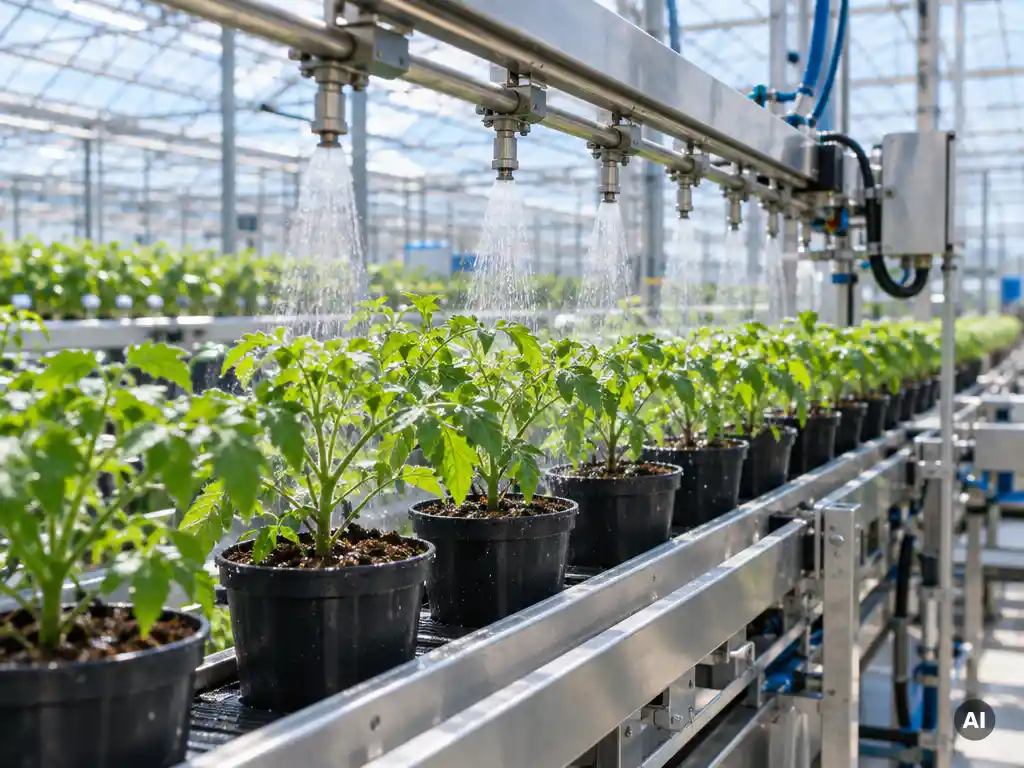
How to raise greenhouse efficiency with automated watering stations
Where Manual Watering Quietly Drains Efficiency
Manual watering drains efficiency because it ties up skilled people in repetitive walking, handling and checking, while delivering inconsistent results from tray to tray.
Think about what a watering round really involves. Someone moves between benches or trolleys, handles hoses, judges by eye or by feel when a pot has had enough, and then moves on. Multiply that by hundreds of trolleys a day in peak weeks, and the hours add up quickly, often without anyone tracking them.
The costs also hide in places that rarely show up on a spreadsheet. Physical strain leads to absence and turnover. Differences between employees mean one batch gets slightly more water than the next. Seasonal peaks force you to use temporary staff who need training just as the pressure is highest.
Then there is the opportunity cost. Every hour a trained colleague spends on watering is an hour not spent on crop monitoring, quality control or planning. In a labor market where vacancies stay open for months, that is a price few growers can afford to keep paying.
How Automated Watering Stations Change the Workflow
An automated watering station moves the plants to the water instead of moving people to the plants, which makes the process consistent, repeatable and far less labor-intensive.
In practice, trays or trolleys travel through a dedicated station on a conveyor line. The station applies a set amount of water to each pot, then passes the product on to the next step. Because the dosing is programmed rather than judged by hand, every plant in the batch gets the same treatment.
Connecting watering to the rest of the line
The real strength shows when watering is part of a connected flow. A station can sit behind a potting machine, link up with buffer tables and feed into conveyor belts that carry product to packing or dispatch. Add work tables, scales or lighting where needed, and the whole route from potting to shipping becomes one smooth line.
That connection removes many small handling moments. Fewer manual transfers mean fewer interruptions, less lifting and a calmer, more predictable rhythm on the nursery floor.
Measurable Gains in Labor, Water and Quality
The clearest gains from automated watering show up in three areas: fewer working hours per batch, more controlled water use, and more uniform plant quality.
Labor is usually the biggest lever. When transport and watering run on a line, the same output needs far fewer people. One of our customers went from 26 to 6 FTE for the same output after automating their internal transport, and watering is a natural part of that kind of shift. Results always depend on your layout and crop, but the direction is consistent: less manual handling, more output per person.
Water use becomes easier to manage because dosing is set and repeatable rather than left to individual judgment. Overwatering becomes less likely, which is good for both resources and plant health. Uniform watering also supports uniform growth, which means more consistent batches and fewer plants that fall short of grade.
There is a human benefit too. Removing heavy, repetitive tasks makes the work more ergonomic and the job more attractive. For growers struggling to keep good people, that can matter just as much as the hours saved.
Building a Step-by-Step Automation Plan
The most reliable way to automate is to start small, learn from real daily use, and expand the system as your confidence and needs grow.
Begin by mapping your current flow. Note where plants wait, where people walk the most and where handling is heaviest. These are the points where automation pays back fastest, and they often point to a clear first step rather than a big overhaul.
Next, test before you commit. A mobile conveyor belt is a low-threshold way to experience automation on your own floor, and renting equipment during a peak period lets you see the effect on your team without a large upfront investment. Many growers start this way and then build toward fixed systems once the benefits are proven.
From there, add stations and connections one at a time: a watering station, then buffer tables, then links to potting and packing. Choosing equipment that combines easily keeps every step compatible with the next. If you would like a second pair of eyes on your layout, you can get in touch with our team and we will think along with you about the best starting point.
Common Pitfalls When Automating Your Watering
Most automation problems come from rushing the plan, not from the technology itself, so avoiding a handful of familiar mistakes goes a long way.
The first is automating one isolated task without looking at the full flow. A watering station that delivers plants faster than the next step can absorb simply moves the bottleneck. Buffer capacity and a balanced line prevent this, so think in terms of the whole route rather than a single machine.
The second is skipping the trial phase. Layouts that look perfect on paper can behave differently once real trolleys, real staff and real peak pressure are involved. Starting with flexible, mobile equipment gives you room to adjust before fixing anything in place.
The third is juggling too many suppliers. When hardware, software and installation come from different parties, small compatibility issues can turn into long delays. Working with one partner for the whole chain keeps responsibility clear and the rollout smooth.
Finally, do not forget your people. Involve the team early, show them how the new setup removes the heaviest parts of their day, and give them time to get comfortable. Greenhouse efficiency is built by the combination of good equipment and a team that trusts it. If you are curious how this could look at your nursery, you can always start with a conversation at martinstolze.nl.
Frequently Asked Questions
How do I calculate whether an automated watering station will pay back for my nursery?
Start by tracking how many hours per week your team spends on watering and the related handling, then multiply by your fully loaded hourly labor cost, including temporary staff in peak season. Add estimated savings from reduced water use and fewer plants falling below grade. Compare the total to the investment, and consider renting or testing equipment first so you can base your calculation on real results from your own floor rather than assumptions.
What is the best first step if I have never automated anything in my greenhouse?
Begin by mapping your current flow and noting where people walk the most, where plants wait, and where handling is heaviest. Then trial a flexible solution such as a mobile conveyor belt during a busy period. This lets you see the effect on your team and workflow without a large upfront commitment, and it shows you which fixed station or connection to add next.
Will an automated watering station work with different pot sizes and crop types?
In most cases, yes, but you should confirm this during planning. Share details about your pot sizes, tray or trolley types, and the crops with water needs that differ most. A good supplier can advise on dosing settings and configuration, and testing a representative batch before full rollout will show whether any adjustments are needed.
How do I avoid creating a new bottleneck after adding a watering station?
Look at the line as a whole rather than at one machine. If the station delivers plants faster than the next step can handle them, add buffer tables or adjust the flow so product does not pile up. Checking the capacity of upstream and downstream steps, such as potting and packing, before you expand helps keep the line balanced.
How can I get my team on board with automated watering?
Involve your people early and focus on what the change removes: heavy lifting, repetitive walking, and the pressure of peak weeks. Let them take part in the trial phase and give them a say in layout decisions. Make clear that automation frees skilled colleagues for more valuable work like crop monitoring and quality control, not that it replaces them.
Can I expand my watering automation gradually over time?
Yes, and this is often the safest approach. Start with a single watering station or a mobile conveyor, then add buffer tables, work tables, and links to potting and packing as you gain experience. Choosing equipment that combines easily ensures each new step fits what you already have, so you never need to start over.
What should I look for when choosing a supplier for an automated watering line?
Look for a partner who can handle the whole chain, including hardware, software, and installation, so responsibility stays clear and compatibility issues are avoided. Ask whether they offer rental or trial options and whether their equipment is modular for future expansion. It also helps if they are willing to review your layout and think along about the best starting point for your specific nursery.