
How to reduce labor needs and lift greenhouse efficiency at the same time
Where Greenhouse Labor Hours Quietly Disappear
Most labor hours in a greenhouse are lost to handling and walking, not to the skilled work that actually adds value to the crop. Carrying trays, pushing carts, waiting for the next batch, and repositioning plants all consume time that never shows up as a line item.
These hidden hours are hard to spot because they are spread across the whole day and across many people. One employee spends twenty minutes searching for a free cart, another walks the same corridor forty times, and a third waits at the potting station because the previous step is running behind. Individually these moments seem small. Added up over a season, they represent a large share of the payroll.
Physical strain makes the problem worse. Repetitive lifting and carrying wear people down, which drives up sick leave and makes it harder to retain good staff. A nursery that relies on heavy manual transport often finds itself in a loop: tired employees, higher turnover, constant retraining, and slower output.
Before investing in anything, it helps to map the journey of a single product from potting to dispatch. Counting the touches, the steps, and the waiting moments usually reveals where the biggest gains are hiding.
Automating Internal Transport for Faster Flow
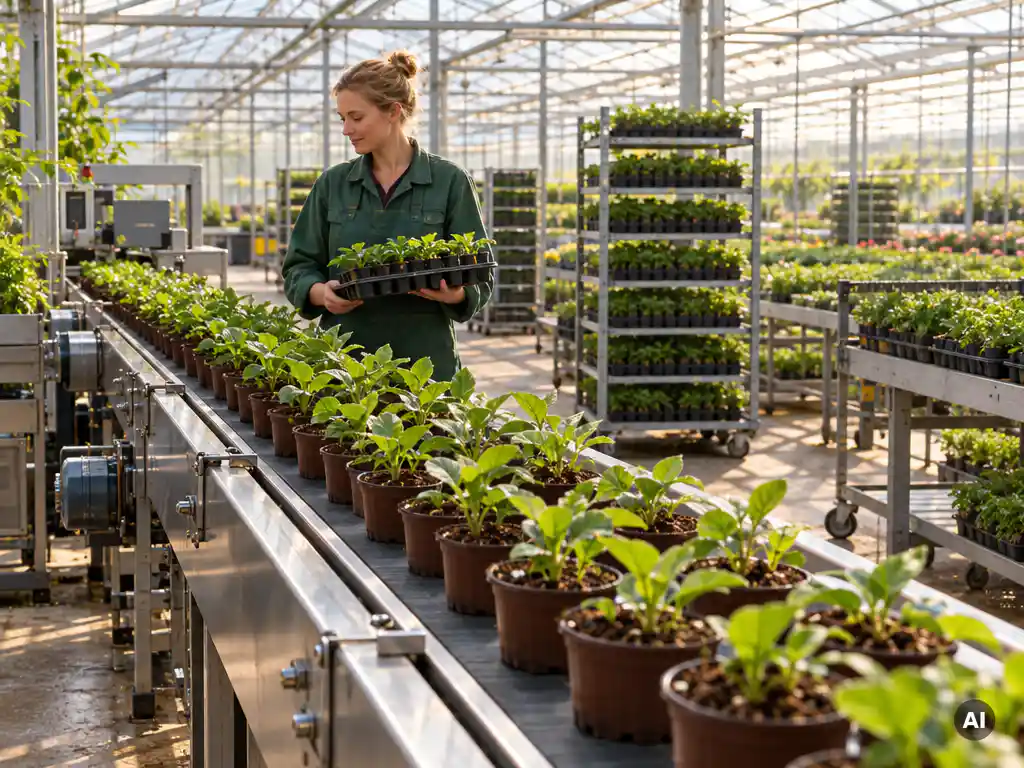
Automating internal transport means letting conveyors, buffer tables, and roller tracks carry the product so people can focus on tasks that need human judgment. The result is a steadier flow, fewer bottlenecks, and a measurable lift in greenhouse efficiency.
Conveyor belts are usually the starting point. They connect workstations, eliminate carrying, and set a consistent pace for the line. Buffer tables smooth out the differences between fast and slow steps, so one station does not stall the next. Potting machines, roller tracks, and watering stations can be linked into the same line, which turns a collection of separate tasks into one continuous process.
Because the components combine with work tables, scales, and lighting, a line can be shaped around the actual task at hand, whether that is sorting, quality control, packing, or potting. Ergonomics improve at the same time. When the product comes to the worker at a comfortable height, strain drops and so does the risk of absence.
If you want to see what is possible, our range of conveyor belts is a good place to get a feel for how the building blocks work together.
A Step-by-Step Path From Mobile to Fixed Systems
The most practical way to automate is gradually: start with a mobile conveyor, learn how it changes your daily routine, and then expand toward fixed systems as the benefits become clear. This keeps risk low and lets the operation grow into automation instead of being disrupted by it.
Start small with a mobile belt
A flexible, mobile conveyor is a low-threshold way to begin. It can be moved between sections, used during a peak period, and adapted as tasks change. Many growers start by renting equipment for a busy season, which makes it possible to experience the time savings firsthand before committing to a purchase.
Grow into a fixed line
Once the team has seen how a mobile belt reduces walking and carrying, the next steps feel natural. Additional belts, buffer tables, and potting or watering stations can be added one at a time. Eventually the separate pieces become a fully integrated, fixed system that forms the heart of the production process.
This stepwise approach has another advantage: employees get used to the new way of working at a comfortable pace. They help shape the layout, spot improvements, and feel ownership of the result, which makes adoption much smoother.
Real Results: From 26 to 6 FTE
When internal transport is automated thoroughly, the effect on staffing can be dramatic. In one of our projects, a customer went from 26 FTE to 6 FTE while producing the same output.
That kind of result does not come from a single machine. It comes from rethinking the whole flow so that every manual transport step is questioned. Where people once carried trays between stations, belts now do the moving. Where workers once waited for the previous step, buffer tables absorb the difference. The remaining team handles supervision, quality, and the tasks that truly require skill.
The benefits go beyond payroll. Fewer people means less dependence on a tight labor market, fewer seasonal hiring headaches, and less time spent on recruiting and training. Output becomes more predictable, errors drop, and margins improve, which makes the business more resilient when wages rise or demand fluctuates.
Every nursery is different, so results will vary with layout, crop, and volume. Still, the principle holds: the more manual transport is replaced, the more room there is to do more with fewer people.
Common Automation Pitfalls and How to Avoid Them
The most common automation mistakes are automating in isolated pieces, ignoring the existing process, and splitting the project across too many suppliers. Each one is avoidable with some planning up front.
Automating a single station without considering the rest of the line often just moves the bottleneck. If potting speeds up but packing cannot keep pace, the gain disappears. Looking at the entire flow first ensures that every step supports the next one.
Another trap is buying equipment before understanding the process. The best results come from fitting the technology to how the nursery actually works, not the other way around. Involving the team early helps, because the people on the floor know exactly where the friction is.
Finally, coordinating several suppliers for hardware, software, and installation can lead to delays and finger-pointing when something does not fit. Working with one partner who handles everything from design to installation keeps the project smooth and the results consistent.
If you are weighing where to begin, a conversation about your layout and bottlenecks is often the fastest way to find the right first step. Feel free to get in touch with us and we will think it through with you, whether that means a rented mobile belt for the next peak or a plan for a complete line.
Frequently Asked Questions
How do I know which bottleneck to tackle first in my greenhouse?
Start by mapping the journey of a single product from potting to dispatch and count every touch, step, and waiting moment. The stations where product piles up, or where employees stand idle waiting for the previous step, are your biggest bottlenecks. Ask your floor staff as well, since they usually know exactly where the friction is. Fixing the point with the most waiting and handling typically delivers the fastest payback.
How do I get started with automation if I have a limited budget?
Begin with a single mobile conveyor belt, either purchased or rented for a busy season. This keeps the upfront investment low and lets you measure the actual time savings in your own operation before committing further. Place it where walking and carrying are most intensive, track hours before and after, and use those numbers to justify the next step.
Will automating internal transport mean I have to lay off staff?
Not necessarily. Many growers use automation to fill vacancies they cannot fill anyway, to avoid hiring expensive temporary workers during peaks, or to move people from heavy carrying work to more skilled tasks like quality control and supervision. Reducing physical strain also lowers absence and turnover, which helps you retain the good employees you already have.
How do I get my team on board with new equipment?
Involve employees early and let them help shape the layout and spot improvements. Introducing automation gradually, for example starting with a mobile belt, gives people time to get used to the new way of working at a comfortable pace. When staff see that the product now comes to them at a comfortable height and that heavy carrying is gone, acceptance usually follows quickly.
What should I do if automating one station just moves the bottleneck elsewhere?
This is a sign that the line needs to be looked at as a whole rather than station by station. Buffer tables can absorb speed differences between steps, and adjacent stations such as packing or watering may need to be upgraded or linked into the same line. Re-map the flow after each change to see where the constraint has shifted, and plan the next improvement accordingly.
Is a fixed conveyor system better than a mobile one?
Neither is better in every case; it depends on your layout, crops, and how stable your processes are. Mobile belts offer flexibility for changing tasks and seasonal peaks, while fixed lines deliver the highest efficiency for steady, high-volume flows. Many nurseries start mobile and grow into a fixed, integrated system once the benefits are proven.
Can conveyor lines be adapted to different tasks like sorting, packing, or potting?
Yes. Because belts can be combined with work tables, scales, lighting, buffer tables, and roller tracks, a line can be configured around the specific task, whether that is sorting, quality control, packing, or potting. Ergonomic height and layout can also be tailored so the work is comfortable for your team. Sharing your layout and product types with a supplier is the best way to determine the right configuration.