

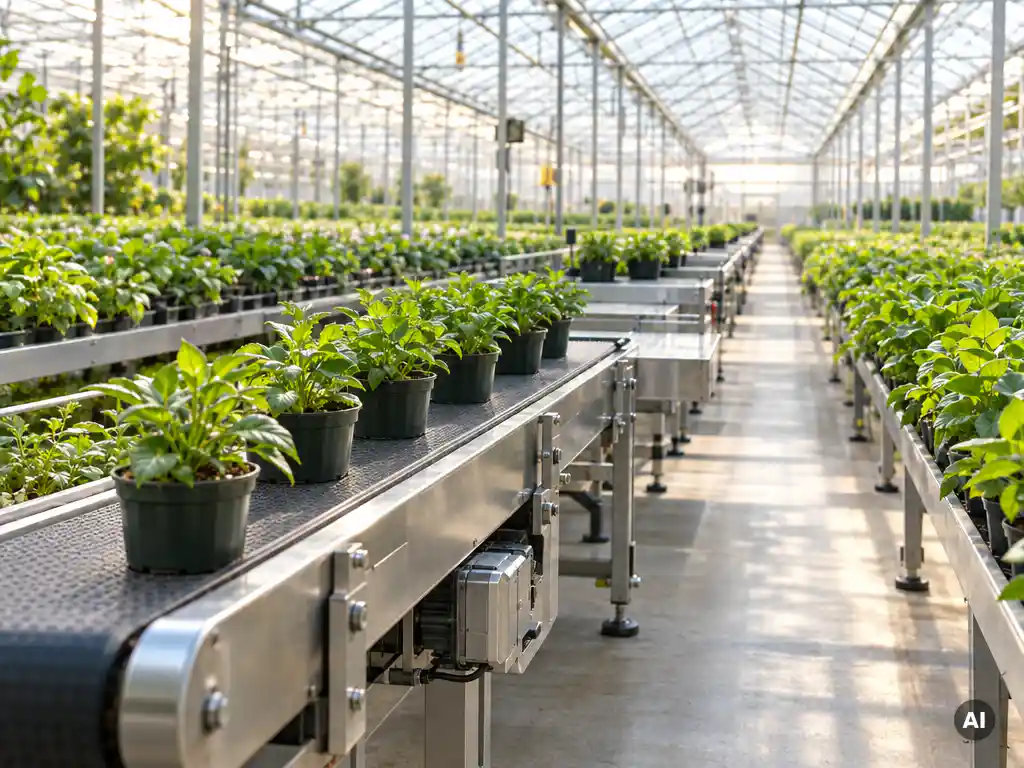
How to scale greenhouse efficiency from one mobile belt to a full line
Spotting the Bottlenecks a Single Belt Can Fix
The best first automation target is the spot where people carry, push or lift the most product over the shortest distance. A mobile transport belt tackles exactly that kind of repetitive internal transport.
Start by watching the work floor for a few days. Where do employees walk back and forth with trays? Where does product pile up because the next step cannot keep pace? Where do people complain about heavy lifting or strained backs? These moments reveal the real constraints in your process, and they are usually easier to solve than they look.
A single belt often pays off fast in places like the transition between the potting area and the greenhouse, or at a packing station where trays are moved by hand. Because a mobile belt can be repositioned, it also works well for seasonal peaks. If the pressure moves from one area to another during the year, the belt moves with it.
Testing Automation With Rental Mobile Belts
Renting a mobile belt lets a grower experience the time and labor savings in real working conditions before committing to a purchase. It turns automation from a leap of faith into a practical trial.
Many nurseries first meet automation during a peak period, when temporary staff are expensive and hard to find. Renting a belt for those weeks shows how much walking, carrying and waiting disappear from the daily routine. Employees get used to the equipment, and the owner sees what the numbers look like with fewer people on the line.
This low-threshold start also answers the questions that are hard to settle on paper. Does the belt height suit the team? Does the flow match the way trays actually travel through the greenhouse? A trial period gives honest answers, and it makes the next investment decision far more confident. If you want to see which belt types fit your situation, our range of transport belts is a good place to begin.
Adding Buffer Tables, Potting Machines and Watering Stations
Once a belt has proven its value, the next gains come from connecting it to machines that handle the steps before and after transport. Buffer tables, potting machines and watering stations each remove a different manual bottleneck.
Buffer tables: smoothing the flow
A buffer table collects product between two process steps so that neither one has to wait for the other. This keeps people and machines working at a steady pace instead of in bursts, which is a quiet but significant boost to greenhouse efficiency.
Potting machines and watering stations
Potting is one of the most labor-intensive jobs in a nursery, and a potting machine takes over its most repetitive part while keeping results consistent. A watering station then handles the next step in the same flow, so trays do not have to be moved and watered by hand. Together with the belts, these machines form the backbone of a connected process.
Because all of these machines are designed to be combined, growers can add them one at a time. Each addition builds on what is already in place, so the line grows alongside the business rather than ahead of it.
Designing the Layout of a Full Transport Line
A good transport line layout follows the natural journey of the product, with as few turns, crossings and manual handovers as possible. The goal is a continuous flow from start to finish.
Begin by mapping the route a tray takes, from the potting area through watering and growing, and finally to dispatch. Then look for places where product stops, changes direction or depends on a person to move it onward. Those are the points where belts, roller conveyors and buffer tables earn their place.
It also pays to think ahead. Leave room for future machines, plan for the width of your trolleys and trays, and consider where work tables, scales or lighting might be added later. When hardware, software and installation come from a single partner, these choices fit together far more smoothly, and the line works as one system instead of a collection of separate parts.
Real Results: From 26 to 6 FTE
The results of a fully automated internal transport line can be dramatic. In one of our projects, a customer went from 26 to 6 FTE for the same output.
That outcome did not come from one big purchase. It came from a step-by-step approach that started with mobile belts and grew into fixed systems, with each stage removing another layer of manual work. Fewer people were needed, work moved faster, and the remaining team shifted to more skilled, less physically demanding tasks.
For growers dealing with open vacancies, expensive temporary staff and rising wage costs, this is the real promise of automation. It reduces dependence on a labor market that is not going to become easier, while protecting margins against competitors who are already automating.
Avoiding Common Mistakes When Scaling Up
The most common mistake is trying to automate everything at once without understanding where the real bottlenecks are. A phased plan keeps the investment manageable and the results visible.
Another frequent pitfall is buying machines from several suppliers that were never designed to work together. Interfaces, heights and controls do not match, and the grower ends up coordinating problems instead of solving them. Choosing combinable equipment and one point of contact avoids much of that friction.
Finally, do not forget the people. Involving employees early, explaining what changes and letting them test the equipment builds acceptance and surfaces practical improvements. If you are unsure where to begin, we are happy to think along with you about the first step, and you can get in touch with our team to talk through your situation. In 2026, the growers who start small and scale with intention are the ones best placed to stay efficient, whatever the labor market brings.
Frequently Asked Questions
How do I know which task to automate first in my nursery?
Spend a few days observing the work floor and note where employees carry, push or lift the most product over short distances. The best first target is usually the place where people walk back and forth with trays, where product piles up, or where staff complain about heavy lifting. Write down how many people are involved and how many hours the task takes per day, so you can compare the situation before and after automation.
What should I measure during a rental trial of a mobile belt?
Track the number of labor hours needed for the task before and during the trial, the number of trays moved per hour, and how often the process stops or waits. Also collect feedback from employees on belt height, ergonomics and how well the flow fits your routine. Having this data in hand makes it much easier to calculate a realistic payback period before you decide to buy.
What if my greenhouse layout is cramped or changes every season?
This is exactly where mobile belts are useful, because they can be repositioned as the pressure moves from one area to another. Before expanding, sketch the route a tray takes and note the width of your trolleys and aisles. Choose equipment that can be moved or extended later, so your setup can adapt without a complete redesign.
In what order should I add buffer tables, potting machines and watering stations?
Start with the step that causes the biggest manual bottleneck in your own process, which for many growers is potting or the transport right after it. A buffer table is often a smart early addition because it smooths the flow between steps and prevents waiting. Watering stations typically follow once trays are already moving consistently, so they can plug straight into the existing flow.
How can I get my employees on board with automation?
Involve them early by explaining what will change and why, and let them test the equipment during a rental period. Emphasize that machines take over heavy, repetitive work so people can focus on more skilled and less physically demanding tasks. Employees often spot practical improvements, such as belt placement or height, that make the system work better for everyone.
How do I avoid compatibility problems when expanding my line?
Choose machines that are designed to be combined, ideally from a single supplier who also handles hardware, software and installation. This ensures that heights, interfaces and controls match from the start. Ask about future expansion options before your first purchase, so each new machine builds on what is already in place.
Can a small nursery really benefit from automation, or is it only for large operations?
Small nurseries can benefit just as much, because the step-by-step approach means you only invest in what solves a current problem. A single mobile belt, rented or purchased, can already reduce walking, carrying and dependence on temporary staff. As the business grows, you can add buffer tables, potting machines and fixed systems at your own pace.