

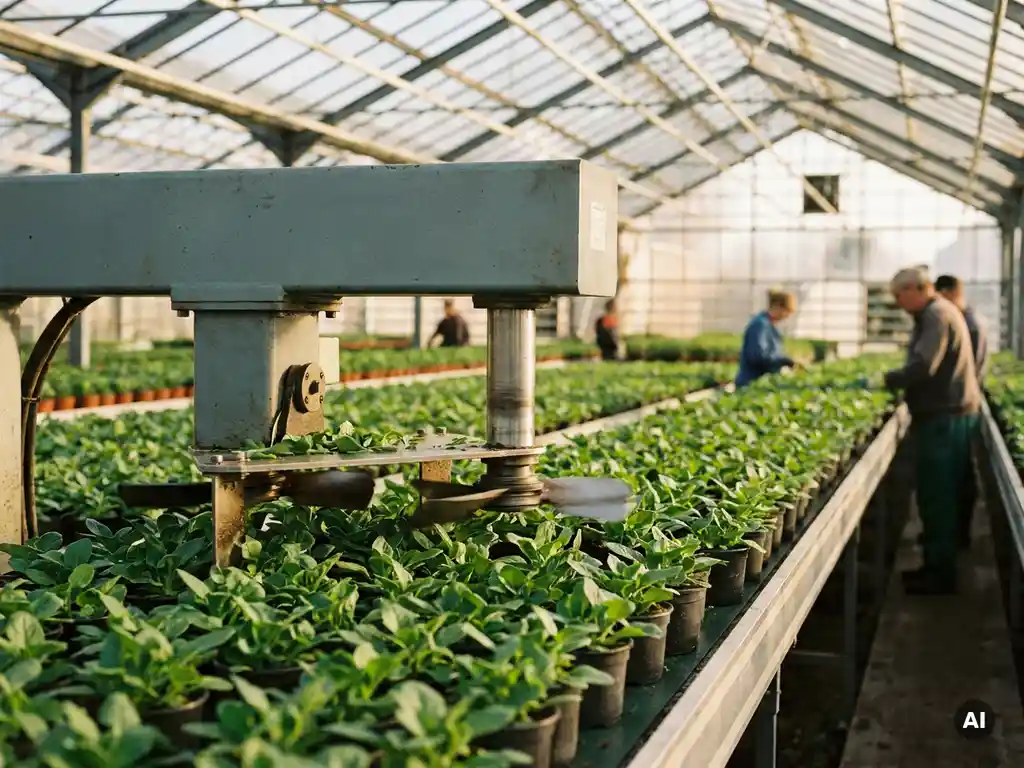
Is a topping machine worthwhile for nurseries with seasonal production peaks?
Yes, a potting machine is worthwhile for nurseries with seasonal production peaks. When demand spikes in spring or around key sales windows, manual potting simply cannot keep pace without adding significant labour costs and risking inconsistent quality. A potting machine delivers consistent output at high speed precisely when the pressure is greatest.
For nurseries that pot large volumes of ornamental plants or pot plants, the investment pays back quickly through labour savings, reduced errors, and the ability to meet auction deadlines without scrambling for extra staff. The sections below walk through the key questions nursery owners and production managers ask before making this decision.
How much time does manual potting actually cost nurseries?
Manual potting is far more time-consuming than most nurseries realise when they add up the full picture. An experienced worker can pot somewhere between 200 and 400 pots per hour depending on pot size and substrate. A potting machine running at capacity can process up to 8,000 pots per hour, meaning a single machine replaces the output of many hands simultaneously.
Beyond raw speed, the hidden time costs compound quickly. Workers tire, pace slows, and breaks are unavoidable. Inconsistent fill levels mean some pots need rework. Supervisors spend time managing the line rather than focusing on plant quality. When you calculate labour hours against total pots potted across a full season, the gap between manual and automated potting is substantial. For nurseries producing tens of thousands of pots per week, those hours translate directly into wage costs and missed capacity.
What types of nurseries benefit most from a potting machine?
Nurseries that benefit most from a potting machine are those growing ornamental plants or pot plants at high volumes, particularly where speed, consistency, and labour efficiency are critical. Growers working with pot sizes between 7 and 30 cm and producing thousands of pots per shift see the clearest return.
The profile that gains most is typically a professional ornamental or pot plant nursery where:
- Weekly potting volumes run into the tens of thousands
- Labour availability is tight or seasonal staff are expensive to manage
- Consistent pot density directly affects plant quality and shelf life
- Auction deadlines create hard production windows that cannot slip
- A specific substrate or soil mix is used that cheaper machines struggle to handle reliably
Smaller nurseries with low weekly volumes may find the investment harder to justify on speed alone, but even mid-sized operations often discover that the consistency and ergonomic benefits tip the calculation in favour of automation.
How does a potting machine handle seasonal demand spikes?
A potting machine handles seasonal demand spikes by maintaining a constant, high output regardless of how many pots need to be processed or how long the shift runs. Unlike a manual workforce, a machine does not slow down over the course of a day or require additional onboarding when volumes suddenly increase.
During peak periods, the ability to programme different pot sizes, fill depths, and rotation speeds in advance means the machine can be reconfigured quickly as product lines change. This flexibility is particularly valuable when a nursery is running multiple pot sizes through the same production week. The machine simply switches settings rather than requiring the team to retrain or reorganise the line.
For nurseries that only experience high volumes during specific months, the option to rent a potting machine for the peak period removes the need to justify a full purchase against off-season downtime. This makes automated potting accessible even when the busy window is relatively short.
What’s the difference between a standard and a PRO potting machine?
The key difference between a standard potting machine and a PRO version is the level of automation, precision, and ease of operation. The PRO model adds automatic soil detection, a fully guided chain for greater stability, and a touchscreen interface that allows settings for different pot sizes, fill depths, soil feed rates, and rotation speeds to be saved and recalled quickly.
Standard potting machine
A standard model like the Stolze 3030 is a robust, reliable machine suited to high-volume production. It handles single, double, or alternating potting configurations and works across the full range of common pot sizes. PLC controls and a touchscreen make day-to-day operation straightforward for any operator.
PRO potting machine
The Stolze 3030 PRO is designed for more demanding growing environments where consistency, noise levels, and maintenance downtime matter. Automatic soil detection ensures every pot receives a precise and consistent fill, reducing waste and improving plant uniformity. The fully guided chain adds mechanical stability during long production runs, and the quieter operation reduces workshop noise across extended shifts. For nurseries running complex programmes across multiple pot sizes in a single day, the ability to pre-programme and switch between settings quickly is a meaningful operational advantage.
Should nurseries buy or rent a potting machine for peak season?
Whether to buy or rent a potting machine depends on how many months per year the machine would be in active use. Nurseries with a year-round or near-continuous potting programme almost always find purchasing the better long-term value. Nurseries with a concentrated peak of one to three months may find rental more cost-effective, at least initially.
Renting also serves as a low-risk way to evaluate a specific machine before committing to a purchase. Running a machine through a real production peak, with your own substrate and pot sizes, gives far more useful information than any demonstration. If the machine performs well under actual conditions, the decision to buy becomes much easier to justify to stakeholders.
For nurseries already considering a purchase but uncertain about the investment, a rental period with the option to buy provides a practical middle path that removes much of the financial risk.
How quickly does a potting machine pay for itself?
A potting machine typically pays for itself through labour savings within one to three seasons for nurseries operating at high volumes. The exact timeline depends on current labour costs, the number of pots produced per week, and how many staff hours are freed up by the machine.
The calculation is straightforward in principle. Take the total labour cost of your current manual potting operation across a season, including wages, social contributions, and the time spent managing a larger team during peaks. Compare that against the machine’s purchase price and annual maintenance costs. For most professional nurseries producing at scale, the saving in direct labour alone covers the investment within a manageable number of seasons.
Indirect savings add to the case: fewer potting errors mean less substrate waste and more consistent plant quality. Ergonomic benefits reduce the physical strain on workers, which matters for long-term staff retention. And the ability to meet tight auction deadlines reliably has a value that is harder to quantify but very real for any grower selling through the wholesale channel.
How Martin Stolze supports your potting operation
We develop and produce our potting machines entirely in-house, from design and programming through to assembly and installation. That means we control every aspect of quality and can support you directly when something needs adjusting. Our two main models, the Stolze 3030 and the Stolze 3030 PRO, cover the full range of professional ornamental and pot plant production, with capacities up to 8,000 pots per hour and compatibility with pot sizes from 7 to 30 cm.
Here is what working with us looks like in practice:
- Machine selection: We help you choose the right configuration for your specific crop, pot sizes, and substrate
- Integration: Our potting machines connect seamlessly with conveyor systems and sorting lines for a fully automated production line
- Training: Operators are trained in our own demo and teaching facility in De Lier
- Buy or rent: Both options are available, including a trial period so you can evaluate the machine under real production conditions before committing
- Ongoing support: Our own engineers handle installation and servicing, so you are never dependent on a third party when the machine needs attention
If you are weighing up whether a potting machine is the right step for your nursery, we are happy to think through the options with you. Get in touch with our team and we will help you find the solution that fits your production process.
Frequently Asked Questions
What pot sizes and substrates can a potting machine reliably handle?
Most professional potting machines, including the Stolze 3030 and 3030 PRO, are designed to work with pot sizes ranging from 7 to 30 cm. Substrate compatibility is an important factor to check before purchasing — cheaper machines can struggle with coarser or wetter mixes, while a well-engineered machine handles a wide range of professional growing substrates consistently. If you use a specific or non-standard substrate, it is worth running a trial under real production conditions to confirm performance before committing to a purchase.
How many operators are needed to run a potting machine?
A potting machine typically requires just one to two operators to manage the line, compared to the much larger team needed for equivalent manual output. One operator generally oversees the machine settings and substrate feed, while a second handles pot placement or output management depending on how the line is configured. This dramatic reduction in labour per pot is one of the primary drivers of the machine’s return on investment, especially during peak season when additional staff are both expensive and difficult to source.
How difficult is it to switch between different pot sizes during a production run?
On a standard potting machine, switching between pot sizes requires a manual adjustment to settings, which takes a modest amount of time but is straightforward for a trained operator. On the PRO model, different pot sizes, fill depths, and soil feed rates can be pre-programmed and recalled instantly via the touchscreen interface, making mid-run changeovers significantly faster. For nurseries running multiple pot sizes in a single production day, this programmability is a meaningful time-saver that reduces downtime between batches.
What maintenance does a potting machine require, and how much downtime should I expect?
Routine maintenance on a professional potting machine is generally limited to regular cleaning, lubrication of moving parts, and periodic inspection of wear components such as the chain and soil feed mechanism. Scheduled maintenance is straightforward and can typically be carried out by your own team following manufacturer guidelines. When working with a supplier like Martin Stolze, in-house engineers handle installation and servicing directly, which means you are not reliant on a third party if an issue arises during a critical production period.
Can a potting machine integrate with our existing conveyor or sorting line?
Yes, modern professional potting machines are designed to connect with conveyor systems and sorting lines to create a fully automated production flow. Integration eliminates manual handling between potting and the next stage of production, further reducing labour requirements and the risk of damage to freshly potted plants. If you are planning to expand or upgrade your production line, it is worth discussing integration options with your supplier at the specification stage to ensure compatibility from the outset.
What is the best way to calculate whether a potting machine makes financial sense for our nursery?
The most reliable starting point is to calculate your total seasonal labour cost for manual potting — including wages, employer contributions, and management time — and compare it against the machine’s purchase price plus estimated annual maintenance. From there, factor in indirect savings such as reduced substrate waste from consistent fill levels, fewer potting errors, and the value of reliably meeting auction deadlines without emergency staffing. For nurseries unsure about the numbers, speaking directly with a supplier who can model the return based on your actual volumes and labour costs is a practical first step.
Is renting a potting machine a realistic option if we only have a short busy season?
Renting is a genuinely practical option for nurseries whose peak potting window is concentrated into one to three months per year, as it avoids the need to justify a full purchase against extended off-season downtime. Beyond cost, renting gives you the opportunity to run the machine through a real production peak with your own substrate and pot sizes — providing far more useful performance data than any showroom demonstration. Many suppliers, including Martin Stolze, offer a rental-to-buy pathway, so a successful trial period can transition smoothly into ownership if the machine proves its value.