

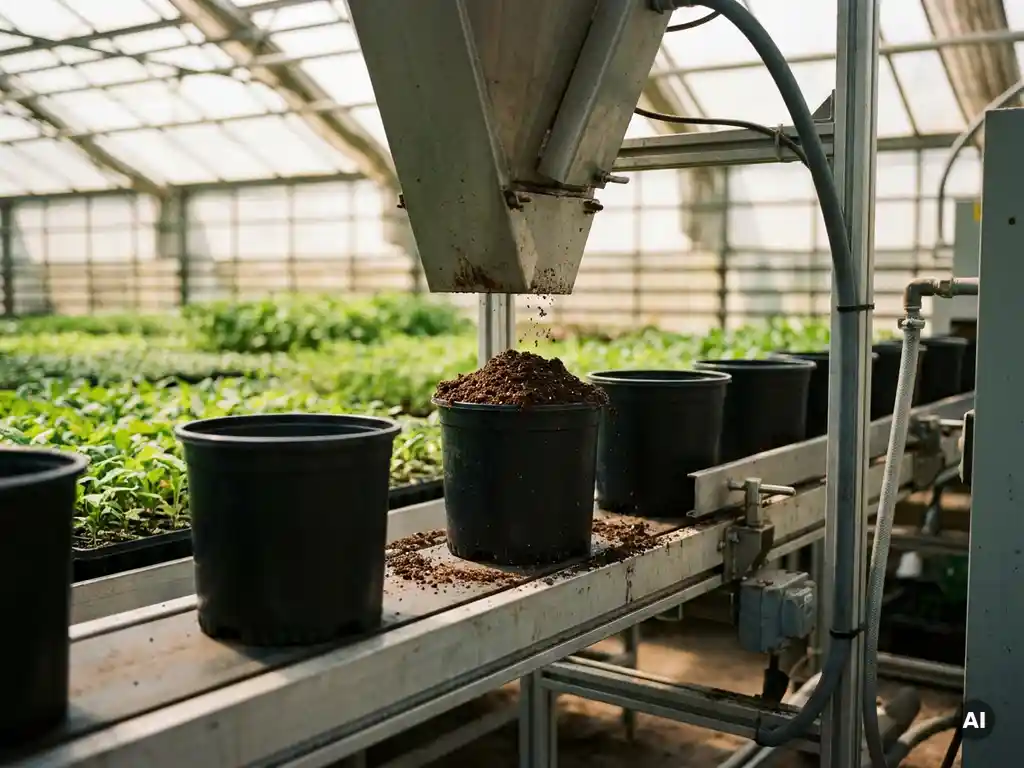
Is pots per hour the best metric for comparing potting machines?
Pots per hour is not the best metric for comparing potting machines on its own. It tells you how fast a machine can run under ideal conditions, but it says nothing about fill consistency, soil mix compatibility, or how much operator time is actually saved. For growers making a serious investment, a broader set of specifications gives a far more accurate picture of real-world performance.
The right potting machine is the one that fits your specific crop, your soil mix, and your production rhythm, not simply the one with the highest number on the spec sheet. The questions below unpack what actually matters when you compare options.
What other specs matter when choosing a potting machine?
Beyond pots per hour, the specifications that matter most when choosing a potting machine are pot size range, fill consistency, soil mix compatibility, automation level, and ease of programming. These factors determine whether a machine performs reliably in your specific growing environment, not just in a controlled demonstration.
A machine rated at 8,000 pots per hour means very little if it jams every time it encounters a coarser substrate, or if it requires constant manual adjustment when you switch between pot sizes. Look for these practical specifications alongside raw speed:
- Pot size range: Does the machine handle the full range of sizes you use, from small 7 cm pots to larger 30 cm containers?
- Drive system: A fully guided chain system reduces pot movement and improves stability at higher speeds.
- Control interface: Touchscreen controls with programmable presets for different pot sizes and drilling depths save significant time between runs.
- Noise and maintenance profile: Quieter machines with fewer wear parts reduce both operator fatigue and downtime.
- Integration options: Can the machine connect directly to conveyor systems and sorting lines without custom adapters?
These specifications reflect how a machine performs across a full working day and a full growing season, not just during a sales demonstration.
How does soil mix compatibility affect potting machine output?
Soil mix compatibility directly affects potting machine output because machines designed for fine, uniform substrates will jam, clog, or underfill when fed coarser mixes containing perlite, bark, or chunky organic matter. When a machine cannot handle your specific substrate, your effective output drops sharply, regardless of the rated pots per hour.
This is one of the most common and costly mismatches growers encounter. A machine purchased based on speed alone may perform perfectly with a standard peat mix but struggle the moment you switch to a more open, free-draining substrate. The result is not just slower throughput; it is increased wear on mechanical components, more frequent stops for clearing blockages, and inconsistent fill levels that affect crop quality.
Before committing to any machine, test it with your actual soil mix. A supplier who cannot or will not demonstrate the machine with your substrate is a red flag. The design of the auger, the hopper, and the feed mechanism all influence how well a machine handles different soil types, and these details are rarely captured in a single capacity figure.
What is fill consistency and why does it affect crop quality?
Fill consistency is the degree to which every pot receives the same volume and density of growing medium. It matters for crop quality because uneven fill leads to uneven water retention, root development, and plant growth, producing batches where some plants develop faster than others, which creates problems at auction and in the supply chain.
When pots are underfilled, roots run out of growing medium too quickly. When they are overfilled, drainage is compromised. Either way, the grower ends up with an inconsistent batch that is harder to price, present, and sell. For high-volume ornamental and pot plant growers, this inconsistency is not just a quality issue; it is a commercial one.
Machines with automatic soil detection address this directly. By sensing the fill level in real time and adjusting the feed accordingly, they compensate for variations in substrate density and hopper load. This is the core difference between a machine that simply moves soil fast and one that delivers a reliably uniform pot every single time.
How does automation level change a potting machine’s true capacity?
The automation level of a potting machine changes its true capacity by determining how much operator involvement is needed to maintain consistent output. A machine with basic controls may be rated at the same pots per hour as a fully automated model, but if it requires constant manual adjustment, its real-world throughput is considerably lower.
Consider what happens during a long production run. A machine without automatic soil detection needs an operator to monitor fill levels and manually correct the feed when substrate density changes. A machine without programmable presets requires manual recalibration every time you switch pot sizes. Each of these interventions takes time and introduces the possibility of human error.
Higher automation levels translate to true capacity in three practical ways:
- Fewer operator interventions: Automatic detection and adjustment keeps the line running without constant supervision.
- Faster changeovers: Programmable settings for different pot sizes, drilling depths, and rotation speeds reduce setup time between runs.
- More consistent output: Automation removes variability introduced by manual adjustments, which means the rated capacity is closer to the actual capacity across a full shift.
When comparing machines, ask how much of that rated pots-per-hour figure depends on ideal, uninterrupted conditions, and how the machine performs when conditions are less than perfect.
Should you buy or rent a potting machine?
Whether you should buy or rent a potting machine depends on your production volume, the predictability of your demand, and how confident you are in the specific model. Buying makes sense for growers with consistent, high-volume needs and a clear idea of which machine fits their process. Renting is a practical way to test a machine in your own operation before committing.
Renting is particularly valuable if you are replacing an older machine and are uncertain whether the next model will meet your expectations. A trial period under real production conditions, with your soil mix, your pot sizes, and your team, gives you information that no showroom demonstration can replicate. It also reduces the financial risk during seasonal peaks, when you may need additional capacity for a defined period rather than a permanent second machine.
For growers who are confident in their requirements, purchasing offers better long-term value and the ability to fully integrate the machine into a custom production line. The choice between buying and renting is less about cost per unit and more about how much certainty you have going into the decision.
What questions should you ask before buying a potting machine?
Before buying a potting machine, ask about soil mix compatibility, the range of pot sizes it handles, what the changeover process looks like between sizes, what maintenance is required and how often, and what after-sales support looks like. These questions reveal far more about real-world fit than the headline capacity figure.
Here is a practical checklist to take into any conversation with a supplier:
- Can the machine be demonstrated with my specific soil mix?
- What pot sizes does it handle, and how long does a changeover take?
- How does the machine handle substrate variations during a long production run?
- What does routine maintenance involve, and how often is it needed?
- Is the machine produced and serviced by the supplier directly, or through third parties?
- Can it be integrated with existing or planned conveyor and sorting equipment?
- Is a rental or trial period available before purchase?
- What training is provided for operators?
A supplier who answers these questions clearly and confidently, and who is willing to demonstrate the machine under realistic conditions, is one who stands behind what they sell.
How MartinStolze helps you find the right potting machine
We develop and produce our potting machines entirely in-house, from design and programming through to assembly and installation. That means we can configure the right solution for your specific crop, substrate, and production volume, not just recommend the fastest machine on the shelf.
Our Stolze 3030 and Stolze 3030 PRO are built for professional ornamental and pot plant growers who need reliable, consistent output at scale. Here is what sets our approach apart:
- Automatic soil detection on the 3030 PRO ensures accurate, consistent fill in every pot, regardless of substrate variation.
- Touchscreen programming with presets for pot size, drilling depth, soil feed, and rotation speed makes changeovers fast and repeatable.
- Fully guided chain drive for greater stability and quieter operation with less maintenance.
- Seamless integration with our own conveyor systems, topping machines, and sorting lines.
- Both buying and renting available, including a trial period so you can test the machine in your own operation before committing.
- Training and support from our own technicians, including hands-on sessions at our demo facility in De Lier.
If you are comparing potting machines and want to talk through what will actually work for your situation, get in touch with our team, we are happy to help you find the right fit.
Frequently Asked Questions
How do I know if a potting machine's rated speed is realistic for my operation?
Ask the supplier to demonstrate the machine under conditions that mirror your own: your soil mix, your pot sizes, and a continuous run rather than a short showcase. A realistic throughput figure accounts for brief stops, changeovers, and substrate variation across a full shift. If a supplier will only demonstrate under ideal lab conditions, treat the rated speed as a best-case ceiling rather than an expected average.
What happens if my soil mix changes seasonally — will I need to recalibrate the machine each time?
Yes, but how much work that involves depends on the machine. Basic models require manual feed adjustments whenever substrate density or composition changes, which can interrupt production and introduce inconsistency. Machines with automatic soil detection handle this in real time, compensating for density shifts without operator intervention, making them a much better fit for growers who work with multiple or seasonal substrate blends.
How long does a typical pot size changeover take, and what does that mean for daily output?
On machines without programmable presets, a changeover between pot sizes can take 20 to 40 minutes of manual adjustment and testing. On machines with saved presets for each pot size, that drops to just a few minutes. If you run multiple pot sizes in a single day, those time savings compound quickly and have a significant impact on your actual daily output, making changeover speed one of the most underrated specs to ask about.
What maintenance should I plan for, and how does it affect production downtime?
Routine maintenance on a potting machine typically includes cleaning the hopper and auger, checking drive components, and inspecting wear parts such as belts or chains. Machines with fewer moving parts and a fully guided chain drive generally require less frequent maintenance and are quicker to service when needed. Before purchasing, ask for a maintenance schedule and find out whether your supplier’s own technicians carry out service visits, as third-party servicing can mean longer wait times when something needs attention.
Can a potting machine be integrated with equipment I already have, or do I need to replace my whole line?
Many potting machines can be connected to existing conveyor systems, but compatibility is not guaranteed, and custom adapters are sometimes required, adding cost and potential weak points in the line. The cleanest integrations happen when the potting machine and the surrounding equipment come from the same supplier, since the interfaces are designed to work together from the start. If you have existing equipment, share the specifications with your supplier before purchasing so they can confirm compatibility upfront.
Is it worth investing in a more automated machine if my team is already experienced with manual adjustments?
Experienced operators can compensate for a lack of automation up to a point, but manual adjustments still take time, introduce variability, and depend on individual attention across a full shift. As production volumes increase, the gap between what a skilled operator can maintain manually and what automation delivers consistently tends to widen. Higher automation also reduces your dependency on any single operator’s experience, which matters for staffing flexibility and long-term scalability.
What should I look for in after-sales support when buying a potting machine?
Look for a supplier who provides training for your operators, offers direct technical support from their own team rather than through a third party, and can supply spare parts quickly. It is also worth asking whether they offer on-site service visits and how quickly they can respond if the machine goes down during a peak production period. A supplier who manufactures their own machines is generally better positioned to diagnose and resolve issues faster than one who resells equipment built elsewhere.