

Proven ways to improve greenhouse efficiency on a tight labor market
Where Greenhouse Labor Hours Quietly Disappear
The biggest labor losses in a greenhouse rarely come from the plant work itself. They hide in the movement of trays, pots and containers between workstations, buffers and the shipping area.
Think about a typical day. People carry trays from the potting line to the growing area, push trolleys to the watering station, and walk back and forth to feed packing tables. Each trip seems small, but added up across a whole team and a whole season, it consumes a huge share of paid hours without adding any value to the plant.
Waiting time is the second leak. When one station runs faster than the next, people stand idle or pile up product on the floor. Tracking where staff actually spend their time for just a week often reveals that handling and transport outweigh the skilled tasks growers hired them for.
Automating Internal Transport for the Biggest Gains
Automating internal transport delivers the largest and most reliable efficiency gains because it removes repetitive, low-value movement without touching the growing process itself.
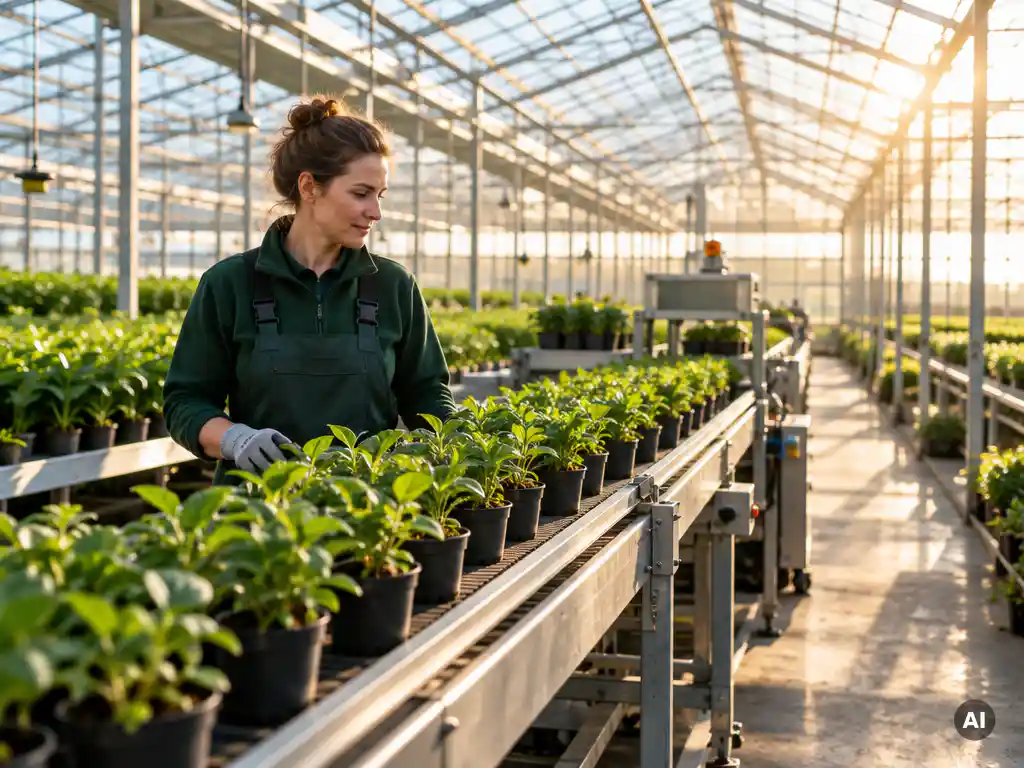
Conveyor belts, roller tracks, buffer tables and automatic potting machines take over the carrying, sorting and feeding work that eats up hours. Products flow steadily from one step to the next, so people can focus on tasks that truly need human judgment, such as quality control and crop care. Because these machines can be combined with work tables, scales and lighting, a simple line can grow into a complete processing line over time.
This is where our experience since 1991 shows. We build our transport conveyors in our own workshop in De Lier, so we know exactly how they behave in a real greenhouse environment. A steady, predictable flow also reduces errors and damaged product, which improves overall greenhouse efficiency beyond the pure labor savings.
Start Small With Mobile and Rental Systems
Growers do not need to invest in a fully fixed system on day one. Starting with a mobile conveyor or a rental setup lets a nursery prove the value before committing capital.
A mobile belt can be placed where the bottleneck is worst, for example during a seasonal peak, and moved when needs change. Renting equipment for a busy period gives the whole team hands-on experience with automation, which builds confidence and reveals which steps benefit most. Many growers find that a few weeks of use answers questions that no brochure could.
From there, the path is natural. Successful mobile solutions can be expanded step by step into fixed systems that form the backbone of the production process. This staged approach keeps risk low and lets the investment follow real results rather than assumptions.
Ergonomics as a Tool for Retaining Staff
Ergonomic workstations keep people healthier and more willing to stay, which directly protects the workforce a nursery already has.
Heavy lifting, constant bending and repetitive carrying cause strain, sick leave and turnover. When machines handle the heavy movement and work tables sit at a comfortable height, the job becomes physically lighter. Employees who go home less tired are more likely to return the next season, and a lighter workplace also makes vacancies easier to fill.
Retention is often overlooked in efficiency discussions, yet every experienced employee who leaves takes knowledge with them and costs time to replace. Treating ergonomics as part of the efficiency strategy, not just a comfort measure, pays back in lower absenteeism and a more stable team.
From 26 to 6 FTE: Real-World Results
The potential is not theoretical. One of our clients went from 26 to 6 FTE for the same output after automating internal transport and processing steps.
That kind of change does not happen with a single machine. It comes from looking at the whole flow, removing manual handling step by step and connecting the machines into one coherent line. The remaining team members take on more skilled, more varied work instead of repetitive carrying.
Results will differ by nursery, depending on crop, layout and volume. What the example shows is the scale of what becomes possible when transport, buffering and processing are treated as one system rather than separate tasks.
Common Automation Pitfalls and How to Avoid Them
Most automation projects that disappoint share the same few causes, and nearly all of them can be avoided with preparation.
The first pitfall is automating a step in isolation. A fast new machine that feeds into a slow, manual station simply moves the bottleneck. Mapping the full flow first keeps the investment focused where it matters. The second pitfall is buying too much too soon, which is why starting with mobile or rental equipment is such a safe route.
A third trap is spreading the project across several suppliers, leaving the grower to coordinate hardware, software and installation alone. Working with one partner who delivers and installs everything keeps the implementation smooth. If you are weighing where to begin, get in touch with our team and we will think with you about the right first step for your nursery.
A tight labor market is not going away in 2026, but it does not have to limit growth. Growers who map their transport flows, start small and build up gradually can run leaner, keep their people healthier and stay ahead of competitors who wait.
Frequently Asked Questions
How do I figure out where my greenhouse is losing the most labor hours?
Track how staff actually spend their time for one representative week, splitting tasks into plant work, internal transport, waiting and other activities. Simple tools like a time-log sheet or a stopwatch at key workstations are enough. Most nurseries find that carrying, pushing trolleys and waiting for the next station take up far more hours than expected, which shows exactly where to automate first.
What is the best first step if I have never automated internal transport before?
Start with the single worst bottleneck, such as the route between the potting line and the growing area or the feed to the packing tables. Place a mobile conveyor or a rental setup there and measure the hours saved over a few weeks. This low-risk approach gives your team hands-on experience and provides real data to justify a larger investment.
How can I avoid simply moving the bottleneck when I add a machine?
Map the entire product flow from potting to shipping before buying anything, and note the capacity of each station. A new machine should match the speed of the steps before and after it, with buffer tables where flows need to be balanced. After installation, check again where product starts to pile up, since that shows the next step to improve.
Is renting equipment really a good idea, or should I just buy straight away?
Renting makes sense for seasonal peaks or when you are not yet sure which steps benefit most from automation. It limits upfront capital and lets you test the equipment in your own layout and with your own crops. If the results are good, mobile solutions can usually be expanded step by step into a fixed system.
How do I get my employees on board with automation?
Be open that the goal is to remove heavy, repetitive carrying, not to replace skilled people, and involve staff in choosing where the first machine goes. Letting them try a mobile or rental system early builds confidence quickly. Emphasize the benefits they will notice, such as less lifting, more varied tasks and more work in quality control and crop care.
What ergonomic improvements can I make alongside automation?
Adjust work tables to a comfortable height, use conveyors to eliminate carrying and bending, and add proper lighting and scales at workstations. Small changes like these reduce strain, sick leave and turnover. Ask your team where they feel the most physical strain, as their answers often point to quick wins.
Will I see results as dramatic as going from 26 to 6 FTE?
Results depend on your crop, layout and volume, so outcomes will differ per nursery. Large reductions typically come from treating transport, buffering and processing as one connected system rather than automating a single step. A good way to estimate your own potential is to have a specialist review your flow and suggest a staged plan.