

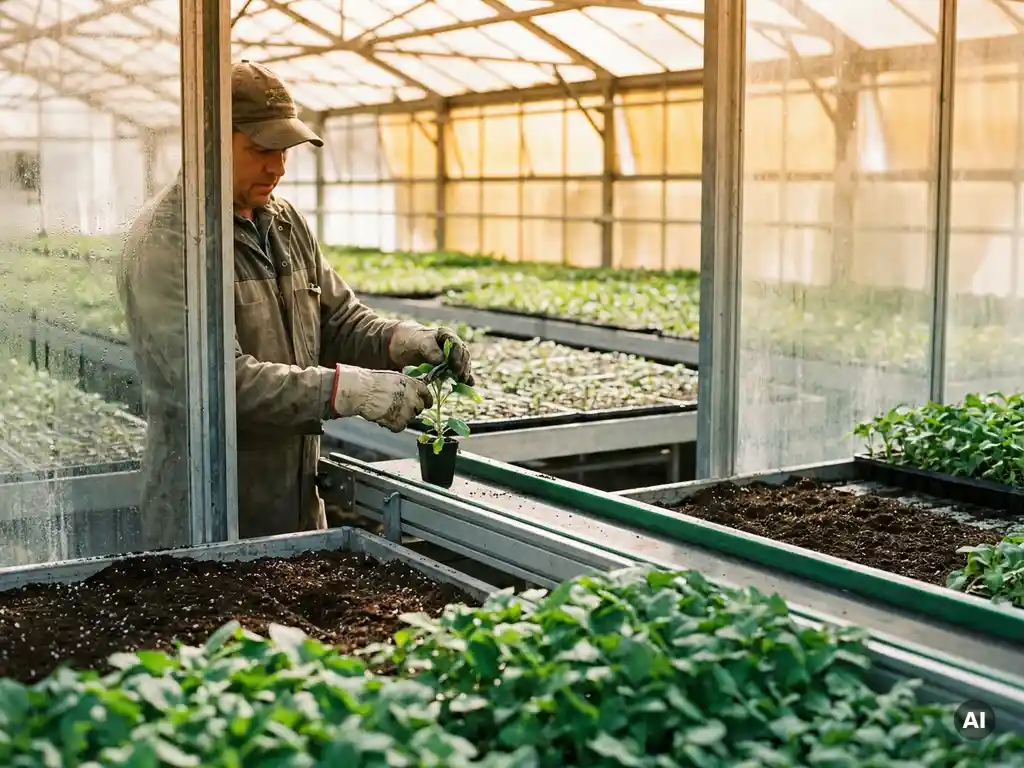
Should topping take place before or after watering?
Potting should generally take place before watering, not after. When plants are potted into dry or lightly moist substrate and watered immediately afterwards, the growing medium settles naturally around the root plug, creating better contact and more consistent pot density. This approach also protects root plugs from damage and keeps automated potting lines running smoothly.
The right moisture level in your substrate at the moment of potting makes a measurable difference to both plant quality and machine performance. The questions below unpack exactly why the order matters and when the standard advice needs adjusting.
Does soil moisture affect how well potting machines perform?
Yes, substrate moisture level has a direct impact on potting machine performance. Substrate that is too wet clumps together, blocks filling mechanisms, and causes uneven pot weights. Substrate that is too dry becomes loose and difficult to compress consistently. The ideal moisture level allows the growing medium to flow freely through the machine while still holding its shape once it lands in the pot.
For automated potting lines, consistency is everything. When the substrate behaves unpredictably, the machine cannot maintain a steady fill volume from pot to pot. This leads to variation in pot weight and density, which affects how plants root, how they present at auction, and how reliable your output looks across a full production run.
Machines with automatic soil detection, such as the Stolze 3030 PRO, compensate for minor variation by adjusting fill levels in real time. But even the most advanced machine performs best when the substrate arrives at the right moisture level to begin with. Preparing your growing medium correctly before it enters the line is always the first line of defense against inconsistency.
Should you water plants before or after potting them?
In most professional potting operations, plants should be watered after potting, not before. Watering after potting allows the substrate to settle naturally around the root plug as water moves through it, which creates even density and good root-to-medium contact. Pre-watering the plug can make it fragile and more prone to damage during handling and machine transit.
The post-potting watering approach also gives you more control over the process. Once the plant is in the pot and the substrate is in place, you can apply water at the right volume for that specific pot size and crop type. This is particularly important when you are running multiple pot sizes in a single production session, where watering needs differ significantly.
There is also a practical consideration for high-volume operations: pre-watered plugs are heavier and more difficult to handle at speed. On a line producing thousands of pots per hour, even small handling complications add up quickly and increase the risk of plant damage or line stoppages.
What happens to root plugs if the substrate is too dry during potting?
When substrate is too dry during potting, root plugs are at risk of desiccation stress, poor substrate contact, and physical damage. Dry growing medium does not bind well around the root plug, leaving air pockets that slow root development and reduce early establishment. In severe cases, the lack of moisture contact can cause the outer roots of the plug to dry out during the critical first hours after potting.
On the mechanical side, very dry substrate also behaves differently in the potting machine. It tends to be dusty, flows unevenly, and can create inconsistent fill volumes because it does not compact in the same way as correctly moistened substrate. This leads to lighter pots, lower pot density, and visible differences between plants that should look identical.
The solution is straightforward: substrate should be pre-moistened to the correct level before it enters the production line. A simple squeeze test, where the substrate holds its shape briefly when compressed but crumbles when touched, is a reliable on-the-floor check that requires no equipment.
How does potting order affect plant quality and consistency?
Potting order, meaning whether you water before or after placing the plant into the pot, affects both the uniformity of pot density and the quality of root development. Potting into dry or lightly moist substrate and watering afterwards produces more consistent results because the substrate settles uniformly and the root plug is handled in a stable, undamaged state.
Consistency is the key word for professional growers supplying auctions or retail chains. Buyers expect uniform pot weights, uniform plant height, and uniform appearance across entire batches. When potting order varies across a team or across different shifts, small differences in how wet the plug is or how the substrate settles can produce visible variation in the end product.
Automated potting lines reduce human variation significantly, but they amplify the importance of upstream decisions like substrate moisture and potting order. A well-configured machine running at high speed will faithfully reproduce whatever conditions it is given. If those conditions are consistent, the output is consistent. If they are not, the machine scales up the inconsistency rather than correcting it.
When is pre-watering the wrong choice for automated potting lines?
Pre-watering is the wrong choice for automated potting lines when it makes the substrate too wet to flow correctly through the machine, when it softens root plugs to the point where they deform under mechanical handling, or when it adds unnecessary weight that slows conveyor speed and increases plant damage risk. In high-volume automated environments, these three problems are common and often underestimated.
There is also a timing issue specific to automated lines. On a manual potting bench, a grower can adjust their technique in real time if a plug feels too soft or a substrate feels too wet. On an automated line running at several thousand pots per hour, there is no opportunity to correct mid-run. The conditions you set at the start of the line determine the quality of every pot that comes off it.
Pre-watering can be appropriate in specific situations, such as when working with very fine or hydrophobic substrates that need moisture before they will accept water evenly after potting. In these cases, light pre-moistening of the substrate, not the plug, is the better approach. The plug itself should remain firm and intact for as long as possible during the mechanical potting process.
How MartinStolze supports consistent potting results
Getting the watering order right is one piece of the puzzle. The other is having a potting machine that handles substrate and root plugs with enough precision to maintain consistency at high volumes. That is exactly what we design our machines to do.
- Automatic soil detection on the Stolze 3030 PRO ensures every pot receives an accurate, consistent fill, regardless of minor variation in substrate behavior
- Programmable settings for pot size, boring depth, soil feed, and rotation speed mean you can dial in the right configuration for each crop and substrate type
- Full integration with conveyor systems and topping machines keeps your entire line running at the same pace, reducing bottlenecks and handling damage
- In-house production and support means our own technicians know every component, which makes troubleshooting faster and downtime shorter
- Rental options with a trial period let you test the machine in your own operation before committing to a purchase
If you want to talk through the right setup for your substrate, crop, or production volume, get in touch with our team and we will help you find the configuration that fits.
Frequently Asked Questions
How do I know if my substrate is at the right moisture level before it enters the potting line?
The squeeze test is the most practical on-the-floor method: take a handful of substrate and compress it firmly. If it holds its shape briefly but crumbles when you tap or touch it, the moisture level is correct. If it stays in a solid clump or releases water when squeezed, it is too wet. If it falls apart immediately without holding any shape at all, it is too dry and needs pre-moistening before it reaches the machine.
Can I use the same substrate moisture level for all pot sizes and crop types?
Not always. While the general target moisture range applies broadly, different crop types and pot sizes can require slight adjustments. Larger pots with coarser substrate mixes may tolerate a slightly drier fill, while smaller pots with fine-textured media benefit from more precise moisture control to maintain consistent density. If you are running multiple pot sizes in a single session, it is worth checking substrate behavior at the machine for each format change rather than assuming one setting covers all.
What are the most common mistakes growers make when setting up a potting line for the first time?
The most common mistakes are starting the line with substrate that has not been pre-checked for moisture, skipping a trial run before full-speed production, and underestimating how much plug condition affects machine performance. Many first-time users also overlook the importance of consistent plug size and firmness across a batch — if plugs vary significantly in size or moisture, even a well-configured machine will produce uneven results. Running a short test batch and inspecting pot weight and density before committing to a full production run saves a lot of corrective work later.
What should I do if I notice inconsistent pot weights mid-run on an automated line?
Stop the line and check your substrate supply first — inconsistent pot weights are most often caused by a change in substrate moisture or a blockage in the filling mechanism. Check whether the substrate has dried out or clumped since the start of the run, and inspect the soil feed for any bridging or uneven flow. If your machine has automatic soil detection, review whether the detection settings are still calibrated correctly for the current substrate batch. Catching and correcting the root cause early prevents the problem from scaling across thousands of pots.
How does root plug quality before potting affect the final plant product?
Plug quality going into the machine directly determines how well the plant establishes after potting. A firm, intact plug with a healthy root structure makes good contact with the surrounding substrate once watered, which supports fast and even rooting. A plug that is damaged, overly soft, or partially dried out before it enters the pot will establish more slowly and inconsistently, which shows up as visible variation in plant height and appearance — exactly what auction buyers and retail chain buyers penalise. Protecting plug integrity during handling and transit is just as important as getting the substrate moisture right.
Is it worth investing in an automated potting machine if my production volume is relatively modest?
Automation pays off at lower volumes than many growers expect, particularly when you factor in labour costs, handling damage, and the consistency premium that comes with uniform plant output. If you are unsure whether the investment is justified for your current volume, a rental option with a trial period — like the one offered by MartinStolze — lets you measure the actual impact on your operation before committing. Running your own numbers on labour hours saved and reduction in plant losses often makes the case more clearly than any general rule of thumb.
How often should potting machine settings be recalibrated, and what triggers a recalibration?
Settings should be reviewed at the start of every new production run and whenever you switch substrate batches, pot sizes, or crop types. Substrate from different suppliers or even different deliveries from the same supplier can behave differently in the machine, so treating each new batch as a potential variable is good practice. Beyond scheduled checks, any sudden change in pot weight consistency, fill level, or machine throughput is a signal to stop and recalibrate rather than run through the problem and hope it self-corrects.