

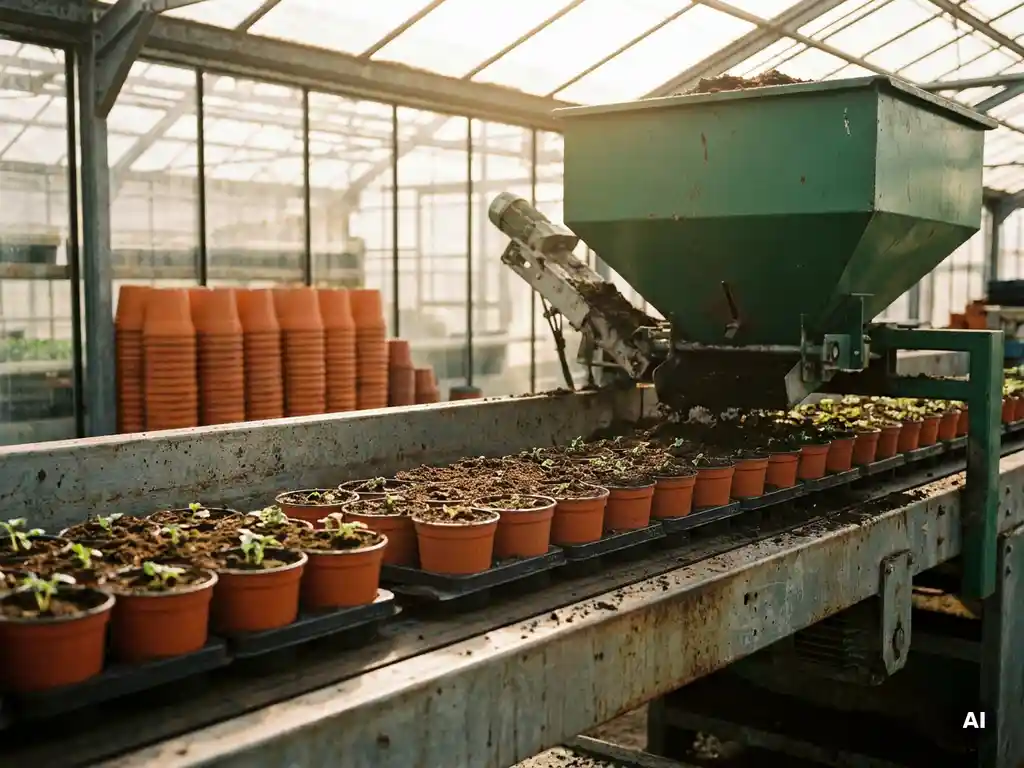
Should you choose a potting machine based on average or peak production volume?
Size your potting machine for peak production volume, not average output. If your machine can’t keep up during your busiest weeks, it becomes the bottleneck in your entire operation, costing you time, labour, and sales at exactly the moment when speed matters most. The sections below unpack how to think through this decision, what rental changes about the calculation, and which machine features hold up under pressure.
What happens when a potting machine can’t keep up with peak demand?
When a potting machine falls short during peak demand, the entire production line stalls. Staff are forced to work faster by hand to compensate, quality becomes inconsistent, and output targets slip. In a seasonal business where the timing of delivery to the auction or retailer is critical, a capacity shortfall during your busiest weeks has a direct commercial cost.
The ripple effect goes further than lost hours. When operators push an underpowered machine harder than it was designed to run, wear accelerates and the risk of breakdown increases, at precisely the worst time. A machine that handles 3,000 pots per hour comfortably in February may become a liability in April when you need 6,000. The gap between what the machine can do and what the operation demands is where profit disappears.
There is also a labour dimension. Growers often hire seasonal workers to cover peak periods. If the machine is the limiting factor, you are paying for labour that is standing idle waiting for pots to come through. Removing that bottleneck is frequently one of the fastest ways to reduce the cost per pot.
What’s the difference between average and peak production volume?
Average production volume is the number of pots you fill across a typical working day or week when demand is steady. Peak production volume is the maximum output you need to achieve during your busiest period, often driven by seasonal flowering cycles, auction schedules, or retailer delivery windows. The two figures can differ by a factor of two or more.
For most ornamental plant and pot plant growers, production is not linear. There are weeks when the greenhouse is at full capacity and every hour counts, and there are quieter periods when the machine runs at a fraction of its capability. Understanding both numbers matters because they define different things:
- Average volume tells you what the machine will handle on a normal day and helps you estimate running costs and throughput over a full season.
- Peak volume tells you the maximum output the machine must be capable of delivering without breaking stride: this is the number that should drive your capacity decision.
Confusing the two is one of the most common mistakes growers make when investing in a potting machine. A machine sized for average demand will be adequate for most of the year and inadequate precisely when it matters most.
Should you size a potting machine for average or peak output?
Size your potting machine for peak output, with a comfortable margin above your highest realistic demand. A machine that only just meets your peak requirement leaves no room for unexpected surges, minor stoppages, or the natural variability in soil mix flow and pot handling. Building in a buffer of 15 to 25 percent above your peak figure is a practical starting point.
The reasoning is straightforward. A machine running at 70 percent of its maximum capacity during a peak period is operating in a stable, controllable range. A machine running at 100 percent is at its limit, where small disruptions cascade into delays. The cost difference between a machine rated at 5,000 pots per hour and one rated at 6,500 pots per hour is often modest compared to the operational risk of under-specifying.
That said, there is a ceiling to this logic. Investing in a machine far beyond your realistic peak, for example, buying an 8,000 pot-per-hour machine when your genuine peak is 2,500, means paying for capacity you will never use. The goal is to identify your true peak, add a sensible buffer, and match that figure to the machine’s rated output under real working conditions with your specific soil mix.
How does rental change the capacity calculation?
Rental fundamentally changes the capacity calculation because it removes the need to own a machine large enough for every conceivable peak. Instead of purchasing for your maximum demand, you can buy or lease a machine sized for your reliable baseline and rent additional capacity during exceptional peak periods. This approach reduces capital commitment while keeping operational flexibility.
For growers who experience a short but intense seasonal peak, a few weeks in spring, for example, the economics of renting a second machine for that window can be significantly more attractive than owning a larger machine that sits underused for ten months of the year. Rental also allows you to trial a specific model or capacity level before committing to a purchase, which reduces the investment risk that many growers feel when upgrading from an older machine.
We offer both purchase and rental options, including a trial period, so you can validate the right capacity for your operation before making a long-term decision. If you are unsure whether your current or planned machine will cover your peak, speak with our team to work through the numbers together.
What potting machine features matter most at high output volumes?
At high output volumes, above 5,000 pots per hour, the features that matter most are soil detection accuracy, mechanical stability, and ease of programming. These three factors determine whether a machine maintains consistent pot quality under sustained pressure or begins producing variable results as throughput increases.
Soil detection and fill consistency
Automatic soil detection ensures that every pot receives the correct amount of growing medium regardless of how the soil mix flows or compacts during a long run. Without it, operators must monitor and adjust manually, which introduces inconsistency and adds cognitive load during high-speed production. The Stolze 3030 PRO includes automatic soil detection as a standard feature, which is one of the key differences between it and the base Stolze 3030 model.
Mechanical stability and noise at speed
A fully guided chain system reduces vibration and mechanical stress when the machine is running at its upper capacity range. This matters both for the quality of the output, pots are handled more consistently, and for the longevity of the machine. Machines that vibrate excessively at high speeds wear faster and require more frequent maintenance, which is a significant hidden cost over the life of the equipment.
Touchscreen programming and preset management
When you are running multiple pot sizes across a season, the ability to pre-programme settings for each size, bore depth, soil feed rate, rotation speed, and recall them instantly saves meaningful time at changeover. At high volumes, even a 20-minute reconfiguration delay repeated across a season adds up. A well-designed touchscreen interface makes this fast and reduces the risk of operator error during setup.
Both the Stolze 3030 and the Stolze 3030 PRO can be integrated into a complete potting line alongside conveyor systems and sorting lines, which is worth considering when high output volumes require the entire line to move at the same pace as the potting machine itself.
How Martin Stolze helps you choose the right potting machine capacity
We work with growers to match machine capacity to real operational demand, not just average throughput figures, but genuine peak requirements based on your crop, your season, and your soil mix. Here is what that looks like in practice:
- Capacity assessment: We help you calculate your realistic peak pots per hour requirement, including the buffer you need to operate comfortably rather than at the limit.
- Model matching: We advise on whether the Stolze 3030 or the Stolze 3030 PRO fits your output level, with specific guidance on automatic soil detection, chain stability, and programming needs at your volume.
- Line integration: Both machines integrate directly with our conveyor and sorting systems, so the potting machine is never the weak link in a fully automated line.
- Flexible entry: Purchase and rental are both available, including a trial period, so you can confirm the right capacity before committing.
- On-site support: Our own engineers handle installation, training, and maintenance, with a dedicated demo and training facility in De Lier.
If you are deciding between models or working out whether your current machine will cover your 2026 peak season, contact us and we will help you find the right answer for your specific situation.
Frequently Asked Questions
How do I calculate my true peak pots-per-hour requirement if my production varies week to week?
Start by reviewing your output records from the last two or three seasons and identify the single busiest week, not the busiest day, as a one-off spike can be misleading. Divide the total pots filled that week by the number of productive machine hours to get your real peak hourly rate. Then add a buffer of 15–25% to that figure to account for soil flow variability, minor stoppages, and unexpected demand surges — that final number is the minimum rated capacity your machine should meet.
What are the warning signs that my current potting machine is already a bottleneck in my operation?
The clearest signs are staff waiting on pots rather than moving them, operators manually topping up or adjusting fills during busy runs, and a noticeable increase in machine noise or vibration as throughput climbs. If you are consistently running the machine above 85–90% of its rated capacity during peak weeks, you are already in the danger zone where small disruptions become costly delays. Tracking how often production targets are missed specifically during peak periods — rather than across the whole season — will confirm whether the machine or another part of the line is the true constraint.
Is it worth upgrading to a machine with automatic soil detection if my operators are experienced?
Yes, even with highly experienced operators. At high output volumes, manual monitoring of fill consistency adds cognitive load that compounds over a long shift, and even skilled operators will see more variation as speed increases. Automatic soil detection removes that variable entirely, delivering consistent fill weights regardless of how the soil mix compacts or flows as the hopper empties. The consistency gain also reduces the risk of customer complaints or retailer rejections due to underweight or overweight pots, which can be a significant hidden cost.
Can I integrate a new potting machine into my existing conveyor line, or do I need to replace everything at once?
In most cases, a new potting machine can be integrated into an existing line, but compatibility depends on conveyor speed, belt width, and the pot sizes you are running. The key is ensuring the conveyor can keep pace with the potting machine at peak output — a common mistake is upgrading the potting machine without checking whether the surrounding line can match the new throughput. It is worth having a line assessment done before installation so that the potting machine does not simply shift the bottleneck to the conveyor or sorting stage.
How long does a typical rental period last, and is it practical for a peak window of just two or three weeks?
Rental periods can be tailored to your seasonal window, and a two-to-three-week peak rental is a realistic and commercially practical option for many growers. The key consideration is lead time — arranging rental well in advance of your peak ensures the right machine and capacity level are available when you need them, rather than when alternatives have already been booked. Renting for a short peak also gives you the opportunity to run a specific model under your own conditions and soil mix before deciding whether to purchase that capacity permanently.
What maintenance should I plan for before the peak season to make sure my machine doesn't fail at the worst moment?
Before your peak season, prioritise checking chain tension and wear, cleaning and calibrating the soil detection sensors, and inspecting all drive components for signs of fatigue. Machines that have been running at high throughput for several seasons are most vulnerable to unexpected failure during the next peak, particularly if maintenance has been deferred during quieter months. Scheduling a pre-season service with a qualified engineer — ideally one familiar with your specific model — is the most reliable way to avoid a breakdown at exactly the moment you cannot afford downtime.
What is the realistic lifespan of a potting machine, and when does it make more sense to replace than repair?
A well-maintained potting machine from a reputable manufacturer can remain productive for 10–15 years or more, but the economics of repair versus replacement shift as the machine ages and production demands grow. The clearest signal to replace is when repair costs in a single season approach 20–30% of the replacement cost, or when the machine's rated capacity can no longer meet your peak requirements even after servicing. Upgrading also makes sense when newer models offer features — such as touchscreen programming, automatic soil detection, or improved chain stability — that would meaningfully reduce your cost per pot or improve output quality at the volumes you now require.
Related Articles
- Can a potting machine have too much capacity for your production line?
- How do you calculate realistic pots per hour for your nursery?
- How long does it take to pot 25,000 plants with an automated potting machine?
- Why does machine utilization matter more than maximum pots per hour?
- How many pots per hour do you need to reach your daily production target?