
Simple steps to boost greenhouse efficiency at your nursery this year
Every grower knows the feeling: the greenhouse is full, the orders are coming in, and yet the day never seems long enough. When people talk about greenhouse efficiency, they often jump straight to climate computers, LED lighting, or energy screens. Those matter, but for many nurseries the biggest gains in 2026 sit somewhere much closer to the ground, in the way plants, pots, and trays move through the business.
With wages rising and good staff harder to find, small improvements in internal logistics can free up more hours than almost any other investment. The steps below are practical, realistic, and designed so you can start without rebuilding your entire operation.
Spot Where Labor Hours Quietly Disappear
The fastest way to improve efficiency is to measure where people actually spend their time, because most lost hours hide in repetitive, low-value movements rather than in the work that grows the crop.
Spend a few days simply watching. Follow a tray from the potting area to the growing bay, then to the packing line, and note how many times someone lifts, carries, pushes, or waits. You will often find that employees spend a surprising share of the day walking with carts, stacking trays by hand, or standing idle while the next step catches up.
A simple tally sheet is enough. Write down each handling step, how long it takes, and how many people are involved. When you add it up across a full week or a peak season, the pattern becomes obvious, and so does the priority list.
Pay special attention to the physically heavy tasks. Repetitive lifting is not only slow; it also drives sick leave and turnover, which quietly add recruitment and training costs on top of the wage bill.
Automate Internal Transport First
Automating internal transport is usually the smartest first move because it replaces the most repetitive, labor-intensive work without changing how you grow your plants.
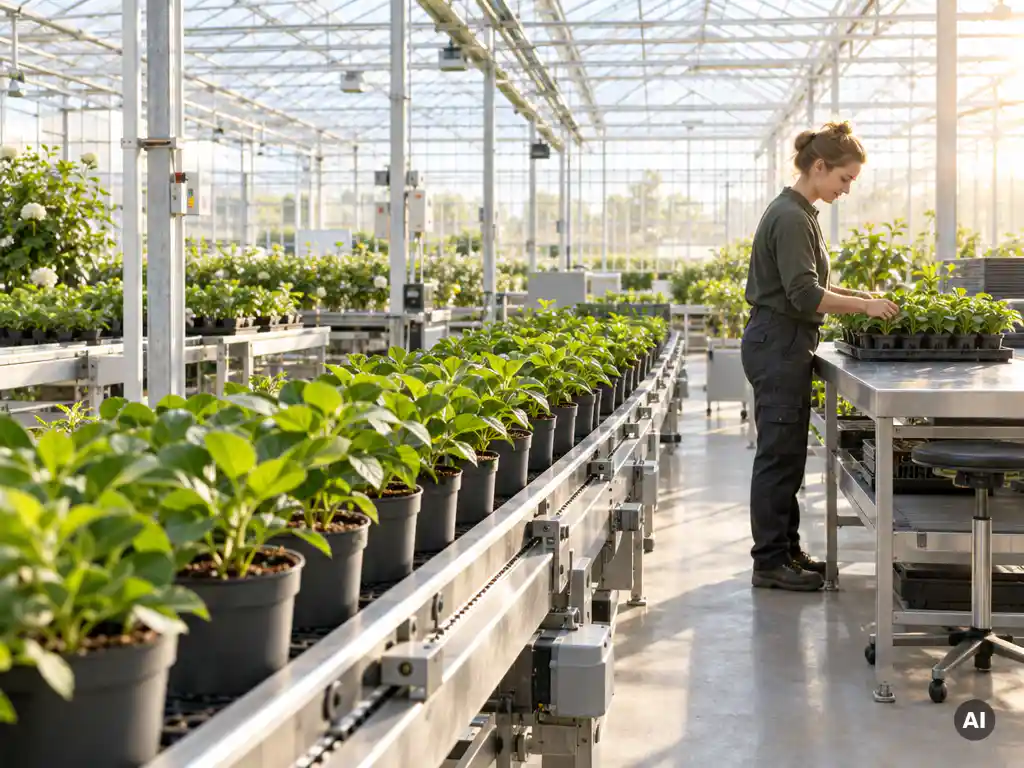
Think of internal transport as the circulation system of your nursery. Conveyor belts, roller tracks, and buffer tables carry products between stations so people no longer have to. The workers you already have can then focus on tasks that truly need human attention, such as quality checks, crop care, and packing decisions.
This is also where the numbers can be dramatic. Some growers who automated their transport and handling processes have gone from 26 FTE down to 6 FTE for the same output. Results like that depend on the layout and the crop, but they show how much capacity is tied up in simple movement.
Ergonomics matter just as much as speed. When belts bring the work to the person at a comfortable height, strain drops, absenteeism falls, and the job becomes more attractive in a tight labor market. Our range of conveyor belts is built in our own workshop in De Lier with exactly this kind of daily use in mind.
Connect Machines Into One Smooth Line
A connected line beats a collection of stand-alone machines, because the real efficiency gain comes from removing the pauses and manual handovers between steps.
Many nurseries already own a potting machine, a watering station, or a few belts. The problem is that each one works in isolation, with people shuttling plants in between. Linking them with transport belts, buffer tables, and roller tracks turns separate tasks into a continuous flow.
Buffer tables deserve a special mention. They absorb small differences in speed between stations, so one slow step no longer stalls everything behind it. Add work tables, scales, or lighting along the line and the same route can handle sorting, weighing, and inspection without extra movement.
Why one supplier makes it easier
Combining equipment from several suppliers often leads to mismatched heights, speeds, and controls. Working with one partner for hardware, software, and installation means the pieces are designed to fit together from the start. That saves coordination time and avoids the finger-pointing that can follow when a mixed setup does not run smoothly.
Start Small With Mobile Belts or Rental
You do not need a full production line on day one: mobile conveyor belts and rental equipment let you test the benefits on your own site before committing to a larger investment.
A mobile belt is a low-threshold entry point. It can be moved between bays, used during a seasonal peak, and put away when it is not needed. Many growers begin exactly this way, then add fixed systems once they have seen how much time the first belt saves.
Renting takes the risk out of the decision. You can run a peak period with the equipment, see what changes for your team, and then decide how to grow the setup step by step. If you are unsure where to begin, we are happy to think along with you, and you can get in touch with our team to talk through your situation.
This stepwise approach also keeps your team on board. People get used to new ways of working gradually, and they see the benefits for themselves rather than having a big change imposed overnight.
Common Efficiency Mistakes to Avoid This Season
The most common mistakes are automating without a plan, ignoring the people who use the equipment, and fixing one bottleneck while creating another.
The first trap is buying equipment before mapping the process. A fast belt in the wrong place simply moves the queue somewhere else. Starting with the time study described earlier keeps investments pointed at real problems.
The second is forgetting the team. Involve the people on the floor early, ask where their work is hardest, and let them test equipment. Their practical feedback often improves the layout, and their buy-in makes the change stick.
A third mistake is thinking too small or too big. Automating a single task in isolation rarely transforms the business, while trying to automate everything at once can overwhelm the budget and the schedule. A phased plan that starts with the biggest labor drain and builds toward a connected line is usually the sweet spot.
Finally, do not wait for the perfect moment. Staffing pressure and rising wage costs are not going away, and every season spent on manual handling is a season of hours you cannot get back. Pick one bottleneck, test a solution, and let the results guide the next step. If you would like a partner who knows the nursery sector inside out, take a look at what we do at MartinStolze.
Frequently Asked Questions
How do I calculate the return on investment for conveyor belts or automated transport in my nursery?
Start with your time study: multiply the hours spent on manual handling per week by your fully loaded hourly labor cost (wages, social charges, training, and absenteeism). Compare that annual figure to the purchase or rental cost of the equipment, plus maintenance. Most growers also factor in softer gains such as fewer sick days, lower turnover, and the ability to handle peak orders without extra temporary staff.
What is the best first step if I have a small nursery and a limited budget?
Begin with a few days of observation and a simple tally sheet to identify your single biggest labor drain. Then test a solution at low risk, such as a mobile conveyor belt or a rental setup during your busiest weeks. This lets you measure real time savings before committing to a fixed installation.
Will automating internal transport mean I have to lay off staff?
Not necessarily. In most nurseries the goal is to move people away from repetitive carrying and stacking toward tasks that need human judgment, such as crop care, quality control, and packing decisions. In a tight labor market, automation often means you can maintain or grow output without having to recruit and train additional hands.
How can I get my team on board with new equipment?
Involve the people on the floor from the start by asking which tasks are physically hardest and letting them test equipment before a final decision. Introduce changes gradually, for example with one mobile belt, so employees can see the benefits for themselves. Their practical feedback often improves the layout and makes the change stick.
How do I know if I'm creating a new bottleneck when I automate one step?
After installing equipment, watch the steps immediately before and after it for a full shift and note where plants queue up or where people wait. If the queue has simply moved, add a buffer table or adjust the speed and capacity of the neighboring station. Reviewing the whole flow rather than a single task is the best way to avoid shifting the problem.
Can existing machines like a potting machine or watering station be linked into a connected line?
In many cases, yes. Transport belts, roller tracks, and buffer tables can be used to connect equipment you already own so plants flow from one station to the next without manual handovers. Check heights, speeds, and control compatibility first, and consider working with a single supplier to make sure all the pieces fit together smoothly.
How do I know whether to choose mobile belts, rental, or a fixed installation?
Choose mobile belts or rental if your needs are seasonal, your layout may change, or you want to prove the benefits first. Opt for a fixed installation when the same route is used every day at high volumes and you have already confirmed the time savings. Many nurseries follow a phased path, starting mobile and gradually adding fixed sections toward a fully connected line.