

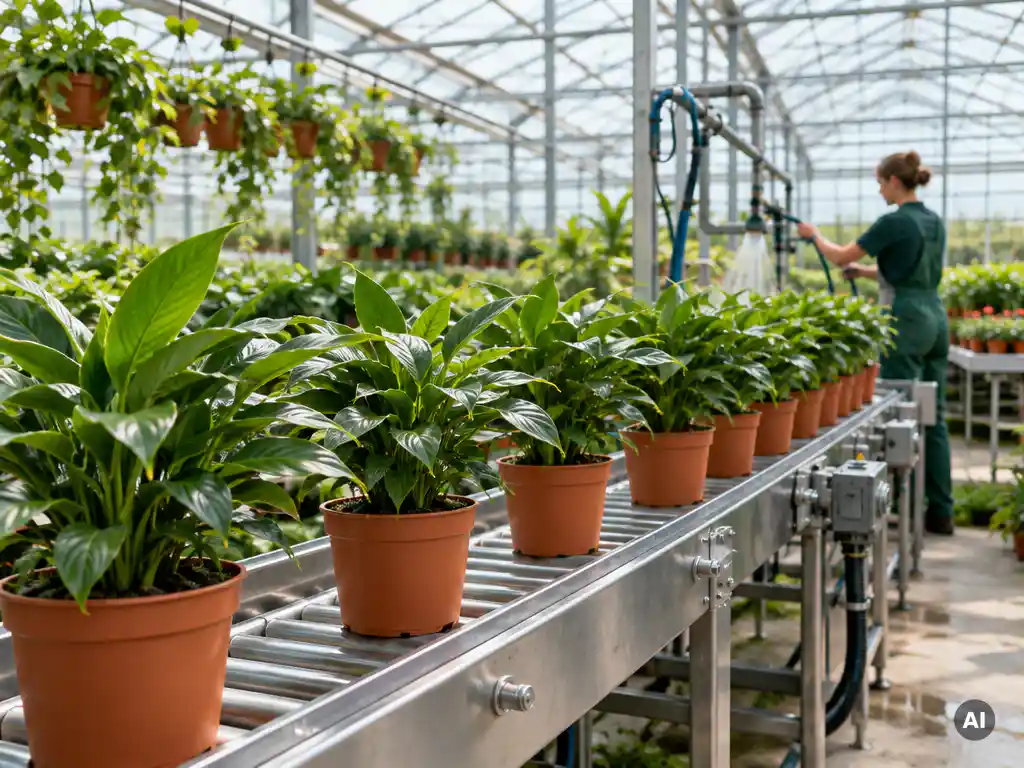
What affects greenhouse efficiency most in a potted plant operation
Ask any grower what holds back greenhouse efficiency and you will hear a familiar list: climate control, energy prices, crop scheduling, plant genetics. All of these matter. But in a potted plant operation, the factor that quietly decides whether a day runs smoothly or falls behind is usually much simpler: how many people it takes to move plants from A to B, and how often they have to do it.
This article looks at where efficiency is really won or lost in a pot plant nursery, from labor hours and internal transport to layout and automation. It also shows how growers can improve step by step without turning the whole business upside down.
Labor Hours: The Biggest Efficiency Lever
In most potted plant operations, labor is the largest controllable cost and the biggest driver of greenhouse efficiency. Climate and energy are important, but they are largely set by the building and the market. Labor is where daily decisions make a measurable difference.
The pressure is easy to recognize. Vacancies stay open for months, seasonal peaks force growers to rely on expensive temporary staff, and physically demanding tasks lead to absenteeism and high turnover. Meanwhile wages rise year after year, which squeezes margins for family businesses of every size.
The useful question is not only “how do we find more people?” but “how much of our labor is spent on work that adds no value to the plant?” Walking, carrying, lifting and repositioning trays rarely improve the crop, yet they can fill a large part of the working day. Reducing that share is often the fastest route to better output per employee.
How Internal Transport Drains Productivity
Internal transport drains productivity because every manual move of pots, trays or trolleys consumes labor without creating any value. In a typical pot plant nursery, plants are handled many times between potting, watering, sorting, packing and dispatch.
Each of those moves seems small. Together they add up to a hidden workforce: people pushing trolleys, stacking trays, carrying boxes and waiting for the next batch to arrive. Delays at one station ripple down the line, so a packing team may stand idle while the potting team catches up, or the other way around.
The ergonomic cost
Repetitive lifting and carrying also take a toll on people. Strain injuries lead to sick leave, and sick leave leads to gaps in the schedule that are hard to fill. Making transport easier on the body is therefore not just a comfort issue. It protects the capacity of the team you already have.
Bottlenecks and buffers
Uneven flow is another quiet drain. When one process runs faster than the next, plants pile up and people spend time managing the pile instead of working on the product. A buffer between stations smooths the rhythm so that each team can work at a steady pace.
Greenhouse Layout and Process Flow Design
A good greenhouse layout shortens the distance plants travel and creates a logical, one-directional flow from potting to dispatch. Layout rarely gets attention until it becomes a problem, yet it determines how much walking, carrying and backtracking every employee does each day.
Start by mapping the actual route a plant takes through the nursery. Where does it cross paths with other flows? Where does it double back? Where do trolleys wait? Even a simple sketch often reveals unnecessary detours, narrow passages and workstations placed far from the processes they depend on.
Think about the flow as a line rather than a collection of separate areas. When potting, watering, sorting and packing are arranged in sequence, plants can move from one step to the next with minimal handling. This also makes it far easier to add automation later, because the route is already clear.
Flexibility matters as well. Crops, seasons and customer orders change, so a layout that works at peak volume should still function when volumes drop. Designs that allow for modular adjustments tend to age better than rigid ones.
Automation Tools That Cut Labor Most
The automation tools that cut the most labor in a pot plant nursery are the ones that remove repetitive handling: conveyor systems, buffer tables, potting machines, roller conveyors and automated watering stations. They target the tasks that consume hours but add no value to the plant.
Conveyor belts are usually the starting point. They replace the constant carrying and trolley pushing between stations, and they can be combined with work tables, scales and lighting to create a complete processing line. If you want to see what is possible, take a look at our range of conveyor belts.
Buffer tables keep the flow even by storing plants between processes, so one team does not have to wait for another. Potting machines take over a repetitive and physically demanding task, while watering stations make a routine job consistent and less labor-intensive. Roller conveyors and soil conveyors handle heavier materials with far less effort.
The real gain comes from combining these tools. Because the equipment is designed to work together, a nursery can build a line that fits its own crops and volumes. The results can be substantial. Some of the growers we work with have gone from 26 to 6 FTE for the same output, simply by automating internal transport and the steps around it.
Starting Small With a Step-by-Step Approach
The easiest way to begin is to start with one bottleneck, test a mobile solution, and expand only once the benefit is clear. Automation does not have to mean a large upfront investment or a complete rebuild of the nursery.
A common route is to begin with a mobile conveyor belt at the busiest point in the process. Renting equipment during a peak period is a low-risk way to find out how much time it really saves, and how the team responds to working with it. Once the effect is visible in the hours and the output, it becomes much easier to decide what to automate next.
From there, growers can move toward fixed systems, adding buffers, potting machines or watering stations as the business grows. Each step builds on the last, and because everything is designed to be combined, nothing has to be replaced along the way. We also handle the full installation, so there is no need to coordinate between multiple suppliers.
For 2026, the question for many nurseries is not whether to automate, but where to begin. If you are unsure which process to tackle first, get in touch with us and we will think it through with you, based on more than 30 years of experience in the horticultural sector.
Frequently Asked Questions
How do I figure out which process in my nursery to automate first?
Start by tracking where your team spends the most time on walking, carrying and waiting rather than working on the plant. Do a simple time study for a few days at each station, or sketch the route a plant takes from potting to dispatch and mark every manual move. The station with the most repeated handling or the one that regularly causes a pile-up is usually your best first candidate.
How can I measure whether automation is actually paying off?
Record a baseline before you change anything: labor hours per 1,000 pots, number of people on the line, and daily output. After introducing a mobile conveyor or buffer table, measure the same figures over a comparable period. Also track secondary indicators such as sick leave, overtime and temporary staff costs, since reduced physical strain often shows up there first.
What if my greenhouse is small or has narrow paths? Can I still use conveyor systems?
Yes. Mobile and modular conveyor belts can be set up in a limited space and moved or removed when not needed. Measure your narrowest passage and the turning space for trolleys first, then choose equipment dimensions that fit. In many cases, simply removing trolley traffic from narrow paths frees up more room than the conveyor takes up.
What are the most common mistakes when automating internal transport?
The most frequent mistake is automating one station without looking at the stations before and after it, which just moves the bottleneck elsewhere. Another is buying equipment that cannot be combined or extended later. Plan the flow as a whole line, include buffer tables to even out speed differences, and choose components that are designed to work together.
How do I get my team on board with new equipment?
Involve employees early by asking which tasks are the most tiring or time-consuming, and let them test a mobile solution during a busy period. Emphasize that the goal is to remove heavy, repetitive work rather than replace people. Giving staff a short training and a chance to suggest adjustments to the setup usually builds acceptance quickly.
Is renting equipment a good way to test automation before buying?
Renting is a low-risk way to find out how much time a solution really saves in your own situation. Rent during a peak period so the effect is clearly visible, and use the baseline measurements you took beforehand to compare results. If the benefit is clear, you can move to a fixed system and expand step by step.
Does a more efficient flow help with crop quality as well as labor costs?
Often it does. Less handling means less risk of damaged leaves, tipped pots and plants standing too long in the wrong place. A steady, one-directional flow also helps ensure that watering, sorting and dispatch happen on schedule, which supports consistent quality at delivery.