

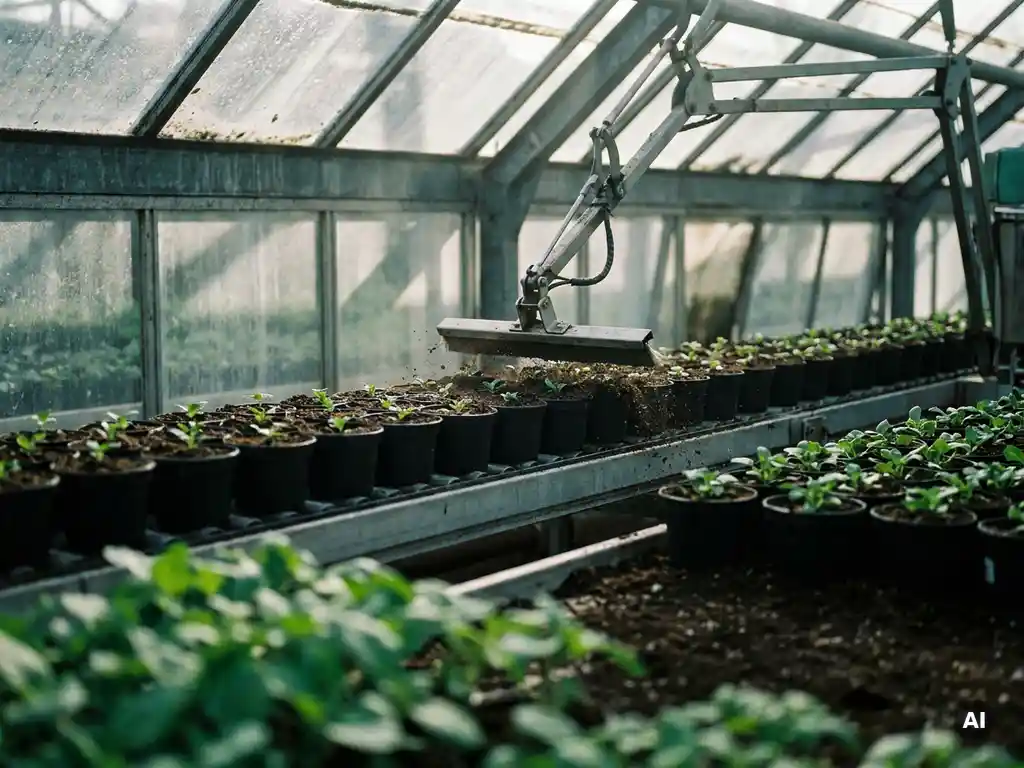
What are the benefits of using a topping machine after potting?
A topping machine after potting adds a layer of substrate, bark, or decorative material on top of freshly filled pots in a single automated pass. This finishing step improves moisture retention, suppresses weeds, and gives each pot a uniform, professional appearance. The sections below walk through how the process works, what it delivers in terms of quality and speed, and how to decide whether to integrate it into your potting line.
How does a topping machine work after potting?
A topping machine applies a controlled, even layer of top-dressing material directly onto pots immediately after they leave the potting machine. Pots travel along a conveyor beneath a hopper or dosing unit, which releases a measured amount of material onto each pot. The flow rate and layer thickness are adjustable, so every pot receives the same coverage regardless of line speed.
Most topping machines use a belt or vibrating floor system inside the hopper to keep loose materials like bark or gravel flowing smoothly without bridging or blocking. Sensors detect the presence of a pot and trigger the dosing mechanism, preventing waste between pots. The result is a clean, consistent finish applied at full production speed without any manual handling.
What quality improvements does a topper deliver?
A topping machine delivers consistent layer thickness across every single pot, eliminating the variation that comes with manual application. This consistency directly improves plant quality: a uniform top layer retains moisture more evenly, reduces surface evaporation, and gives roots a stable growing environment. It also gives every product a clean, market-ready appearance before it reaches the retailer or auction.
Beyond aesthetics, a well-applied top layer of bark or coarse substrate suppresses algae and weed growth on the pot surface, reducing the need for chemical treatment later in the growing cycle. For growers supplying retail chains or auction markets, that uniform look is not just cosmetic. Buyers increasingly expect consistent presentation, and a topping machine makes that standard repeatable at scale rather than making it dependent on the attention of individual workers.
How much faster is production with a topping machine?
Integrating a topping machine into a potting line eliminates topping as a separate manual step entirely, which means production speed is limited only by the potting machine itself rather than by a downstream bottleneck. In practice, growers who previously topped pots by hand or in a separate batch process can reduce total cycle time per pot significantly, often cutting the overall line time for a batch by a third or more depending on the previous workflow.
When the topping machine runs inline with the conveyor system, pots move from filling to topping to staging in one continuous flow. There is no waiting, no re-handling, and no queue of untouched pots building up at a separate workstation. During peak seasons, when throughput directly affects how many batches you can turn around before a delivery or auction deadline, that uninterrupted flow makes a measurable difference.
What labour savings can growers expect?
A topping machine typically replaces one to two full-time positions on the potting line, depending on the scale of the operation and how topping was handled before. Manual topping is repetitive, physically demanding work that contributes to fatigue and inconsistency over a long shift. Automating it frees those workers to handle tasks that genuinely require human judgment, such as quality checks, plant spacing, or logistics.
For seasonal growers who rely on temporary staff, the savings are even more significant. Recruiting, training, and managing extra hands for topping is a real operational cost. A topping machine removes that dependency entirely, which also means output does not drop when staff availability is tight. Over a full growing season, the reduction in labour hours tends to be one of the clearest financial arguments for the investment.
Which substrates and top-dressings work with a topping machine?
Most topping machines handle a wide range of loose, granular, or fibrous materials, including fine and coarse bark, perlite, gravel, sand, coco chips, and decorative stone. The key requirement is that the material flows freely enough to pass through the dosing mechanism without clumping or bridging. Very fine or wet materials can cause feeding issues, so material moisture content and particle size are worth checking before committing to a machine configuration.
Some topping machines can also apply a thin layer of the same growing substrate used in the pot itself, which is useful when the goal is to cover an uneven pot surface rather than add a distinct top layer. If you work with multiple top-dressing types across different crops or pot sizes, look for a machine with a hopper that can be cleaned and refilled quickly, or consider a setup with interchangeable dosing inserts to switch materials between runs without significant downtime.
Should a topping machine be integrated with the potting line or run separately?
For most professional growers, integrating the topping machine directly into the potting line is the better choice. Inline integration means pots are topped immediately after filling, in the same continuous pass, which eliminates handling, reduces the risk of substrate settling unevenly before topping, and keeps the line running at full capacity. A standalone topping machine only makes sense if your production volumes are low or if you need to top pots that were filled at a different time or location.
The practical consideration is conveyor compatibility. The topping machine needs to match the height, width, and speed of the existing line. When the potting machine, conveyor, and topper are sourced from the same supplier, alignment is straightforward. When mixing equipment from different manufacturers, you may need custom transitions or speed synchronisation to prevent pots from tipping or spacing unevenly under the dosing unit.
How MartinStolze supports your topping and potting setup
We design and build complete potting lines that bring together potting machines, conveyors, and topping machines in one integrated, efficient system. Our machines are produced entirely in-house, which means every component is built to work together from the start. Here is what that means in practice for your operation:
- Inline integration: Our topping machines connect directly to the Stolze 3030 and 3030 PRO potting machines via our own conveyor systems, so there is no compatibility guesswork.
- Flexible configuration: We configure dosing settings, layer thickness, and line speed to match your specific substrate and pot size requirements.
- Full support: Our own technicians handle installation, commissioning, and training at your site.
- Buy or hire: Both options are available, including a trial period, so you can evaluate the setup in your own production environment before committing.
If you are weighing up whether a topping machine fits your current line or planning a new setup from scratch, we are happy to think through the options with you. Get in touch with our team and we will help you find the right configuration for your crop, your volumes, and your workflow.
Frequently Asked Questions
How do I know if my current potting line is compatible with a topping machine?
The key factors to check are conveyor height, belt width, and line speed — your topping machine needs to match all three to ensure pots pass through smoothly without tipping or misalignment. If your potting machine and conveyor are already from the same supplier, integration is usually straightforward. When mixing brands, ask the topping machine manufacturer for the exact dimensional and speed specifications upfront, and budget for any custom transition sections or synchronisation adjustments that may be needed.
What is the typical return on investment (ROI) timeframe for a topping machine?
For most professional growing operations, a topping machine pays for itself within one to three growing seasons, depending on labour costs, production volume, and how topping was previously handled. The clearest savings come from reduced labour hours and the elimination of a separate topping step, but growers also report indirect gains from fewer quality rejections and more consistent auction or retail presentation. Running a simple calculation based on your current hourly labour costs and the number of pots topped per season will give you a reliable baseline to compare against the machine's purchase or hire cost.
Can a topping machine handle different pot sizes without lengthy changeovers?
Yes — most modern topping machines are designed to accommodate a range of pot diameters and heights with minimal adjustment, typically by changing conveyor guides or adjusting the dosing height. The more important variable is the dosing volume, which should be recalibrated whenever you switch to a significantly different pot size to maintain a consistent layer thickness. If you regularly run multiple pot sizes in the same day, look for a machine with quick-adjust dosing settings so changeovers don't become a production bottleneck.
What happens if the top-dressing material is too wet or too fine — will it block the machine?
Wet or very fine materials are the most common cause of bridging and blockages in the hopper or dosing mechanism, and this is worth testing before committing to a specific material or machine configuration. As a general rule, top-dressing material should have a particle size and moisture content that allows it to flow freely under gravity or light vibration. If you work with materials prone to clumping, look for a topping machine with an active agitation system in the hopper, and always store your top-dressing material under cover to prevent moisture uptake before use.
Is it possible to apply two different top-dressing materials in the same production run?
Applying two distinct materials in a single pass is not standard on most topping machines, but some setups allow for a layered approach using two sequential dosing units on the same line. A more practical solution for most growers is to configure the machine for one material per run and schedule different top-dressing types as separate production batches. If dual-material topping is a regular requirement for your crops, discuss this with your supplier early in the planning stage so the line can be designed with the right hopper and dosing configuration from the start.
Do topping machines require a lot of maintenance, and what does that involve?
Topping machines are mechanically straightforward compared to potting machines, and routine maintenance is generally limited to cleaning the hopper and dosing unit between material changes, checking belt tension, and inspecting sensors for substrate build-up. The most important habit is clearing residual material from the machine at the end of each shift, especially with organic top-dressings like bark or coco that can compact or attract moisture overnight. Following the manufacturer's scheduled service intervals and keeping spare dosing inserts or belts on hand will keep unplanned downtime to a minimum during peak production periods.
Can a topping machine be trialled before purchasing to make sure it fits our workflow?
Yes — some suppliers, including MartinStolze, offer both hire and trial options that let you run the machine in your own production environment before making a final purchasing decision. This is particularly valuable if you have a mixed or unusual substrate, non-standard pot sizes, or a high-speed line where integration needs to be verified under real conditions. A trial period also gives your team time to get comfortable with the machine's settings and maintenance routine, so you hit the ground running from day one of full ownership.
Related Articles
- Where should a topping machine be positioned in a production line?
- How do you calculate realistic pots per hour for your nursery?
- How long does it take to pot 25,000 plants with an automated potting machine?
- How do you convert pots per hour into daily production capacity?
- How do you reduce physical strain on staff during potting season?