
What causes bottlenecks in greenhouse production lines?
Greenhouse production lines are under constant pressure. Plants move through potting, sorting, watering, and packing stages in rapid succession, and any disruption in that flow creates a ripple effect that costs time, money, and staff energy. Understanding what causes bottlenecks in greenhouse operations is the first step toward building a smarter, more efficient system.
Whether you manage a nursery, a distribution centre, or a processing line, the same core challenges tend to appear. This article answers the most common questions growers and operations managers ask about production flow, internal transport, and the role of conveyor belts in horticulture.
What is a bottleneck in a greenhouse production line?
A bottleneck in a greenhouse production line is any point in the process where the flow of plants, pots, or products slows down or stops, causing a backlog that limits the overall output of the entire line. It is the weakest link in your workflow, and the speed of the whole operation is determined by that single constraint.
Bottlenecks can be physical, such as a narrow corridor or a single workstation handling too much volume. They can also be process-related, such as a manual handoff between two automated stages. In a greenhouse environment, where humidity, soil, and living plants add complexity, bottlenecks tend to compound quickly. A delay at one station does not stay there. It backs up into the previous stage and starves the next one, reducing throughput across the entire facility.
What are the most common causes of production bottlenecks in greenhouses?
The most common causes of production bottlenecks in greenhouses are manual handling between process stages, mismatched speeds between machines and workers, insufficient buffer capacity, and a lack of continuous internal transport. Any one of these can bring a production line to a standstill during peak periods.
Manual handling is the most frequent culprit. When workers carry trays or pots from one station to the next, they introduce inconsistent timing that no machine can compensate for. Mismatched capacity is another major issue: if your potting machine runs faster than your sorting line can receive product, plants pile up in between. Poor buffer capacity means there is nowhere for that overflow to go. And without a structured internal transport system, workers spend a significant portion of their shift simply moving materials rather than adding value to them.
- Manual transport between workstations
- Speed mismatches between machines and human operators
- No buffer capacity between production stages
- Unstructured or ad hoc internal logistics
- Equipment not designed for the greenhouse environment
How does manual internal transport slow down greenhouse operations?
Manual internal transport slows down greenhouse operations because workers walking with plants or trolleys introduce unpredictable timing, cover significant distances per shift, and are unavailable for productive tasks while in transit. Industry experience consistently shows that staff in non-automated facilities walk several kilometres per day simply moving materials from place to place.
The physical toll is significant. Repetitive lifting, carrying, and bending lead to fatigue and musculoskeletal complaints, which in turn drive absenteeism. When a worker calls in sick, the manual link they covered disappears from the line entirely, creating an immediate bottleneck with no automatic fallback. Beyond the human cost, manual transport simply cannot keep pace with automated machinery. A potting machine that processes hundreds of plants per hour cannot be served efficiently by a person with a trolley. The gap between machine speed and human carrying capacity is where production time is lost.
What’s the difference between fixed and mobile conveyor systems in horticulture?
Fixed conveyor systems are permanently installed along a set production route, while mobile conveyor systems can be repositioned to serve different areas of a greenhouse as operational needs change. The right choice depends on whether your workflow is consistent and predictable or varies across seasons and crop types.
Fixed conveyor systems
Fixed systems are ideal for facilities with a stable, high-volume production line where the same route is used consistently. They offer maximum throughput, can be integrated directly with potting machines, sorters, and packaging lines, and require minimal daily setup. Once installed, they become the backbone of the production flow and can be expanded over time.
Mobile conveyor systems
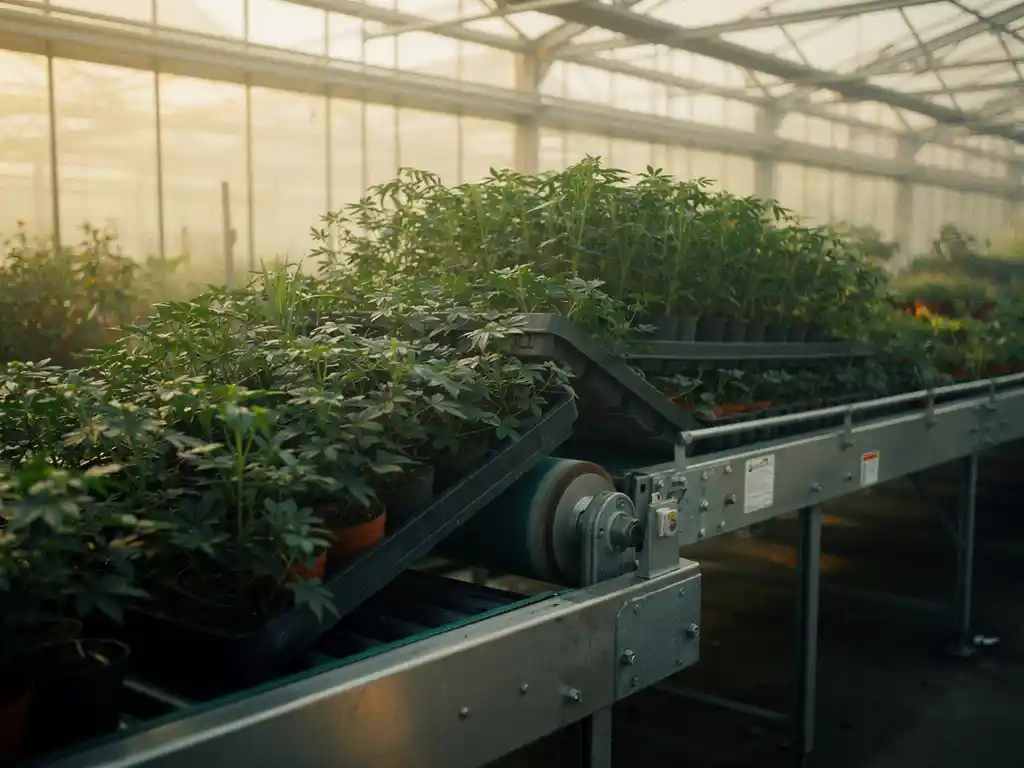
Mobile systems offer flexibility that fixed installations cannot match. In greenhouses where different crop types require different handling routes, or where seasonal peaks demand temporary capacity, a mobile belt can be repositioned quickly. We produce mobile solutions such as the EasyMax and Wevab specifically for horticultural environments, built from materials that withstand moisture, soil, and the demanding conditions of a working greenhouse. For businesses that are not yet ready to commit to a full installation, renting mobile equipment is a practical way to experience the benefits before making a larger investment.
How can conveyor belts eliminate bottlenecks in greenhouse production?
Conveyor belts eliminate bottlenecks in greenhouse production by creating a continuous, consistent flow of materials between workstations, removing the dependency on manual transport, and ensuring each stage of the line receives product at the right pace. When transport is automated, the line runs at a predictable rhythm that workers and machines can both align with.
The key benefit is that a conveyor belt does not get tired, does not take breaks, and does not vary its speed based on how busy a shift is. It creates a reliable baseline that the rest of the operation can be built around. Buffer belts add an additional layer of resilience: they absorb temporary speed differences between stages, preventing a short delay at one point from cascading into a full stoppage. When combined with potting machines, watering stations, and sorting lines, a well-designed conveyor system transforms a reactive production environment into a controlled, efficient one.
When should a greenhouse consider automating its internal transport?
A greenhouse should consider automating its internal transport when manual handling is visibly limiting throughput, when staff spend a significant portion of their shift moving materials rather than processing them, or when physical strain and absenteeism are becoming recurring operational problems. These are the clearest signals that the current system is holding the business back.
Growth is another strong trigger. When production volume increases, manual systems do not scale proportionally. Hiring more staff to carry more plants is expensive and creates new coordination challenges. Automation scales more predictably and delivers a consistent return. If you are expanding your facility, integrating new machinery, or entering new markets that demand higher output, internal transport automation should be part of that planning from the start.
For operations that are uncertain about the scope of investment required, starting with a rental arrangement is a low-threshold way to test the impact of automated transport on a live production line. We offer rentals as a practical entry point, allowing you to experience the operational difference before committing to a permanent installation. With more than three decades of experience designing transport solutions specifically for horticulture, we can help you identify exactly where your bottlenecks are and what it takes to resolve them.
Frequently Asked Questions
How do I calculate the right conveyor belt speed for my greenhouse production line?
Start by identifying the output rate of your slowest machine or workstation — this is your baseline throughput. Your conveyor speed should match or slightly exceed that rate to prevent product buildup without outpacing the receiving station. It's also worth building in a small buffer margin (typically 10–15%) to absorb natural variation in processing times. A specialist with greenhouse experience can help you map these speeds across your full line before specifying equipment.
What if my greenhouse layout is irregular or has tight corners — can conveyor systems still work?
Yes, modern horticultural conveyor systems are designed to accommodate challenging layouts, including tight corners, level changes, and narrow aisles. Mobile solutions like belt conveyors on wheels can be angled and repositioned to navigate non-linear routes, while fixed systems can be engineered with corner units and incline sections to suit your specific floor plan. The key is to have your layout assessed by a specialist before selecting a system, rather than trying to adapt a generic solution after the fact.
What's the best way to get started if I'm not sure which conveyor solution fits my operation?
The lowest-risk starting point is a rental arrangement, which allows you to introduce automated internal transport into a live production environment without committing to a permanent installation. This gives you real operational data — throughput improvements, labour savings, staff feedback — that makes the case for a full investment far clearer. From there, a site visit with an experienced horticultural transport specialist can help you identify the exact bottlenecks in your line and match the right fixed or mobile solution to your workflow.
How do greenhouse conveyor belts hold up against moisture, soil, and fertilisers?
Conveyor systems built specifically for horticulture use materials selected for resistance to the harsh greenhouse environment — including stainless steel frames, food-grade or moisture-resistant belt surfaces, and sealed components that can handle regular cleaning with water and mild disinfectants. Generic industrial conveyors not designed for this environment tend to corrode, clog, or degrade quickly under these conditions. Always confirm that any system you consider is rated for horticultural use before purchasing or renting.
Can a conveyor system integrate with my existing potting machine or sorting line?
In most cases, yes — conveyor systems can be configured to connect directly with potting machines, watering carousels, grading and sorting lines, and packaging stations. The critical factor is matching belt height, width, and speed to the infeed and outfeed specifications of your existing equipment. If you're integrating with machinery from multiple manufacturers, a specialist can design a transport layout that bridges those systems cleanly, often using buffer belts to absorb speed differences between stages.
What's a common mistake greenhouse operators make when trying to fix a bottleneck?
One of the most common mistakes is addressing the symptom rather than the root cause — for example, adding more staff to a manual transport step when the real problem is that the step shouldn't be manual at all. Another frequent error is upgrading a single machine (such as a faster potting machine) without considering whether the downstream stages can handle the increased output, which simply shifts the bottleneck rather than removing it. A whole-line assessment before making any changes will save significant time and cost.
How much disruption should I expect when installing a conveyor system in an active greenhouse?
Disruption depends heavily on whether you choose a fixed or mobile system. Mobile conveyor solutions can typically be introduced with minimal downtime, as they require no structural installation and can be operational within hours. Fixed installations require more planning and may involve a phased approach to avoid halting production entirely during setup. Experienced installers familiar with greenhouse environments will schedule work around your production calendar and can often complete key installation stages during off-peak periods or planned maintenance windows.
Related Articles
- How much capacity do you gain by switching to double-row production?
- How do soil mix properties affect potting machine performance?
- What is the real difference between a standard and PRO potting machine?
- What is the difference between a conveyor belt and a roller conveyor in horticulture?
- How do conveyor belts handle moisture and soil in horticulture?