

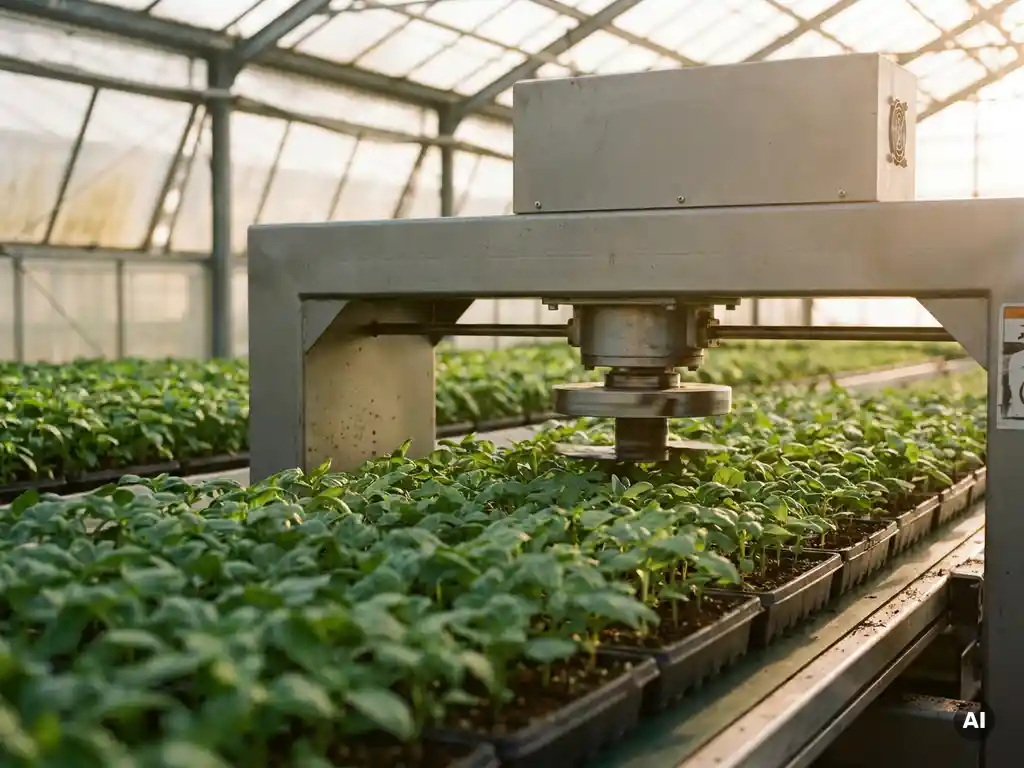
What determines the capacity of a topping machine?
The capacity of a potting machine is determined by a combination of mechanical speed, soil mix properties, pot size, and how well the surrounding line is set up to keep pace with the machine itself. Most professional potting machines are rated in pots per hour, but that number only holds under ideal conditions. In practice, growers regularly see output fall short of the rated figure because of factors that are entirely within their control. The sections below break down each of those factors so you can make informed decisions about your potting line.
What factors limit how many pots a machine can process per hour?
The main factors that limit potting machine capacity are soil mix flow rate, pot size and shape, the speed of upstream and downstream conveyors, operator handling time, and the mechanical ceiling of the machine’s filling and compaction system. No single factor works in isolation, a bottleneck anywhere in the line pulls the entire output down.
Think of a potting line as a chain. The machine itself may be capable of filling 6,000 pots per hour, but if pots are fed in manually, or if a conveyor downstream cannot carry filled pots away fast enough, the real-world number drops significantly. Common limiting factors include:
- Soil mix consistency — clumping or overly wet soil slows the filling mechanism
- Pot feeding speed — manual placement introduces pauses the machine cannot compensate for
- Conveyor throughput — a belt that is too slow creates a backlog at the exit point
- Operator fatigue — during long shifts, human handling speed naturally decreases
- Machine settings — incorrect bore depth or rotation speed for the pot type in use
Identifying which factor is the actual bottleneck in your operation is the first step toward increasing output without necessarily buying a new machine.
How does soil mix type affect potting machine speed?
Soil mix type directly affects how quickly and consistently a potting machine can fill each pot. Mixes that are too wet, too dry, or contain large fibrous particles do not flow freely through the machine’s filling system, which forces the mechanism to slow down or creates uneven fills that require manual correction.
The ideal mix for high-speed potting is uniform in particle size, has the right moisture content to hold its shape after compaction, and contains no oversized debris that can jam the auger or filling wheel. Peat-heavy mixes generally flow well, while mixes with a high proportion of bark, perlite, or coarse coir can cause irregular feeding. When the mix does not flow predictably, the machine compensates by running slower or produces pots with inconsistent soil density — both outcomes reduce effective capacity.
Growers who switch soil suppliers or change their mix recipe mid-season often notice an immediate drop in output. Recalibrating the machine’s fill rate and compaction settings for the new mix is essential before resuming full-speed production.
Does pot size change the output rate of a potting machine?
Yes, pot size directly changes the output rate of a potting machine. Larger pots require more soil per fill cycle, which takes more time to dispense and compact. Smaller pots cycle faster but may require more precise positioning to avoid spillage. As a result, a machine rated at 8,000 pots per hour at 9 cm will produce fewer pots per hour when running 17 cm containers.
The relationship is not purely linear. A machine switching from a 9 cm pot to a 13 cm pot may lose 20 to 30 percent of its headline capacity, while moving to a 25 cm pot could cut output by half or more. Pot shape also matters: tall, narrow pots require a different bore depth setting than wide, shallow ones, and the time taken to adjust and stabilize the machine after a changeover reduces effective daily output.
Machines that allow pre-programmed settings for different pot sizes — where the operator selects a profile from a touchscreen rather than manually adjusting each parameter — significantly reduce changeover time and help maintain consistent output across product lines.
What’s the difference between rated capacity and real-world output?
Rated capacity is the maximum number of pots a machine can process per hour under optimal, controlled conditions. Real-world output is the actual number of filled pots that leave the line during a working shift. The gap between the two is almost always present, and in many operations it ranges from 15 to 40 percent below the rated figure.
Rated capacity is measured with a consistent soil mix, a fixed pot size, a fully staffed and well-practised team, and no interruptions. Real-world production introduces variables that the rated figure does not account for:
- Soil refill pauses when the hopper runs low
- Pot supply interruptions or jams on the infeed
- Brief stoppages for quality checks or adjustments
- Operator breaks and shift changeovers
- Minor mechanical adjustments during the run
When planning production capacity for a peak season, it is more realistic to base calculations on 70 to 80 percent of the rated figure rather than the full headline number. This buffer accounts for the inevitable friction of a live production environment and prevents scheduling targets that are impossible to meet.
How does automation level influence potting line capacity?
The level of automation in a potting line has a direct and compounding effect on capacity. A standalone potting machine with manual pot feeding and manual removal of filled pots will always run well below its mechanical ceiling. Adding automated infeed, integrated conveyor systems, and automatic soil detection removes the human-speed constraint and allows the machine to run consistently at or near its rated output.
Each automation step added to the line contributes to higher throughput:
- Automated pot feeding eliminates the gap between human placement cycles and machine cycle time
- Automatic soil detection ensures each pot receives the correct fill without manual monitoring
- Integrated conveyors remove filled pots immediately, preventing backlog at the machine exit
- Programmable settings reduce changeover time when switching between pot sizes or soil types
- Tray fillers and sorting lines extend automation beyond the potting step, keeping the whole process moving
Higher automation also reduces the impact of operator fatigue over long shifts. A fully automated potting line maintains the same pace at hour eight as it does at hour one, which is rarely true of a manually supported setup.
When should a grower upgrade to a higher-capacity potting machine?
A grower should consider upgrading to a higher-capacity potting machine when the current machine is consistently running at its ceiling during peak periods, when output targets require more pots per hour than the existing setup can reliably deliver, or when recurring mechanical issues are causing production losses that exceed the cost of a new investment.
Specific signals that an upgrade is warranted include:
- The machine runs at full speed but still cannot meet daily targets during peak season
- Older machines require frequent maintenance stops that disrupt production flow
- The soil mix or pot range has changed and the current machine struggles to handle it
- Labour costs for manual support are increasing while output stays flat
- A new product line requires pot sizes or volumes outside the current machine’s range
Upgrading is not always the first answer. Before committing to a higher-capacity machine, it is worth auditing the full line to confirm that the machine itself is the bottleneck and not a conveyor, soil supply, or staffing issue. If the machine is genuinely the limiting factor, then a higher-capacity model, or a more automated configuration of the existing model, is a sound investment that pays back quickly during high-volume seasons.
How MartinStolze helps you maximize potting line capacity
We design and build our potting machines entirely in-house, which means every component is engineered to work together as a system rather than as a collection of separate parts. Our flagship Stolze 3030 and the more advanced Stolze 3030 PRO are built specifically for professional growers who need reliable, high-volume output, with capacities up to 8,000 pots per hour and support for pot sizes from 7 to 30 cm.
Here is what sets our approach apart:
- Automatic soil detection (Stolze 3030 PRO) ensures consistent fill density regardless of mix variation
- Touchscreen programming allows pre-set profiles for different pot sizes, bore depths, and rotation speeds — reducing changeover time to minutes
- Full line integration with our own conveyors, tray fillers, and sorting lines so the entire production process runs at the same pace
- In-house production and installation by our own engineers, with training at our demo facility in De Lier
- Flexible investment options — both purchase and rental are available, including a trial period for growers who want to evaluate before committing
Whether you are configuring a new potting line or looking to get more out of your current setup, we are happy to think through the right solution with you. Get in touch with our team and we will help you find the configuration that matches your crop, your soil mix, and your production targets.
Frequently Asked Questions
How do I calculate the right potting machine capacity for my operation?
Start by calculating your peak daily pot target and divide it by your available production hours, then add a 20–30% buffer to account for the gap between rated and real-world output. For example, if you need 40,000 pots in an 8-hour shift, you need a machine capable of at least 6,250 pots per hour under ideal conditions — meaning a rated capacity of around 7,500–8,000 pots per hour is a safer target. Factor in your pot size range and soil mix type, as both will influence which machine model and configuration actually fits your workflow.
What is the best way to reduce downtime during a pot size changeover?
The most effective way to reduce changeover downtime is to use a machine with pre-programmable settings, where each pot size profile — including bore depth, rotation speed, and compaction — is stored and recalled from a touchscreen rather than adjusted manually. Manual changeovers on older machines can take 30 minutes or more and require recalibration runs to confirm fill consistency, while profile-based systems can reduce that to just a few minutes. Keeping a changeover log that records the exact settings for each pot size and soil mix also helps operators switch reliably without trial and error.
Can I improve my potting line output without buying a new machine?
Yes — in many cases, the machine itself is not the bottleneck. Auditing your infeed and outfeed conveyors, improving soil mix consistency, and adding automated pot feeding can significantly increase throughput without replacing the potting machine. Reducing manual handling steps, scheduling soil hopper refills proactively to avoid pauses, and training operators on optimal machine settings for each pot type are all low-cost interventions that can close a meaningful portion of the gap between rated and real-world output.
What moisture level should my soil mix be at for optimal machine performance?
The ideal moisture level for potting machine performance is often described as the ‘squeeze test’ standard: the mix should hold its shape when compressed in your hand but not release water or crumble apart when released. Mixes that are too wet cause the filling mechanism to clog or produce overfilled pots, while overly dry mixes flow unevenly and result in pots with inconsistent density. If you change soil suppliers or adjust your recipe, always run a short calibration cycle at reduced speed before resuming full production to confirm the new mix behaves as expected.
How does operator fatigue actually affect potting line output over a long shift?
On a manually supported potting line, operator fatigue typically becomes measurable after the third or fourth hour of a shift, with handling speed and consistency gradually declining as the shift progresses. This shows up as slightly longer placement cycles, more frequent misfeeds, and a higher rate of quality check interruptions — all of which compound to reduce effective hourly output. Automated pot feeding and conveyor systems eliminate this variable entirely, maintaining the same machine pace at hour eight as at hour one, which is one of the strongest practical arguments for investing in line automation.
Is it worth renting a potting machine before committing to a purchase?
Renting before purchasing is a practical option for growers who are scaling up for the first time, switching to a new machine model, or unsure whether their soil mix and pot range are compatible with a specific configuration. A trial period allows you to measure real-world output under your own production conditions rather than relying solely on rated capacity figures. It also gives your operators time to build familiarity with the machine before a full production season begins, reducing the learning curve during your busiest period.
What should I check first if my potting machine's output suddenly drops mid-production?
The first things to check are soil mix condition in the hopper, pot infeed consistency, and whether any conveyor downstream has slowed or backed up — these three factors account for the majority of sudden mid-run output drops. If the soil has become wetter or drier than the calibrated setting (common when a new batch is added to the hopper), the fill rate will become inconsistent and the machine may slow automatically or require manual correction. If the soil and conveyors check out, inspect the auger or filling wheel for debris or buildup, and verify that the machine’s bore depth and rotation settings have not been accidentally altered.