

What greenhouse efficiency really means for a potted plant nursery
Ask ten growers what greenhouse efficiency means and you will probably get ten answers: energy use, water, yield per square meter, climate control. All of those matter. But for a potted plant nursery, the biggest efficiency gap often sits somewhere less glamorous: in the hours people spend moving plants from one place to another.
Real greenhouse efficiency is about how well every input, including labor, turns into sellable plants. In an industry where wages keep rising and good people are hard to find, that last input deserves far more attention than it usually gets.
Where Labor Hours Disappear in Potted Plant Production
Most labor hours in a potted plant nursery disappear into handling, not growing. Carrying trays, pushing trolleys, loading and unloading, and repositioning pots between stations add up to a surprising share of the working day.
The problem is that this work rarely shows up as a line item. It hides inside “general production” hours, so it feels like a normal cost of doing business. Yet every step where a person walks a plant from A to B is a step that adds no value to the plant itself.
It also takes a physical toll. Repetitive lifting and carrying lead to sick leave and high staff turnover, and seasonal peaks force nurseries to bring in expensive temporary workers who need training every time. Hours lost to handling are therefore only part of the cost. Absenteeism, recruitment, and onboarding sit on top.
The Numbers That Define Real Efficiency
The most useful efficiency numbers are the ones that connect labor to output: plants handled per person per hour, labor hours per thousand pots, and the share of working time spent on transport versus actual plant work. These figures tell you far more than total headcount ever will.
Start by measuring your own baseline. Follow one product, from potting to dispatch, and note how many times it is touched and by whom. Many growers are surprised to find how often a single pot changes hands before it leaves the nursery.
A few other indicators are worth tracking alongside those:
- Peak versus average staffing: how much extra labor you need during busy weeks
- Absenteeism and turnover: especially in physically demanding roles
- Vacancy duration: how long open positions stay unfilled
- Cost per finished plant: the number that ultimately shapes your margin
Once these numbers are visible, patterns emerge quickly. Transport and handling almost always stand out as the place where improvement is easiest to capture.
Why Smooth Internal Transport Changes Everything
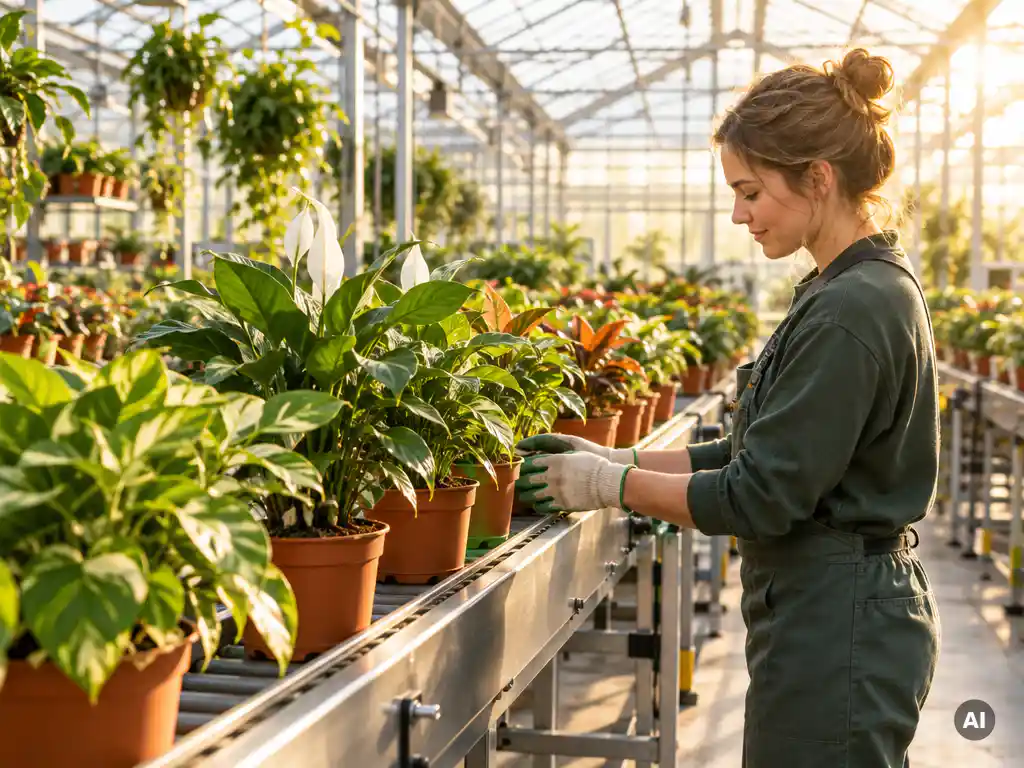
Smooth internal transport turns a chain of manual handovers into one continuous flow. When plants move on conveyors, buffer tables, and roller tracks instead of in people’s hands, the same output needs far fewer people and fewer steps.
The effect goes beyond labor savings. A steady flow means workstations are no longer waiting for product, and nobody is stuck waiting on a trolley. Planting, watering, weighing, and sorting can be linked into one line, so the pace is set by the process rather than by how fast people can walk.
Ergonomics improves too. When plants arrive at a comfortable working height, employees do less lifting and bending. That helps lower sick leave and makes the work more attractive, which matters when you are competing for staff in a tight labor market.
Components can also be combined to fit the process. Conveyor belts can be extended with work tables, scales, and lighting, so the line does more than just move plants. It becomes a place where value is added along the way.
Starting Small With Mobile Conveyors
You do not need to rebuild your nursery to begin automating. A mobile conveyor is a low-threshold way to start: it can be placed where the handling bottleneck is worst, used during a peak period, and moved again when needs change.
This step-by-step approach lowers the risk considerably. Instead of committing to a large fixed installation on a hunch, you see for yourself how much time a single conveyor saves on your own work floor. At our company, many growers begin by renting equipment for a busy season, and the results usually make the next step an easy decision.
From there, growth tends to follow a natural path. A mobile belt proves its value, a second one follows, and eventually fixed systems become the backbone of the production process. Each step builds on the last, so nothing is wasted, and the investment grows at the same pace as your confidence.
From 26 to 6 FTE: What Is Possible
When internal transport is automated thoroughly, the effect on staffing can be dramatic. One of our customers went from 26 to 6 FTE for the same output, a reminder of how much of a nursery’s workforce can be tied up in moving plants rather than growing them.
Results like this are not magic, and they do not happen overnight. They come from looking at the whole process, removing manual handling step by step, and linking machines such as conveyors, potting machines, and watering stations into one coherent line. Every nursery is different, so the outcome depends on layout, crop, and volume.
What stays constant is the direction: fewer people needed, higher output per person, and a business that is less exposed to labor shortages and wage increases. Greenhouse efficiency in 2026 is as much about smart logistics as it is about climate and yield. If you want to see where your own nursery could gain the most, get in touch with us and we will gladly think along with you.
Frequently Asked Questions
How do I measure how much labor my nursery spends on internal transport?
Pick one product and follow it from potting to dispatch, noting every touchpoint, who handles it, and how long each move takes. Alternatively, have a few employees log their time in categories such as transport, plant work, and waiting for a week. Divide the transport hours by the number of pots produced to get a baseline of handling hours per thousand pots, which you can compare after any change.
Where should I place my first mobile conveyor for the biggest impact?
Place it at the point where people spend the most time walking or carrying plants, which is often between potting and the growing area or at the dispatch and loading stage. Your baseline measurement will show where the bottleneck is. Start with one location, track the time saved for a few weeks, and then decide whether to expand.
Is renting conveyor equipment a good way to test automation before buying?
Yes, renting is a low-risk way to prove the concept, especially for a busy season when you would otherwise need extra temporary staff. You can compare labor hours and output per person with and without the conveyor on your own work floor. If the results are good, you can add more equipment or move to fixed systems at your own pace.
What if my nursery layout is cramped or constantly changing?
Mobile conveyors and modular components are designed for exactly this situation, as they can be repositioned when crops, seasons, or layouts change. Map your plant flow first and look for straight, repeatable routes where a belt can replace manual carrying. A supplier can often suggest a configuration that fits tight spaces without a major rebuild.
Will automating transport mean I have to lay off staff?
Not necessarily. In many nurseries the main benefit is covering seasonal peaks without hiring and training temporary workers, and filling positions that stay vacant for months. Existing employees can shift from carrying and pushing trolleys to plant care, quality control, and operating the line, which is more attractive and less physically demanding.
What are common mistakes when starting to automate internal transport?
The most common mistake is buying equipment without first measuring where time is actually lost. Another is automating a single step in isolation, which can simply move the bottleneck to the next station. Look at the whole process, and plan so that conveyors, potting machines, watering stations, and scales can be linked into one line later on.
Can the 26 to 6 FTE result be achieved in any nursery?
Results depend on your layout, crop, volume, and how much manual handling there currently is, so the exact outcome will differ for every nursery. The example shows what is possible when the whole process is automated step by step. A good starting point is a process scan or conversation with a supplier to estimate realistic savings for your situation.