

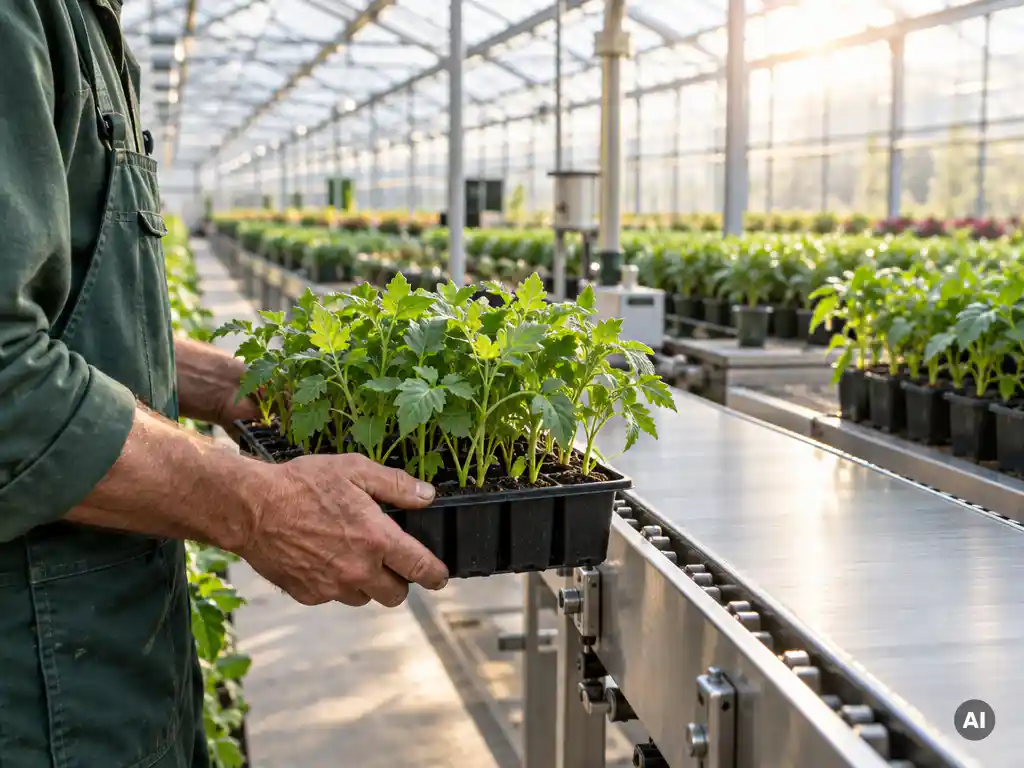
What growers should know about greenhouse efficiency before automating
Every grower wants better greenhouse efficiency, but the first move is rarely a purchase. Many nurseries and horticultural businesses jump straight to machines because labor is scarce and wages keep climbing, only to find that the real bottlenecks sit somewhere else entirely. Automation pays off fastest when it rests on a clear picture of how work flows through the greenhouse today.
This guide walks through what to understand before investing in automation: where hours slip away, how to measure them, why layout matters, and how to start small without taking big risks. The goal is simple. Automate the right things, in the right order, and get the most out of every euro and every hour.
Where Labor Hours Quietly Disappear in Your Greenhouse
Most lost labor hours hide in repetitive internal transport, waiting time, and handling that feels like part of the job but adds no value to the plant.
Walk through a typical day and the pattern shows up quickly. Trays and pots get carried from the potting area to the greenhouse, moved again to a buffer spot, shifted once more for watering, and finally staged for shipping. Each move takes only a minute or two, yet across hundreds of trolleys and thousands of pots, those minutes add up to a large share of the workday.
Other hidden drains include people waiting for the previous step to finish, searching for trolleys or tools, and correcting small mistakes caused by rushed handling. Physically heavy tasks also carry an indirect cost. They drive absenteeism and staff turnover, which means constant training and unfilled shifts. Improving greenhouse efficiency starts with seeing these quiet losses for what they are.
Measuring Your Baseline Before Buying Anything
A baseline is a simple record of how many people, hours, and movements it takes to produce one unit of output today, and without it no automation investment can be judged fairly.
The measurement does not need to be complicated. Pick one or two core processes, such as potting and moving trays to the growing area, and track them for a representative period. Note how many people work on the process, how many hours they spend, how many pots or trays get handled, and how often the line stalls. A stopwatch, a notebook, or a basic spreadsheet is enough to start.
Include the peak season in your numbers, because that is where temporary staff costs and overtime show up. Once you know your cost per tray or per thousand pots, you can compare any proposed solution against a real figure instead of a gut feeling. This also makes it far easier to calculate payback time later.
Fixing Workflow and Layout First
Improving the route that plants and materials take through the greenhouse often delivers savings before a single machine arrives, and it makes every later automation step work better.
Look at how materials physically travel. Are there unnecessary turns, narrow passages, or crossing paths between full and empty trolleys? Is the buffer space too far from the potting line? Even small changes, like shortening distances or creating a clear one-way flow, can cut handling time noticeably. Automating a poor layout only makes a bad process run faster.
It also helps to standardize where possible. Consistent trolley sizes, tray formats, and pallet patterns make it much easier to connect equipment later, whether that means conveyor belts, roller tracks, or buffer tables. Think of this stage as preparing the ground. A tidy, logical flow gives automation something solid to build on.
Choosing Which Process to Automate First
The best first candidate is usually the process with the highest labor hours, the most repetition, and the physically heaviest work, since that is where savings and ergonomic gains stack up together.
Use your baseline data to rank processes. Internal transport is a common winner in horticulture because it is repetitive, time-consuming, and easy to measure. Potting, watering, and buffering follow close behind. Ask three questions about each candidate: how many hours does it take, how much does it vary with the season, and how hard is it to staff?
Resist the urge to automate everything at once. A focused first project is easier to implement, easier to evaluate, and builds confidence within the team. Employees also tend to accept change more readily when they see it removing the heaviest part of their day rather than threatening their role. Once the first process runs smoothly, the next step becomes much clearer.
Starting Small With Mobile and Rental Solutions
Mobile equipment and rental options let growers test automation in real conditions before committing to a fixed installation, which lowers risk and speeds up learning.
A flexible, mobile conveyor is a good example. It can be placed where the work happens, moved when the season changes, and expanded as needs grow. At MartinStolze, we see many growers begin this way, often renting equipment during a peak period and then building toward a more permanent setup step by step. Our range of conveyor belts is designed to be combined, so early choices do not become dead ends later.
Renting also answers questions that no brochure can. How does the team handle the new flow? Where does the next bottleneck appear? What does the real time saving look like? Those answers shape a smarter long-term investment, and growers who want to talk through a sensible starting point can always get in touch with us for advice.
Common Pitfalls That Slow Down Return on Investment
Most disappointing automation projects share the same causes: unclear goals, skipped preparation, and equipment that does not fit the way the business actually works.
One frequent mistake is buying for the busiest week of the year instead of the average one, which leaves expensive capacity idle. Another is moving the bottleneck without realizing it. If potting speeds up but watering and buffering stay manual, the pile of finished trays simply grows somewhere else. Planning the whole chain, even if you implement it in stages, prevents this.
Other pitfalls include juggling several suppliers with systems that do not connect, neglecting staff involvement, and failing to track results after installation. Review your baseline numbers a few months in and compare. Greenhouse efficiency is not a one-time project but an ongoing habit, and the growers who keep measuring, adjusting, and expanding in small steps tend to be the ones who stay ahead as labor costs keep rising through 2026 and beyond.
Frequently Asked Questions
How long should I track my baseline before deciding on automation?
Aim for at least two to four weeks of representative activity for each core process, and if possible include a few days from your peak season. If you cannot wait for peak, review last year’s payroll, temporary staff hours, and overtime records to estimate the seasonal peak. The goal is a reliable cost per tray or per thousand pots, not a perfect dataset.
How do I calculate the payback time of an automation investment?
Divide the total investment (equipment, installation, and any layout changes) by the yearly savings you expect, based on your baseline. Yearly savings are the labor hours saved multiplied by your fully loaded hourly cost, plus reduced overtime, temporary staff, and absenteeism. Be conservative with the time savings, and recalculate after a few months of real use to confirm the figure.
What is the easiest way to get started if I have a small team and a limited budget?
Pick one repetitive process, usually internal transport between potting and the growing area, and measure it for a couple of weeks. Then test a mobile or rented solution, such as a flexible conveyor belt, during a busy period. This gives you real data on time savings with little financial risk, and you can expand step by step if it proves its value.
How do I get my employees on board with automation?
Involve them early by asking which tasks are the heaviest, most repetitive, or most frustrating, and start by automating those. Explain that the goal is to remove strenuous work and fill gaps in staffing, not to replace people. Let the team test the equipment during a trial or rental phase and collect their feedback before making a permanent decision.
What if I automate one process and a new bottleneck appears elsewhere?
This is normal and actually useful information. Map the whole chain, from potting to shipping, before you start, so you can anticipate where the next constraint will show up, such as watering or buffering. After the first installation, re-measure your flow and use the new data to decide which step to improve next.
How do I size equipment so I am not paying for capacity I rarely use?
Base your decision on average weekly volumes rather than your single busiest week. For the occasional peak, consider renting extra capacity or using modular, mobile equipment that you can add to temporarily. This keeps your fixed investment aligned with everyday needs while still handling seasonal spikes.
What layout and standardization changes can I make right now without spending much?
Start by creating a clear one-way flow, separating full and empty trolley routes, and moving buffer space closer to the potting line. Standardize trolley sizes, tray formats, and pallet patterns where you can, since this makes future conveyor or roller track connections far simpler. These changes cost little but often reduce handling time right away.