

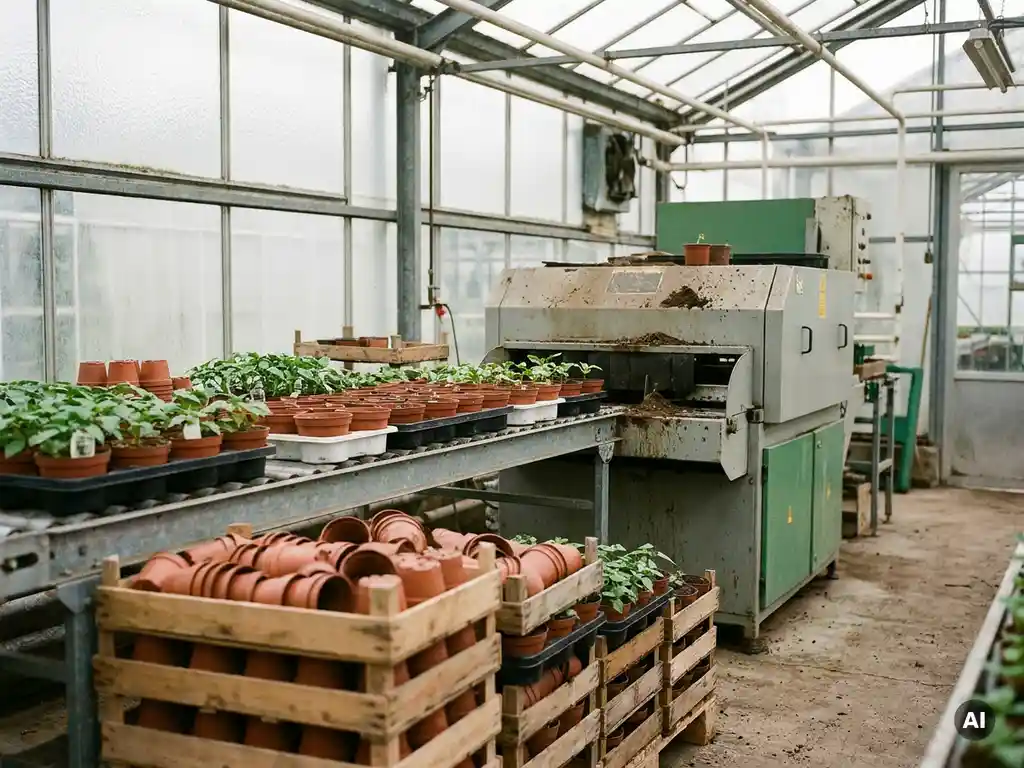
What happens when a topping machine becomes the bottleneck in your production line?
A potting machine becomes the bottleneck in your production line when it can no longer fill pots at the speed the rest of your line demands. The result is a queue of empty pots on one side and idle staff or stalled conveyors on the other. Recognising the warning signs early and understanding what drives them is what separates a minor slowdown from a costly season-ending disruption. The questions below walk through exactly that.
What are the signs that a potting machine is slowing down your line?
The clearest sign that a potting machine is slowing your line is a visible build-up of unprocessed pots upstream while downstream equipment sits idle or runs empty. Other reliable indicators include inconsistent fill levels between pots, frequent manual interventions to clear jams, and a noticeable drop in pots-per-hour output compared to the machine’s rated capacity.
In practice, these signs often appear gradually rather than all at once. A machine that once kept pace with your conveyor system starts lagging by a few hundred pots per hour. Staff begin compensating by hand, which masks the problem until the backlog becomes impossible to ignore. Watch for these specific warning signals:
- Uneven soil density from pot to pot, causing quality rejections at sorting
- Repeated stoppages to clear soil blockages or mechanical faults
- Staff repositioning themselves around the machine rather than working at their designated stations
- Output that consistently falls short of your daily target by the end of a shift
- Increased noise or vibration during operation, suggesting worn components
Any one of these on its own warrants attention. Several appearing together is a strong signal that the machine is no longer performing at the level your operation requires.
What causes a potting machine to fall behind during peak season?
During peak season, a potting machine falls behind primarily because demand exceeds the machine’s sustainable throughput. Extended run hours accelerate wear on mechanical components, soil mixes become heavier or wetter under pressure, and maintenance that was deferred during quieter months catches up all at once. The combination creates failures at the worst possible moment.
Several specific factors compound the problem during high-pressure periods:
- Soil mix variability: Wetter or coarser mixes put more strain on augers and filling mechanisms, slowing cycle times and increasing jam frequency.
- Continuous operation fatigue: Machines running double shifts without adequate maintenance intervals experience accelerated wear on chains, bearings, and drive systems.
- Operator unfamiliarity: During peak periods, additional or temporary staff may not be trained to adjust settings for different pot sizes or soil types, leading to suboptimal configurations.
- Deferred servicing: Small issues ignored in quieter months, such as a slightly misaligned chain or a worn seal, become full failures under sustained load.
The machines most vulnerable during peaks are older models without automated soil detection, since they rely on manual adjustment to maintain consistent fill levels as conditions change throughout the day.
How does a slow potting machine affect the rest of the production line?
A slow potting machine creates a cascade effect across the entire production line. Every process that depends on a steady flow of filled pots, including transport, spacing, watering, and sorting, is forced to match the machine’s reduced pace. The result is idle equipment, underutilised staff, and a throughput ceiling set by the weakest point in the chain.
The downstream impact is often more costly than the machine problem itself. Conveyors run at reduced speed or stop-start repeatedly, which increases mechanical wear on those systems too. Staff at watering stations and spacing tables stand waiting, which inflates labour costs per pot produced. When the auction clock is running, every hour of reduced output translates directly into missed revenue or delayed deliveries.
Upstream, the effect is equally disruptive. Soil supply systems and tray feeders may continue running at full speed, creating overflow or requiring manual intervention to prevent waste. In a tightly integrated line, a potting machine running at 60% capacity does not save 40% of its operating cost. It costs the entire line 40% of its potential output.
What’s the difference between a standard and an automated potting machine?
A standard potting machine fills pots mechanically at a fixed rate, requiring manual adjustment when pot sizes, soil types, or fill depths change. An automated potting machine adds intelligent controls, such as automatic soil detection, programmable settings for different configurations, and self-regulating mechanisms that maintain consistent output without constant operator intervention.
The practical difference becomes most apparent in three areas:
Consistency of fill
A standard machine relies on a fixed mechanical setup. If soil moisture or density changes during a shift, fill levels drift and operators must intervene. An automated machine with soil detection adjusts in real time, maintaining uniform density across every pot regardless of how the mix behaves.
Setup time between runs
Switching pot sizes or borehole depths on a standard machine means manual recalibration, which takes time and introduces human error. On an automated machine with a touchscreen interface, operators select a pre-programmed profile and the machine reconfigures itself. This matters enormously when running multiple pot sizes in a single day.
Noise levels, maintenance intervals, and chain guidance systems also differ significantly between entry-level and advanced models. A fully guided chain, for example, reduces lateral movement and extends the service life of mechanical components, which lowers the total cost of ownership over time.
When should a grower replace a potting machine instead of repairing it?
A grower should replace a potting machine rather than repair it when repair costs consistently exceed 30% of the machine’s replacement value per year, when the machine can no longer meet current production volumes, or when repeated failures are causing disruptions during peak periods that repairs cannot reliably prevent.
Age alone is not the deciding factor, but it is a useful lens. An older machine that still meets your throughput requirements and runs reliably may be worth maintaining. The replacement decision becomes clear when one or more of the following conditions apply:
- Spare parts are no longer readily available or have become disproportionately expensive
- The machine cannot handle your current soil mixes without frequent stoppages
- Your production volumes have grown beyond what the machine was designed for
- Downtime during peak season has already cost more than a new machine would
- The machine lacks the automation features needed to reduce labour dependency
For growers who are uncertain, a trial period with a hire machine offers a low-risk way to evaluate whether a newer model genuinely improves output before committing to a purchase.
How we help when your potting machine becomes a bottleneck
At MartinStolze, we have been solving exactly this kind of production challenge since 1991. Our Stolze 3030 and Stolze 3030 PRO potting machines are designed and built in-house to handle demanding growing environments without becoming the weak link in your line. Here is what sets our approach apart:
- Capacity up to 8,000 pots per hour, suitable for both single and double-row operation
- Automatic soil detection on the 3030 PRO ensures consistent fill density regardless of soil mix variation
- Touchscreen programming for pot size, bore depth, soil feed, and rotation speed, so switching configurations takes seconds rather than minutes
- Seamless integration with our own conveyor systems and sorting lines for a complete, coordinated production line
- Buy or hire options, including a trial period, so you can evaluate performance in your own operation before committing
- Full support from our own technicians, from installation and training to ongoing maintenance
If your current machine is slowing down your line or you want to know which configuration fits your specific crop and soil mix, get in touch with our team. We are happy to think through the right solution with you.
Frequently Asked Questions
How often should a potting machine be serviced to prevent it from becoming a bottleneck?
For machines running standard single-shift operations, a full service every 500–600 operating hours is a reasonable baseline, with visual inspections of chains, bearings, and seals conducted weekly. During peak season, when run hours increase significantly, shorten that interval and add daily checks for wear on high-stress components like augers and drive systems. Keeping a simple maintenance log makes it easy to spot patterns — if the same part keeps failing, that is a signal worth acting on before the next peak period begins.
What soil mix properties are most likely to cause problems in a potting machine?
Mixes that are excessively wet, compacted, or contain large fibrous chunks are the most common culprits behind jams and inconsistent fill levels. Wet soil increases resistance on augers and filling mechanisms, slowing cycle times and causing material to clump rather than flow freely. If you are regularly working with variable or difficult mixes, an automated machine with soil detection will adapt in real time, whereas a standard machine will require frequent manual recalibration to compensate.
Can a potting machine be integrated into an existing production line, or does the whole line need to be replaced?
In most cases, a new potting machine can be integrated into an existing line without replacing every component, provided the conveyor speeds, pot spacing, and tray feed systems are compatible. The key is to assess the throughput capacity of your current line before selecting a machine — a high-capacity potting machine paired with a slower conveyor system will simply move the bottleneck rather than eliminate it. Working with a supplier who also manufactures conveyor and sorting systems, like MartinStolze, makes it easier to identify and resolve compatibility issues before installation.
What is a realistic payback period when upgrading to a higher-capacity or automated potting machine?
Payback periods vary depending on production volume, labour costs, and how much downtime the current machine is causing, but many growers see a return within two to three growing seasons. The calculation should include not just the machine cost but the labour savings from reduced manual intervention, the revenue recovered from higher throughput during peak periods, and the reduction in quality rejections caused by inconsistent fill. If your current machine is already costing you significant downtime or daily labour overheads, the payback period is often shorter than expected.
How do I know which potting machine capacity is right for my operation?
Start by calculating your required pots-per-hour output based on your peak daily target divided by the number of productive hours in a shift — then add a buffer of at least 15–20% to account for stoppages, changeovers, and soil variability. Avoid selecting a machine that only just meets your current peak demand, as production volumes tend to grow and a machine running consistently at its ceiling will wear faster and leave no room for expansion. If you run multiple pot sizes or soil types in a single day, also factor in how quickly the machine can be reconfigured between runs.
Is hiring a potting machine a practical option during peak season, or is it only useful for evaluating a purchase?
Hiring is a genuinely practical short-term solution for growers who face a seasonal spike in demand that their current machine cannot handle, without committing to a full purchase. It is also useful as a bridge when a machine has failed unexpectedly and a replacement needs to be sourced. That said, if you find yourself hiring every peak season, the cumulative hire costs will often exceed the investment in a permanent upgrade — making a trial hire a logical first step toward a purchase decision rather than an ongoing strategy.
What should I ask a supplier before buying a potting machine to avoid making the wrong choice?
Ask specifically about throughput under realistic conditions — not just the rated maximum — and whether that figure applies to your pot sizes and soil types. Find out how long setup and changeover takes between different configurations, what the typical maintenance interval is, and how quickly spare parts can be sourced if something fails during peak season. It is also worth asking whether the supplier offers installation support and operator training, since even a well-specified machine will underperform if the team running it is not fully familiar with its settings and adjustment points.
Related Articles
- How do you compare two potting machines with different hourly capacities?
- Can fewer operators maintain the same pots-per-hour output with automation?
- How do soil mix properties affect potting machine performance?
- What is the real difference between a standard and PRO potting machine?
- How do you scale up internal transport as a nursery grows?