
What happens when your potting machine capacity exceeds the rest of your line?
When your potting machine’s output in pots per hour exceeds what the rest of your line can handle, the result is a bottleneck downstream: plants pile up, quality drops, and your team scrambles to compensate manually. This mismatch is one of the most common efficiency killers in professional potting operations, and it typically shows up not at the machine itself, but several steps further along the line. The questions below unpack exactly what to look for, why it happens, and how to fix it.
What signs indicate a bottleneck downstream from your potting machine?
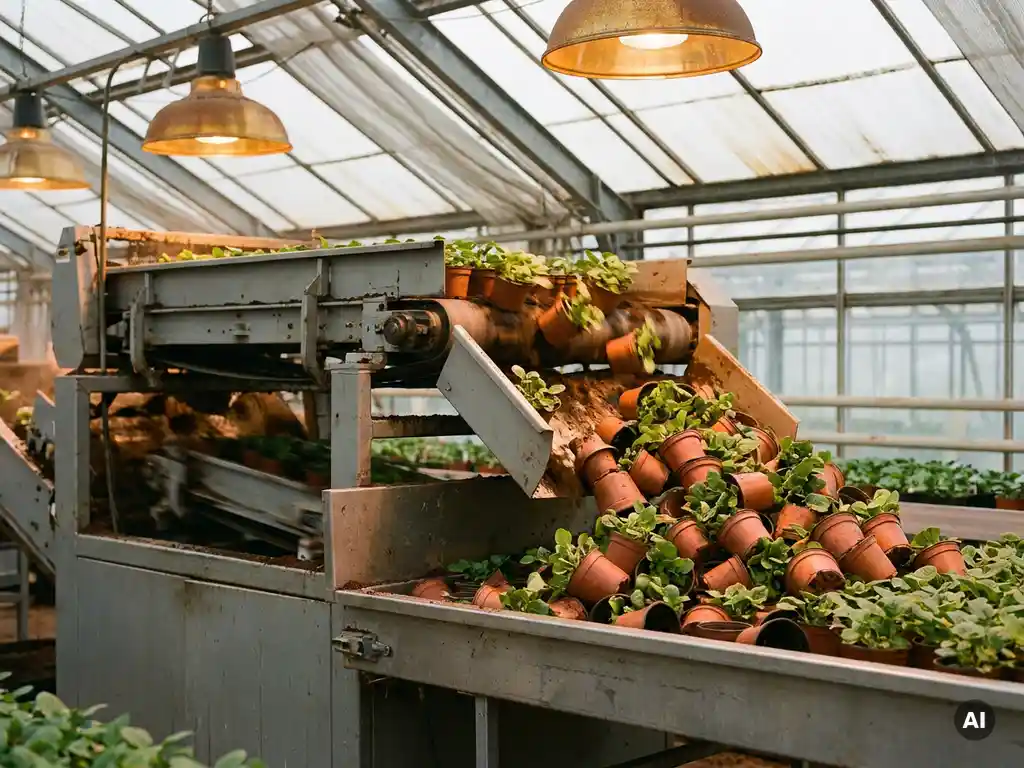
A downstream bottleneck shows up as a visible backlog of filled pots accumulating immediately after the potting machine, while workers further along the line struggle to keep pace. Other clear signs include pots tipping over on conveyors, plants waiting too long before being moved to the greenhouse, and staff having to manually intervene to manage overflow.
Watch for these specific indicators:
- Pots stacking up or jamming at transfer points between conveyor sections
- Workers repositioning or catching pots by hand to prevent falls
- Uneven spacing of pots arriving at labelling, watering, or sorting stations
- Frequent pauses in the potting machine to let the rest of the line catch up
- Increased error rates at downstream stations due to rushed handling
These signs are easy to miss when your team adapts to them over time. If manual intervention has become a normal part of your daily routine, that is a strong signal that your line layout is no longer matched to your machine’s capacity.
How does a capacity mismatch affect plant quality and output?
A capacity mismatch between your potting machine’s pots per hour rate and the speed of downstream equipment directly reduces plant quality and total output. Pots that sit too long before reaching a watering station dry out unevenly, and plants handled under time pressure are more likely to be damaged or incorrectly positioned in their trays.
Beyond individual plant quality, the wider production impact includes:
- Inconsistent pot density: When the line is rushed or paused repeatedly, filling pressure and soil distribution become irregular across batches
- Reduced throughput: Even a high-capacity potting machine running at 8,000 pots per hour delivers little value if downstream stations force it to run at half speed
- Higher labour costs: Bottlenecks pull workers away from their assigned stations to manage overflow, which defeats the purpose of automation
- Auction deadline risk: During peak season, any slowdown in the line directly threatens your delivery schedule to the auction or distribution centre
What are the most common causes of potting line imbalance?
The most common cause of potting line imbalance is upgrading the potting machine without reassessing the capacity of every other component in the line. When a grower moves from an older machine to a modern unit capable of significantly higher pots per hour output, conveyors, buffer tables, and sorting equipment that were adequate before suddenly become the limiting factor.
Other frequent causes include:
- Mismatched conveyor speeds: Conveyor belt sections running at fixed speeds that were calibrated for an older, slower machine
- Insufficient buffer capacity: No buffer table between the potting machine and the next station, leaving no margin when downstream speed drops temporarily
- Manual steps in an otherwise automated line: A single manual sorting or labelling step creates a human-speed ceiling regardless of machine output
- Seasonal volume spikes: Lines that run fine at average volumes hit their limits during peak weeks when you push the machine harder
- Soil mix issues: Difficult or heavy soil mixes can slow filling cycles inconsistently, creating irregular output timing that downstream equipment cannot absorb
Should you slow down your potting machine or upgrade the rest of the line?
Slowing down your potting machine to match a slower downstream line is rarely the right answer. It protects short-term flow at the cost of long-term efficiency and return on investment. If you have invested in a high-capacity potting machine, the smarter path is to bring the rest of the line up to match it rather than throttle the machine that is driving your productivity.
That said, the decision depends on a few practical factors:
- How large is the gap? A small speed difference can sometimes be absorbed with a buffer table. A large gap requires structural changes to conveyor layout or station capacity.
- Is the bottleneck fixed or seasonal? If the mismatch only appears during peak weeks, a temporary rental solution or additional buffer equipment may be more cost-effective than a full upgrade.
- What is the cost of the bottleneck? Calculate how many pots per hour you are actually losing and multiply that by your margin per plant. In most cases, the cost of the bottleneck outweighs the cost of the upgrade within a single season.
Slowing the machine down is only a reasonable short-term measure while you plan and execute the line upgrade.
Which conveyor and buffer solutions close the gap in a potting line?
The most effective way to close a capacity gap in a potting line is to add a buffer table between the potting machine and the next processing station, combined with conveyor sections that can be adjusted in speed independently. This gives the line elasticity: the buffer absorbs temporary speed differences without forcing the potting machine to pause.
Practical solutions to consider include:
- Buffer tables: These accumulate pots during short downstream slowdowns and release them at a controlled rate, smoothing out irregular flow
- Variable-speed conveyor belts: Sections that can be tuned to match the output rate of each station rather than running at a single fixed speed across the whole line
- Roller conveyors: Particularly effective for heavier pots, as they allow gentle accumulation without tipping or damaging plants
- Integrated sorting lines: Adding automated sorting downstream reduces the manual handling step that often creates the human-speed ceiling
The key principle is that every section of the line should be designed around the potting machine’s maximum pots per hour output, not the other way around. You can explore conveyor and transport solutions that are built to integrate directly with potting lines of varying capacities.
When does renting a potting machine make sense during peak season?
Renting a potting machine makes sense during peak season when your current machine cannot meet the temporary volume spike, but the volume increase is not large or consistent enough to justify a permanent second machine. Rental gives you additional pots per hour capacity for the weeks that matter most, without a long-term capital commitment.
Renting is particularly worth considering when:
- Your peak season lasts only four to eight weeks but creates serious production pressure
- You want to trial a higher-capacity model before committing to a purchase
- You are running a single-machine operation and cannot afford downtime if your machine needs maintenance during peak weeks
- Your downstream line is already at capacity and you need to test whether a second potting machine would actually improve throughput before investing
Renting also functions as a low-risk way to evaluate whether upgrading your permanent machine is the right next step. If the rental period consistently reveals downstream bottlenecks rather than machine limitations, the investment priority shifts to the rest of the line rather than the potting machine itself.
How MartinStolze helps you balance your potting line
We design and build complete potting line solutions that are matched from the start to avoid the capacity mismatches described above. Our approach covers every component in the line, not just the potting machine itself. Here is what we offer:
- The Stolze 3030 and 3030 PRO: High-capacity potting machines with up to 8,000 pots per hour, suitable for pots from 7 to 30 cm, with intuitive touchscreen controls and programmable settings for different soil mixes and pot sizes
- Integrated conveyor and buffer systems: Transportbanden, rollenbanen, and buffer tables that are built to match your machine’s output rate and keep the whole line flowing
- Rental with trial period: Both the Stolze 3030 and 3030 PRO are available to rent, including during peak season, so you can scale capacity without committing to a purchase upfront
- Full line design support: From your first consultation to installation and training at our facility in De Lier, we help you configure a line that works as a whole
- Own service technicians: Our own technicians handle installation and ongoing support, so you are not dependent on third parties when it matters most
If you are unsure whether your current line is holding back your potting machine, or if you are planning an upgrade and want to get the configuration right from the start, get in touch with our team for practical advice tailored to your operation.
Frequently Asked Questions
How do I calculate whether my downstream line can actually handle my potting machine's maximum output?
Start by timing each downstream station — labelling, watering, sorting — and recording how many pots per hour each one can process at full capacity. Compare those figures against your potting machine's maximum pots per hour rating. If any single station falls more than 10–15% below the machine's output, that station is your bottleneck. Running this audit with the machine at full speed, rather than at the reduced speed your team has adapted to, often reveals gaps that were previously hidden by manual workarounds.
What is the fastest way to fix a downstream bottleneck without replacing major equipment?
The quickest fix is adding a buffer table between the potting machine and the first downstream station that cannot keep pace. A buffer table absorbs temporary speed differences and prevents the potting machine from having to pause, which is usually the most disruptive part of a bottleneck. In many cases, this single addition buys enough operational flexibility to restore smooth flow while you assess whether more structural changes to the line are needed.
How do I know if my conveyor belts are the problem or if the issue is further downstream?
Walk the line while it is running at full machine speed and identify exactly where pots first begin to accumulate or where spacing becomes irregular — that is your true bottleneck point, not necessarily the first place you notice a problem. If pots are flowing evenly off the potting machine but jamming at a specific transfer point or station, the conveyor section leading into that station is likely running too slowly or at a fixed speed that was calibrated for an older, lower-capacity machine. Adjusting or replacing that specific conveyor section with a variable-speed belt is usually more cost-effective than overhauling the entire line at once.
Can a single manual step really limit the output of an otherwise fully automated potting line?
Yes — a single manual step creates a hard ceiling on your entire line's throughput, regardless of how fast your potting machine or conveyors run. If one worker is manually sorting, labelling, or repositioning pots, the maximum output of the whole line is limited to what that person can physically handle, typically far below the machine's rated capacity. Replacing or supporting that manual step with an automated sorting or labelling solution is often the highest-impact upgrade available once the potting machine itself has been modernised.
What should I check on my potting line before peak season to avoid bottlenecks during the busiest weeks?
Before peak season, run your line at the maximum speed you expect to use during peak weeks — not at your average daily speed — and observe where flow breaks down first. Check that conveyor belt speeds are correctly calibrated for that higher output rate, confirm that your buffer table has enough capacity to absorb realistic downstream slowdowns, and identify any manual steps that will become choke points under volume pressure. Doing this dry run four to six weeks before peak season gives you enough time to make adjustments, source rental equipment if needed, or schedule a service visit before the pressure is on.
Is it worth investing in line upgrades if I only hit capacity limits a few weeks per year?
It depends on the cost of the bottleneck during those weeks. Calculate how many pots per hour you are losing during peak weeks, multiply that by the number of peak hours in your season, and then multiply by your margin per plant — the total often surprises growers. If the lost output across just a few peak weeks exceeds the cost of a buffer table or variable-speed conveyor section, the upgrade pays for itself within a single season. For very short or unpredictable peaks, renting additional equipment is a lower-risk alternative that avoids a permanent capital commitment.
What is the difference between a buffer table and simply running the conveyor belt faster to keep up?
Running a conveyor belt faster moves pots more quickly but does nothing to absorb the speed difference between your potting machine and a slower downstream station — it just delivers the backlog to the bottleneck sooner. A buffer table, by contrast, accumulates pots during temporary downstream slowdowns and releases them at a controlled rate, smoothing out irregular flow without forcing the potting machine to pause or the downstream station to rush. The buffer creates elasticity in the line, which is what allows each section to operate at its optimal speed independently rather than being held to the pace of the slowest station.