
What is a conveyor belt in horticulture?
In horticulture, moving plants, trays, and produce efficiently from one point to another is not just a logistical challenge — it is a daily operational reality that directly affects productivity, staff well-being, and business profitability. Whether you run a greenhouse nursery, a distribution centre, or a packing facility, the way you handle internal transport shapes everything from throughput speed to employee absenteeism. Conveyor belts in horticulture have become one of the most effective tools for addressing these challenges, and understanding how they work and what they offer is the first step towards making a smarter investment.
This guide answers the most common questions growers, operations managers, and technical directors ask when exploring conveyor belt solutions for their horticultural business. Each section is designed to give you a clear, practical answer you can act on.
What types of conveyor belts are used in horticulture?
Horticulture uses several distinct types of conveyor belts, each designed for a specific role in the production or distribution process. The main categories are flat belt conveyors, roller conveyors, buffer belts, elevator belts, and ground-level transport belts. Mobile conveyor systems are also widely used, offering flexibility across different workstations and crop types.
Flat belt conveyors are the workhorses of most greenhouse and nursery operations, transporting pots, trays, and plants along a fixed or adjustable path. Roller conveyors handle heavier loads and are often used in packing and distribution centres where boxes or crates need to move smoothly between stations. Buffer belts create temporary accumulation zones that prevent bottlenecks when one part of the line runs faster than another. Elevator belts handle vertical transport, moving product between floor levels without manual lifting. Ground-level transport belts are built specifically for moving growing substrate and soil, which place unique demands on durability and hygiene.
Mobile conveyor systems deserve special mention. Units like the EasyMax and Wevab that we produce are designed to be repositioned quickly across a greenhouse floor, making them ideal for nurseries where workflows shift with the growing season. Unlike fixed installations, mobile belts can follow the work rather than forcing workers to come to the machine.
How does a conveyor belt work in a greenhouse or nursery?
A conveyor belt in a greenhouse or nursery works by using a motorised looped belt or a series of driven rollers to move products continuously from one point to another. Workers place items at one end, and the belt carries them forward at a controlled speed, reducing the need to walk, carry, or push trolleys across the facility.
The core mechanism is straightforward: an electric motor drives a pulley or roller, which in turn moves the belt surface at a consistent pace. Speed is typically adjustable, allowing the line to be matched to the pace of the slowest workstation and preventing product from piling up. In a greenhouse setting, this means a potting machine can feed directly onto a transport belt, which carries freshly potted plants to a spacing robot or a loading area without any manual handling in between.
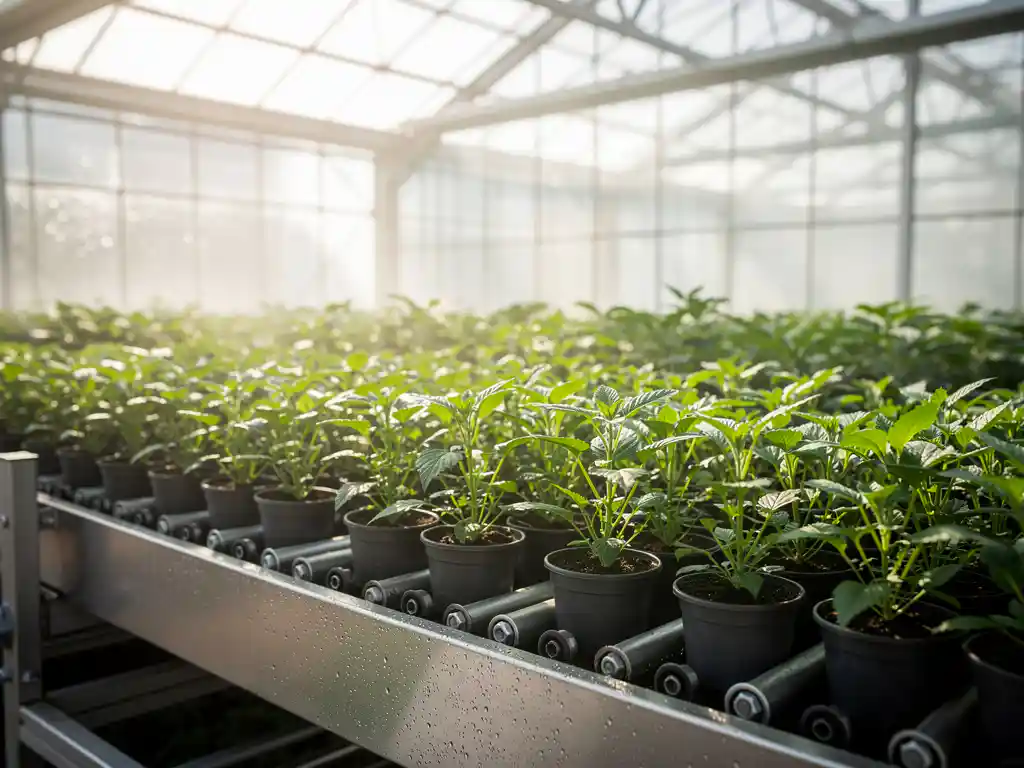
What makes horticultural conveyor systems distinct from standard industrial ones is their construction. Greenhouse environments are humid, often muddy, and subject to frequent washdowns. Belts and frames must be built from materials that resist corrosion and do not degrade under these conditions. Systems also need to handle delicate plants without causing damage, which influences belt surface texture, speed settings, and edge design.
What are the benefits of conveyor belts for horticultural businesses?
Conveyor belts in horticultural businesses reduce labour costs, improve throughput, and significantly lower the physical strain on workers. By automating internal transport, businesses can move more product in less time with fewer people, while also reducing the risk of repetitive strain injuries and absenteeism caused by heavy manual handling.
The productivity gains are substantial. When workers no longer need to walk kilometres per shift carrying trays or pushing trolleys, they can focus on value-adding tasks like potting, grading, or quality control. Production lines flow more smoothly because product moves at a consistent, controlled pace rather than in bursts driven by human capacity.
- Labour efficiency: Fewer staff are needed for internal transport, freeing people for skilled tasks.
- Ergonomics: Reduced walking, carrying, and bending lowers the risk of musculoskeletal complaints.
- Process continuity: Consistent belt speed eliminates bottlenecks and waiting times between workstations.
- Scalability: Conveyor systems can be expanded or reconfigured as the business grows or changes.
- Integration: Belts connect seamlessly with potting machines, robots, weighing scales, and sorting lines.
Beyond day-to-day efficiency, a well-designed conveyor system also makes a business more attractive as an employer. Physical work in horticulture is already demanding, and reducing unnecessary strain helps retain experienced staff in a sector where labour availability is a persistent challenge.
What’s the difference between fixed and mobile conveyor belts?
Fixed conveyor belts are permanently installed along a set route and are best suited to high-volume, repetitive production lines where the workflow does not change. Mobile conveyor belts are freestanding, wheeled units that can be repositioned across the facility and are ideal for operations where tasks and locations shift regularly throughout the year.
Fixed systems offer the highest throughput and can be integrated directly into automated production lines with potting machines, spacing robots, and packing stations. Because they are engineered for a specific layout, they can be optimised precisely for the flow of that facility. The trade-off is that they require a clear plan before installation and are not easily moved once in place.
Mobile systems offer a fundamentally different kind of value. A nursery growing multiple crop types across different greenhouse bays, for example, benefits from being able to wheel a conveyor to wherever the work is happening that day. This flexibility reduces idle time and means a single machine can serve multiple functions across the season. For businesses that are uncertain about committing to a fixed layout, starting with mobile units is also a lower-risk way to experience the benefits of conveyor automation before making a larger investment.
The choice between fixed and mobile is rarely either-or. Many operations combine both: a fixed backbone for the main production line and mobile units for flexible tasks at the edges of the process.
How do you choose the right conveyor belt for your nursery?
Choosing the right conveyor belt for your nursery depends on four key factors: the type of product you are moving, the layout and space available in your facility, the volume and speed requirements of your production process, and whether your workflow is fixed or variable across the year.
Start by mapping your current internal transport flow. Identify where products move, how far, how often, and who is doing the moving. This reveals the bottlenecks and the points where a conveyor would deliver the greatest return. A nursery with a central potting operation will have very different needs from a distribution centre that handles mixed-species orders with varying box sizes.
- Product type: Delicate plants require gentler belt surfaces and lower speeds than robust boxed produce.
- Environment: Humid greenhouse conditions demand corrosion-resistant materials and sealed motors.
- Workflow flexibility: Variable or seasonal operations benefit from mobile systems; consistent high-volume lines suit fixed installations.
- Integration requirements: Consider what the belt needs to connect to — potting machines, robots, weighing stations, or packing lines.
- Future growth: Choose a system that can be extended or adapted as your business scales.
We always recommend involving your technical team early in the process and working with a supplier who understands the specific demands of horticulture. Generic industrial conveyor suppliers often lack the sector knowledge to design systems that perform reliably in a greenhouse environment. A specialist partner can engineer a solution from the ground up, handle installation with their own technicians, and provide ongoing service support — which makes a real difference to long-term reliability and uptime.
If you are not yet ready to commit to a permanent installation, renting a conveyor system is a practical way to test the concept in your own facility before making a final decision. It removes the financial risk and gives you real operational data to inform the investment.
Frequently Asked Questions
How long does it typically take to install a conveyor belt system in a working greenhouse?
Installation timelines vary depending on whether you are fitting a fixed or mobile system. Mobile conveyor units can be operational within a day, as they require no structural modifications. Fixed installations typically take anywhere from a few days to several weeks, depending on the complexity of the layout, integration with existing machinery, and the size of the facility. Working with a specialist supplier who uses their own installation technicians — rather than subcontractors unfamiliar with greenhouse environments — significantly reduces disruption to your ongoing operations.
What maintenance does a horticultural conveyor belt require, and how often?
Routine maintenance typically includes checking belt tension, inspecting drive components and bearings, cleaning belt surfaces to prevent the build-up of soil or organic matter, and verifying that motors and electrical connections are sealed against moisture. In greenhouse environments, washdown cycles are common, so seals and corrosion-resistant coatings should be inspected regularly. Most suppliers recommend a formal service check every three to six months, though high-volume operations may benefit from more frequent inspections. Establishing a simple daily visual check routine for operators can catch minor issues before they become costly breakdowns.
Can conveyor belts handle the humidity and frequent washdowns common in greenhouse environments?
Yes, but only if the system has been specifically designed or specified for horticultural use. Standard industrial conveyor belts are often not built to withstand the persistent humidity, condensation, and regular high-pressure washdowns that are routine in greenhouse and nursery settings. Purpose-built horticultural conveyors use stainless steel or galvanised frames, sealed motors rated for wet environments, and belt materials that resist mould, moisture absorption, and chemical cleaning agents. Always confirm these specifications with your supplier before purchasing, as using an unsuitable system in a wet environment will lead to accelerated wear and reliability problems.
What is the typical return on investment (ROI) timeline for a conveyor belt in a horticultural business?
Most horticultural businesses see a return on investment within one to three years, though this varies significantly based on labour costs, production volume, and the complexity of the system installed. The clearest savings come from reduced labour hours on internal transport tasks, lower absenteeism linked to ergonomic improvements, and increased throughput on production lines. To calculate your own ROI, track how many staff hours per week are currently spent on manual transport, multiply by your hourly labour cost, and compare that against the annualised cost of the conveyor system. A specialist supplier should be able to help you build this business case using data from comparable operations.
What common mistakes should I avoid when implementing a conveyor belt system for the first time?
The most common mistake is underestimating the importance of workflow mapping before selecting a system. Buying a conveyor without first analysing where bottlenecks actually occur often results in a system that solves the wrong problem. Other frequent errors include choosing a system that cannot be expanded as the business grows, neglecting to involve the staff who will use the belt in the planning process, and selecting a generic industrial supplier without horticultural expertise. Finally, avoid over-engineering from the start — a phased approach, beginning with the highest-impact transport point, often delivers faster results and better operator buy-in than attempting a full-facility transformation all at once.
Is it possible to integrate a conveyor belt with existing machinery like potting machines or sorting lines?
Yes, and in most cases this integration is where conveyor systems deliver their greatest value. A conveyor belt connected directly to the output of a potting machine, for example, eliminates the manual step of collecting and distributing freshly potted plants, creating a continuous, uninterrupted flow. Integration with weighing scales, label applicators, spacing robots, and packing stations is also well established in modern horticultural facilities. The key is to specify integration requirements clearly at the design stage, including belt height, speed synchronisation, and product orientation, so that the conveyor becomes a seamless part of the production line rather than an isolated addition.
Is renting a conveyor belt a realistic option, and when does it make sense?
Renting is a genuinely practical option, particularly for businesses that want to validate the benefits of conveyor automation before committing to a capital purchase, or for operations with strong seasonal peaks that do not justify year-round ownership. It allows you to test a specific system in your own facility, with your own products and workflows, and generate real operational data to support a future investment decision. Renting also makes sense when cash flow is a constraint or when you need a temporary solution during a facility expansion. If you find that a rented system consistently runs at full capacity and your team cannot work without it, that is a strong signal that a permanent installation will deliver a solid return.