

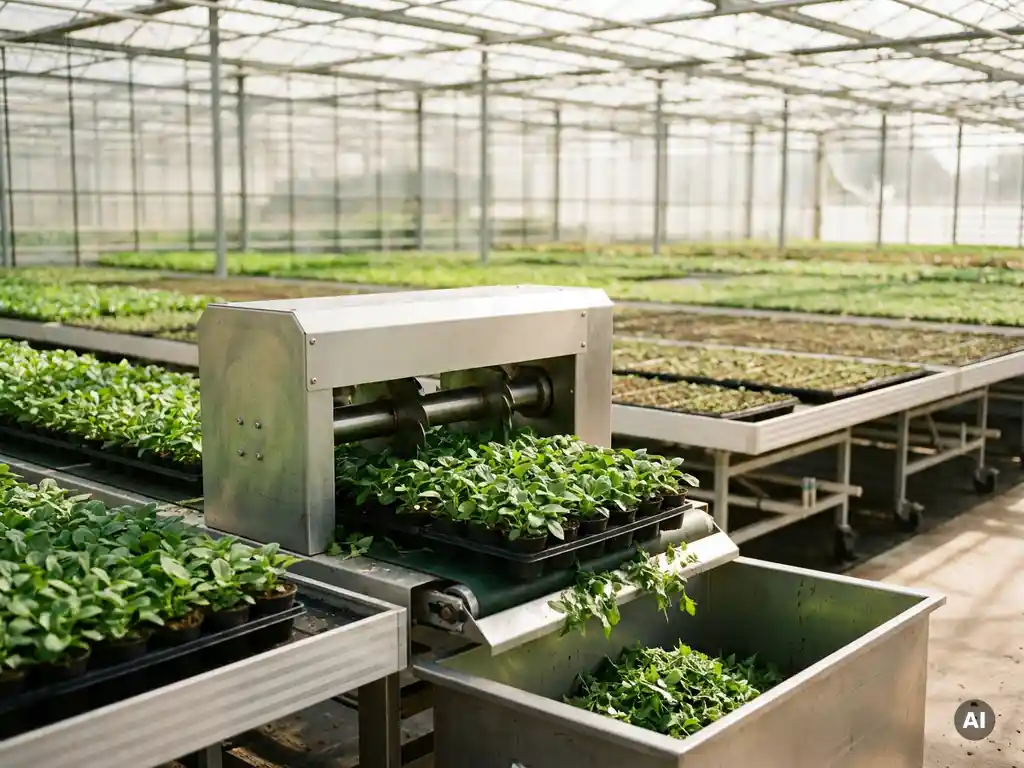
What is a topping machine used for in professional horticulture?
A topping machine in professional horticulture is used to apply a layer of covering soil, bark, or other substrate on top of a freshly potted plant. This finishing step improves moisture retention, suppresses weeds, and gives the final product a clean, professional appearance. For commercial growers working at scale, a topping machine is an essential part of an automated potting line that keeps production fast, consistent, and labour-efficient. Below, we answer the most common questions growers ask before choosing or investing in this type of equipment.
How does a potting machine actually work?
A potting machine fills pots with growing substrate automatically, using a conveyor system to move empty pots through a filling chamber where soil is dispensed at a controlled rate. A boring tool creates the planting hole at the correct depth, and the filled pot moves on for planting or further processing. The entire process replaces the manual act of scooping, pressing, and boring into soil by hand.
Modern potting machines are controlled by a PLC unit and operated via a touchscreen interface. Growers can pre-programme settings for different pot sizes, boring depths, soil feed rates, and rotation speeds. This means switching between pot configurations takes minutes rather than hours. The machine runs single, double, or alternating rows depending on the setup, and integrates directly with conveyor systems that feed pots in and carry them out.
What types of plants and pots are potting machines used for?
Potting machines are used primarily for ornamental plants, potted flowers, and nursery crops grown in rigid plastic pots. They are most common in professional pot plant cultivation and ornamental horticulture, where large volumes of uniform plants need to be potted quickly and consistently. Most commercial machines handle pot sizes ranging from 7 cm to 30 cm in diameter.
The range of compatible plants is broad. Bedding plants, perennials, herbs, indoor plants, and young shrubs are all regularly processed on potting lines. The key requirement is that the growing substrate and pot size fall within the machine’s specifications. Growers working with coarser or heavier soil mixes should pay particular attention to the machine’s soil-handling capacity, as not all models manage dense or fibrous substrates reliably.
What problems does a potting machine solve for growers?
A potting machine solves four core problems that growers face when potting is done manually: physical strain on workers, inconsistent pot fill quality, slow throughput during peak seasons, and dependence on large seasonal labour teams. By automating the filling and boring process, the machine delivers uniform results at a pace no manual team can match.
- Physical strain: Repetitive bending, scooping, and pressing soil is one of the leading causes of musculoskeletal complaints in horticulture. Automation removes this burden from workers entirely.
- Inconsistent quality: Manual potting varies from person to person. Machines apply the same soil density and bore depth to every single pot, which means more predictable crop development and fewer rejects at the auction.
- Slow output during peak periods: When delivery deadlines are tight, manual potting becomes a bottleneck. A machine keeps pace with the rest of the production line regardless of how many workers are available that day.
- Labour dependency: Finding and retaining seasonal workers is increasingly difficult. A potting machine reduces the number of staff needed for this task significantly.
How fast can a professional potting machine work?
A professional potting machine can process up to 8,000 pots per hour, depending on the pot size, soil type, and configuration. Smaller pots generally move through faster, while larger pots or denser substrates may reduce throughput. This level of output is far beyond what any manual team can sustain over a full working day.
Speed is only part of the picture. Consistency at high speed is what makes automation genuinely valuable. A machine that fills 8,000 pots per hour but produces variable fill levels or frequent jams creates different problems. When evaluating speed claims, growers should also ask about uptime reliability and how the machine handles their specific soil mix.
What’s the difference between a standard and an advanced potting machine?
The key difference between a standard and an advanced potting machine lies in automation depth, soil detection, and ease of operation. A standard machine handles the core filling and boring process reliably, while an advanced model adds features like automatic soil detection, guided chain systems for greater stability, touchscreen programming, and quieter, lower-maintenance operation.
To make this concrete, consider the difference between the Stolze 3030 and the Stolze 3030 PRO. The standard model is robust and user-friendly with PLC control. The PRO version adds automatic soil detection, which ensures accurate and consistent fill levels without manual adjustment. Its fully guided chain system improves mechanical stability, and the quieter motor reduces noise in the working environment while lowering maintenance requirements. For growers running long daily shifts or working with multiple pot configurations, these differences add up quickly.
The right choice depends on production volume, the complexity of the soil mix, and how much operator time is available for adjustments. Growers who change pot sizes frequently or run the machine for extended hours tend to benefit most from the advanced features.
When does it make sense to invest in a potting machine?
Investing in a potting machine makes sense when manual potting has become a consistent bottleneck, when labour costs and availability are a growing concern, or when quality inconsistencies are affecting the end product. For most commercial growers, the tipping point comes when production volume exceeds what a small team can handle reliably during peak periods.
There is no single volume threshold that applies to every operation, but growers who are potting tens of thousands of plants per week are generally strong candidates. Those who are already running conveyor lines or sortation systems will find integration straightforward. For growers who are uncertain, renting a machine before committing to a purchase is a practical way to test fit and output within the actual production environment.
Concerns about whether a new machine will suit a specific soil mix or pot range are legitimate and worth exploring before purchase. The right supplier will help you work through these questions before you sign anything.
How MartinStolze supports your potting line
We develop and produce our potting machines entirely in-house, from design and programming through to assembly and installation. That means we control quality at every stage and can tailor configurations to your specific crop, pot range, and soil mix. Here is what working with us looks like in practice:
- Machine options: The Stolze 3030 and Stolze 3030 PRO cover a wide range of production needs, from straightforward high-volume potting to advanced automated lines with soil detection and touchscreen programming.
- Full line integration: Our potting machines connect directly with our own conveyor belts, topping machines, tray fillers, and sorting lines for a complete, seamless production flow.
- Buy or rent: Both purchase and rental are available, including trial periods that let you evaluate the machine in your own environment before committing.
- Training and support: Our own technicians handle installation and provide hands-on training at our demo facility in De Lier. After-sales support comes from the same team that built the machine.
Whether you are replacing an ageing machine, building a new potting line from scratch, or simply exploring what automation could do for your operation, we are happy to think along with you. Get in touch with our team and we will help you find the right configuration for your situation.
Frequently Asked Questions
What should I look for when comparing topping machines from different suppliers?
Focus on three things: compatibility with your substrate type (bark, covering soil, or mixed materials), adjustability for different pot sizes, and how well the topping machine integrates with your existing potting line. A topping machine that works seamlessly with your conveyor and potting machine will always outperform a technically impressive standalone unit that creates bottlenecks at the handoff points. Ask suppliers for a live demonstration using your actual substrate before committing.
Can a topping machine handle different substrates, or is it limited to one material?
Most professional topping machines can handle a range of covering materials, including bark chips, decorative gravel, coco coir, and covering soil, but the machine’s feed mechanism needs to suit the material’s particle size and flow characteristics. Coarser or heavier materials like bark may require a different dosing system than fine covering soil. Always confirm with your supplier that the machine has been tested with the specific substrate you use, and ask about adjustment options if you work with more than one topping material.
How do I make sure the topping layer is applied evenly across every pot?
Consistent topping application depends on a stable conveyor speed, a correctly calibrated dosing mechanism, and a substrate that flows reliably through the machine. If you notice uneven coverage, the most common causes are substrate clumping due to moisture content, an inconsistent pot feed rate, or a dosing belt that needs recalibration. Running the machine at a steady pace and storing your topping substrate in controlled conditions will prevent most consistency issues before they start.
At what point in the potting line should the topping machine be positioned?
The topping machine is always positioned after the potting machine and planting step, as the final station before pots move to a sorting line, tray filler, or dispatch area. Placing it too early in the line risks disturbing the topping layer during subsequent handling. In a fully integrated line, the topping machine connects directly to the outfeed conveyor of the potting machine, keeping the flow continuous and minimising manual intervention between steps.
How much maintenance does a topping machine typically require?
Day-to-day maintenance is minimal and mostly involves cleaning out residual substrate from the dosing mechanism and conveyor belt at the end of each shift, particularly when working with fine or moist materials that can compact or clog over time. Periodic checks on belt tension, drive components, and dosing settings are recommended depending on daily run hours. Machines from suppliers who manufacture in-house typically have shorter maintenance windows because spare parts and technical support are readily available from the same source.
Is it possible to retrofit a topping machine onto an existing potting line, or does it require a full line rebuild?
In most cases, a topping machine can be integrated into an existing line without a full rebuild, provided the conveyor dimensions and pot flow are compatible. The key variables are conveyor height, belt width, and the speed at which pots arrive at the topping station. A supplier with in-house engineering capability can assess your current setup and advise on any adapters or conveyor adjustments needed to make the integration work cleanly. It is worth sharing your current line layout with the supplier before purchasing.
What is the typical return on investment for adding a topping machine to a commercial potting line?
The return on investment depends on your current labour cost for manual topping, your production volume, and the consistency gains you achieve in your finished product. For growers topping tens of thousands of pots per week, the labour savings alone often recover the machine cost within one to two growing seasons. Beyond direct cost savings, the improvement in presentation quality and moisture retention can also reduce crop losses and improve auction results, adding value that is harder to quantify but equally real.