
What is the difference between a fixed and mobile conveyor belt in horticulture?
Choosing the right conveyor belt system for your greenhouse or horticultural operation is one of those decisions that looks straightforward on the surface but quickly reveals real complexity. The wrong choice can mean costly disruptions, poor workflow, or a system that simply does not fit how your business actually operates. Understanding the core differences between fixed and mobile conveyor belts in horticulture is the first step towards making a confident, well-informed decision.
Whether you run a nursery, a packaging centre, or a distribution facility, the question of conveyor belt horticulture solutions comes up sooner or later. This article walks through every key question you are likely to ask, from basic definitions to practical combination strategies, so you can match the right system to your specific situation.
What is a fixed conveyor belt in horticulture?
A fixed conveyor belt in horticulture is a permanently installed transport system that moves plants, pots, or products along a set route within a greenhouse, nursery, or processing facility. It is anchored to the floor or structure of the building and forms a dedicated, continuous transport lane that does not move between tasks or locations.
Fixed belts are typically used as the backbone of a production or processing line. They connect workstations, potting machines, sorting lines, and dispatch areas in a logical sequence. Because they are built into the facility, they can be designed to handle high volumes consistently and reliably, day after day, without requiring repositioning or manual setup time.
In horticultural settings, fixed conveyor belts must be built from materials that can withstand moisture, soil, fertilisers, and the general humidity of a greenhouse environment. Standard industrial belts are rarely up to this task without significant modification. A well-designed fixed system integrates naturally with other automation components, creating a seamless flow from one stage of production to the next.
What is a mobile conveyor belt, and how does it work?
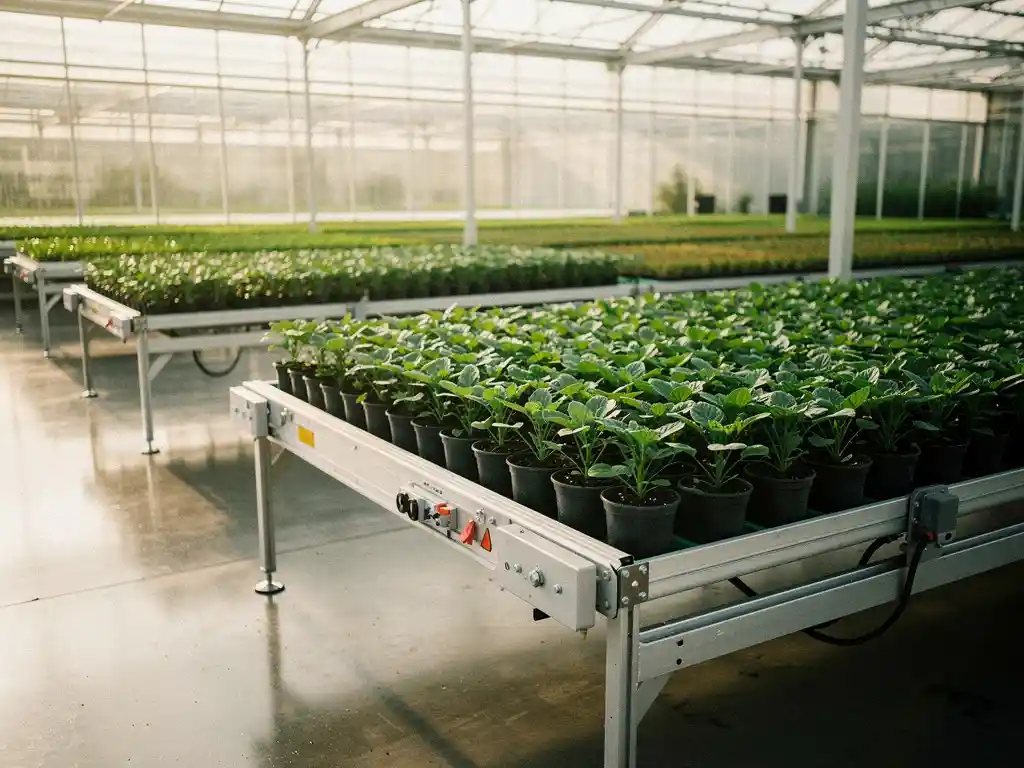
A mobile conveyor belt is a freestanding, wheeled transport system that can be moved to different locations within a greenhouse or facility as needed. It provides a flexible transport surface that operators can position wherever plant handling, spacing, or processing tasks are taking place at any given moment.
Mobile belts are particularly well suited to greenhouse operations where work moves through different bays, rows, or zones over the course of a day or season. Rather than carrying plants by hand from one point to another, workers place them on the mobile belt and let the system do the carrying. This reduces the distance staff cover during a shift and significantly lowers the risk of repetitive strain injuries.
Our EasyMax and Wevab mobile belts are good examples of how this flexibility works in practice. They are designed specifically for horticultural use, meaning they are compact enough to navigate greenhouse aisles, robust enough to handle daily use in humid conditions, and easy to reposition without specialist tools. A single mobile belt can serve multiple functions across a working day simply by moving it to where the work is.
What is the difference between a fixed and mobile conveyor belt?
The key difference between a fixed and mobile conveyor belt is flexibility versus consistency. A fixed belt provides a permanent, high-capacity transport route that never needs repositioning. A mobile belt offers adaptable, location-independent transport that follows the work rather than defining where the work must happen.
Here is a direct comparison of the two approaches:
- Installation: Fixed belts are permanently installed; mobile belts require no installation and can be deployed immediately.
- Flexibility: Mobile belts move with the workflow; fixed belts define a set transport path.
- Capacity: Fixed systems generally support higher throughput and longer transport distances.
- Cost structure: Fixed systems involve higher upfront investment; mobile belts have lower initial costs but may require multiple units to cover a facility.
- Maintenance: Fixed systems require scheduled maintenance in place; mobile units can often be serviced or swapped out more easily.
- Environmental suitability: Both can be built for humid, soil-heavy horticultural conditions, but fixed systems are typically more deeply integrated into the facility structure.
Neither type is inherently better. The right choice depends on how your operation is structured, how your workflows change across seasons, and what volume of product you need to move each day.
Which conveyor belt type is better for greenhouse operations?
For greenhouse operations, neither fixed nor mobile conveyor belts are universally better. Fixed belts suit high-volume, repetitive workflows where transport routes do not change. Mobile belts suit operations where tasks shift between locations, seasons change the work pattern, or flexibility is a daily requirement.
Large-scale nurseries with dedicated potting lines, spacing areas, and dispatch zones often benefit most from fixed systems. The transport route is predictable, the volume is high, and a permanent installation pays back its investment through consistent time savings and labour reduction over many years.
Smaller or more varied operations, including those that grow multiple crop types or work in different greenhouse sections throughout the week, typically find mobile belts more practical. The ability to bring transport to the work rather than bringing the work to the transport is a genuine operational advantage when flexibility matters more than raw throughput.
It is also worth considering the physical environment. Greenhouse aisles can be narrow, floors uneven, and space at a premium. A well-designed mobile belt accounts for these realities in a way that a fixed system, once installed, cannot adapt to after the fact.
Can fixed and mobile conveyor belts be combined in one system?
Yes, fixed and mobile conveyor belts can absolutely be combined in one system, and in many horticultural operations this hybrid approach delivers the best overall result. Fixed belts handle the high-volume core transport routes, while mobile belts extend the system flexibly to wherever additional capacity or reach is needed.
A common example is a packaging or processing centre where a fixed belt runs the main production line from potting through to dispatch. Mobile belts then feed into this fixed line from different greenhouse sections, allowing workers to consolidate product from multiple areas without carrying it by hand. The two systems work together rather than competing.
This combined approach also future-proofs your investment. As your operation grows or changes, mobile units can be added, repositioned, or repurposed without touching the fixed infrastructure. The result is a transport system that scales with your business rather than constraining it.
What should you consider before choosing a conveyor belt system?
Before choosing a conveyor belt system for horticulture, consider your workflow structure, the physical layout of your facility, your expected throughput, and how much your operations change across seasons. These four factors will quickly narrow down whether a fixed system, a mobile system, or a combination of both makes the most sense.
Start with your workflow. Map out where product enters your facility, where it is processed or handled, and where it exits. If that route is consistent and predictable, a fixed system is likely the right foundation. If the route changes regularly, mobility should be a priority.
Next, assess your facility. Measure aisle widths, check floor conditions, and identify any structural constraints that could affect installation. A fixed system requires careful planning before installation; a mobile system needs enough clear space to be manoeuvred effectively.
Consider your volume and growth trajectory. A system that handles today’s throughput comfortably but cannot scale will cost more in the long run than one that is sized with future capacity in mind. It is also worth thinking about maintenance access, spare parts availability, and who will service the system when something needs attention.
Finally, think about the specific demands of the horticultural environment. Moisture, soil, and biological material place real stress on conveyor components. A system built specifically for this sector, rather than adapted from a general industrial context, will perform more reliably and last significantly longer. We have been designing and building conveyor solutions specifically for horticulture for over three decades, which means every component we produce is engineered for exactly these conditions.
Frequently Asked Questions
How do I know if my current setup is ready for a fixed conveyor belt installation?
Before committing to a fixed installation, you will need a structural assessment of your facility, including floor load capacity, aisle dimensions, and ceiling clearances. It is also worth reviewing your utility access points, as fixed systems often require electrical connections along the line. Engaging a specialist conveyor supplier early in the planning process — ideally one with direct horticultural experience — will help you identify any structural or logistical obstacles before they become costly problems on-site.
What are the most common mistakes operators make when choosing a conveyor belt system for horticulture?
The most frequent mistake is selecting a general-purpose industrial conveyor and assuming it will hold up in a greenhouse environment — it rarely does without significant and expensive modification. Another common error is underestimating how much workflows change across seasons, which leads operations to over-invest in fixed infrastructure that becomes a constraint rather than an asset. Taking the time to map your actual daily and seasonal workflows before making any purchasing decision will save considerable time, money, and frustration.
How many mobile conveyor belts does a typical greenhouse operation need?
There is no single answer, as it depends entirely on the size of your facility, the number of active work zones, and how simultaneously those zones operate. A useful starting point is to identify every location where staff currently carry or manually transport plants during a typical working day — each of those points is a candidate for mobile belt coverage. Most small-to-medium nurseries find that two to four mobile units provide meaningful labour savings, while larger facilities with multiple active bays may require more to eliminate bottlenecks effectively.
What maintenance should I expect for a horticultural conveyor belt system?
Both fixed and mobile conveyor belts in horticultural settings require regular cleaning to prevent soil, fertiliser, and organic material from building up on belts, rollers, and drive components. Fixed systems typically follow a scheduled maintenance programme covering belt tension checks, roller inspections, and lubrication of drive mechanisms. Mobile units benefit from daily wipe-downs and periodic checks of wheels, belt alignment, and motor connections — and because they can be brought to a central service point, maintenance is often quicker and less disruptive than servicing fixed infrastructure in place.
Can a mobile conveyor belt handle the same product types as a fixed system?
In most horticultural applications, yes — mobile belts are designed to handle the same range of pots, trays, plants, and packaged products as their fixed counterparts. The key distinction is throughput speed and transport distance rather than product compatibility. If you need to move very high volumes over long, consistent routes without interruption, a fixed system will outperform a mobile unit; but for the majority of day-to-day handling tasks within a greenhouse or nursery, a well-specified mobile belt is entirely capable.
How quickly can a mobile conveyor belt be deployed and repositioned during a working day?
One of the core advantages of mobile conveyor belts designed for horticulture — such as the EasyMax and Wevab models — is that repositioning takes minutes rather than hours, with no tools or specialist knowledge required. A single operator can typically move and re-set a mobile belt between zones within a few minutes, making it practical to reallocate the unit multiple times across a single shift. This speed of deployment is a significant part of what makes mobile belts so cost-effective in operations where work locations change frequently.
Is it possible to expand a fixed conveyor system after it has already been installed?
Expanding a fixed system is possible but requires careful planning, as adding new sections, junctions, or extended runs typically involves structural work, additional electrical connections, and potential downtime for the existing line. This is why it is strongly recommended to design fixed systems with future growth in mind from the outset, even if the additional capacity is not needed immediately. A hybrid approach — where a fixed backbone is extended using mobile units as the business grows — is often the most practical and cost-efficient way to scale without major disruption to ongoing operations.
Related Articles
- How do you reduce dust around an automated topping station?
- Is pots per hour the best metric for comparing potting machines?
- How do you compare two potting machines with different hourly capacities?
- Can you rent a conveyor belt for a horticulture operation?
- How do you know when your greenhouse needs a conveyor belt system?