

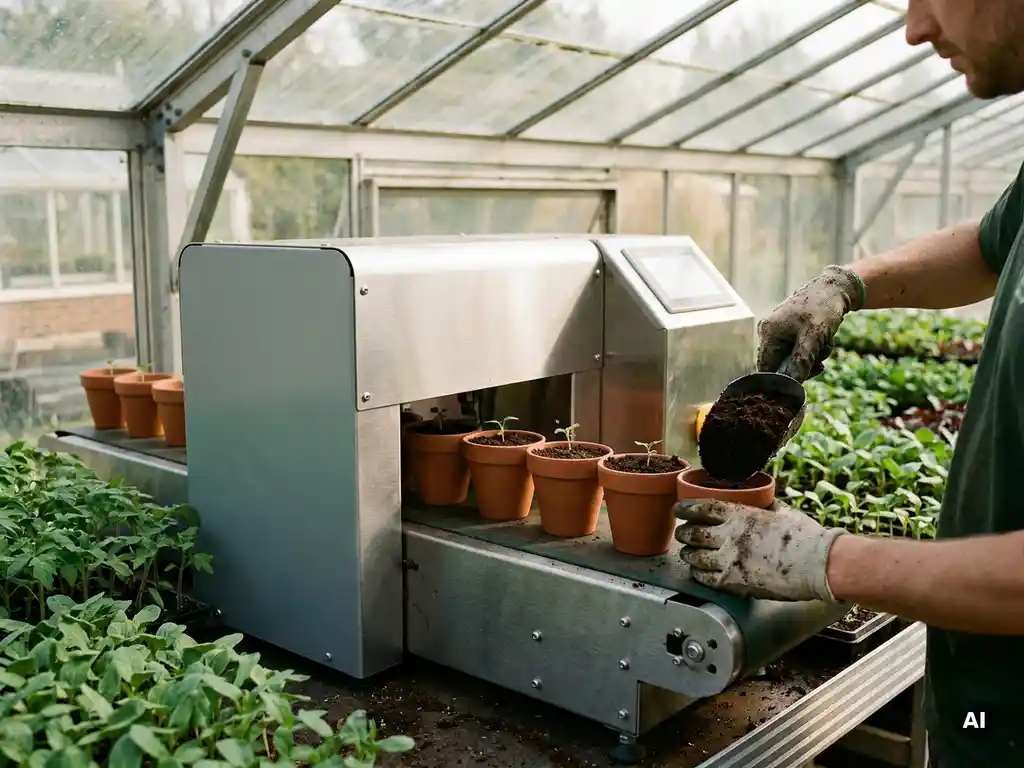
What is the difference between manual and automated pot topping?
Automated pot filling uses a machine to fill, compress, and distribute growing medium into pots at high speed and consistent quality, while manual potting relies entirely on human labor to complete the same steps by hand. The core difference is not just speed, it is consistency, physical strain, and scalability. For professional growers handling high volumes, the gap between the two approaches becomes most visible during peak seasons, when every hour of output matters.
How does automated pot filling actually work?
An automated potting machine takes growing medium from a hopper, meters the correct volume into each pot, and compresses it to a set density, all in one continuous motion. The pot moves along a guided chain or conveyor, passes under the filling head, receives its soil charge, and exits ready for planting. Modern machines like the Stolze 3030 handle pots from 7 to 30 cm and reach capacities of up to 8,000 pots per hour.
The operator programs pot size, boring depth, soil feed rate, and rotation speed via a touchscreen before the run begins. Once set, the machine repeats the same action for every pot in the batch without variation. The Stolze 3030 PRO adds automatic soil detection, which senses the actual fill level in real time and adjusts the feed accordingly, removing the last variable that would otherwise require manual checking.
The process requires minimal staffing. Typically one person loads trays or pots at the infeed and another collects them at the outfeed, while the machine handles everything in between.
What are the biggest drawbacks of manual potting?
Manual potting creates three compounding problems: physical strain on workers, inconsistent output quality, and a hard ceiling on throughput that cannot be raised without hiring more people. Each of these drawbacks intensifies during high-volume periods, which is precisely when reliable output matters most.
Physically, filling and compressing pots by hand is repetitive and demanding. Workers performing the same motion for hours develop fatigue, which slows their pace and increases the risk of musculoskeletal injury. Labor costs rise quickly when you factor in the number of people needed to sustain a meaningful output rate.
From a quality standpoint, every person fills pots slightly differently. One worker presses harder than another; a tired worker fills less firmly in the afternoon than in the morning. These differences in pot density directly affect how plants develop, roots behave differently in loosely filled pots than in firmly packed ones, making uniform crop outcomes harder to guarantee.
Finally, manual throughput simply has a ceiling. Adding more workers helps to a point, but floor space, coordination, and diminishing returns all limit how far that approach can scale. During peak seasons, that ceiling becomes a bottleneck.
How consistent is pot density with a machine versus by hand?
A potting machine delivers significantly more consistent pot density than manual filling because it applies the same mechanical pressure and soil volume to every pot, regardless of operator fatigue, shift changes, or variation between workers. Consistency in pot density directly affects root development, water retention, and ultimately crop uniformity.
With manual potting, density varies not just between workers but within a single worker’s shift. As fatigue sets in, compression tends to decrease, meaning pots filled in the morning may be noticeably firmer than those filled in the afternoon. Over a large batch, these small differences accumulate into measurable quality variation.
Machines eliminate that variable entirely. The Stolze 3030 PRO takes this further with automatic soil detection, which adjusts the fill in real time to compensate for any variation in the growing medium itself, such as differences in moisture content or particle size across a batch of substrate. The result is a pot that meets the same specification every single time.
When does investing in a potting machine make financial sense?
Investing in a potting machine makes financial sense when the combined cost of labor, inconsistent quality losses, and peak-season bottlenecks exceeds the cost of the machine over a reasonable payback period. For most professional growers, that threshold is reached at medium-to-high volumes where manual potting requires multiple dedicated workers over extended shifts.
The clearest signal is labor dependency. If your operation needs three or more people solely for potting during peak weeks, the labor cost alone often justifies a machine within one to three growing seasons. Factor in the indirect costs, quality rejects, replanting due to inconsistent density, and the difficulty of recruiting reliable seasonal staff, and the financial case strengthens further.
Rental options lower the entry threshold considerably. Trying a machine during your busiest period before committing to a purchase lets you measure the actual throughput gain and quality improvement against your specific crop and soil mix. That real-world data makes the investment decision straightforward rather than speculative.
What types of soil mixes can potting machines handle?
Professional potting machines are designed to handle a wide range of growing media, including peat-based mixes, coir substrates, bark-enriched composts, and blended potting soils. The key variable is not the mix type itself but its physical properties, particle size, moisture content, and the presence of fibrous or chunky materials that can affect flow through the machine.
Cheaper or less robust machines often struggle with denser or coarser mixes, leading to blockages, inconsistent fill, or mechanical wear. This is one of the most common causes of downtime at the worst possible moment. Machines built for professional horticulture are engineered with wider feed paths, stronger auger or belt mechanisms, and components that tolerate the abrasive nature of most commercial substrates.
If your operation uses a specific or unusual mix, it is worth testing the machine with that substrate before committing to a full run. We offer the opportunity to test our machines in our demo facility in De Lier, where you can run your own soil mix and assess the result directly.
Can a potting machine integrate with existing transport and sorting lines?
Yes, a potting machine can integrate with existing transport and sorting lines, provided the conveyor heights, pot dimensions, and line speeds are compatible. Most professional potting machines are designed with integration in mind, connecting to infeed conveyors, outfeed belt systems, topping machines, and sorting equipment to form a continuous automated production line.
Integration eliminates the manual handoffs between stations that slow down throughput and introduce handling errors. Pots move from filling to topping to transport without being touched, reducing breakage, soil spillage, and the need for workers to reposition product between steps.
Our potting machines connect seamlessly with our own transport conveyors and sorting lines, and we configure each installation around the specific layout and workflow of your facility. Whether you are building a new line from scratch or adding a machine to an existing setup, the integration is planned and installed by our own technicians.
How MartinStolze helps you automate potting
We develop and produce our potting machines entirely in-house, from design and programming to assembly and installation. That means we control every aspect of quality, and our own technicians handle your installation and training. Here is what working with us looks like in practice:
- Machine options for every scale: The Stolze 3030 suits growers who need reliable, high-volume potting with straightforward controls. The Stolze 3030 PRO adds automatic soil detection, a fully guided chain, and quieter operation for more demanding environments.
- Flexible entry points: Both buying and renting are available, including a trial period so you can validate the machine against your own crop and substrate before committing.
- Full-line integration: Our machines connect directly with our transport conveyors, topping machines, tray fillers, and sorting lines, giving you a complete, coordinated production line rather than a collection of standalone pieces.
- Training and support: We train your team in operation and maintenance at our demo facility in De Lier, and our own service technicians are available when you need them.
- Worldwide reach: We serve growers across the Netherlands and internationally, with a dedicated dealer network and international project experience.
If you are weighing up whether a potting machine fits your operation, or want to know which configuration suits your specific soil mix and pot range, get in touch with our team for a no-obligation conversation.
Frequently Asked Questions
How long does it typically take to set up and calibrate a potting machine before a production run?
Initial setup for a new pot size or substrate usually takes between 15 and 30 minutes, covering touchscreen programming, boring depth adjustment, and a short test run to verify fill consistency. Once a configuration has been saved, switching back to it for a repeat run is significantly faster — often just a few minutes. This means even operations with varied pot ranges can change over quickly without losing meaningful production time.
What maintenance does a potting machine require, and how often?
Routine maintenance typically includes daily cleaning of the filling head and conveyor, periodic lubrication of moving parts, and regular inspection of the auger or belt mechanism for wear caused by abrasive substrates. Most professional machines are designed so that these tasks can be carried out by your own team without specialist tools. Following the manufacturer's recommended maintenance schedule is the most reliable way to prevent unplanned downtime during peak production periods.
Can one operator run a potting machine alone, or is a two-person team always required?
In most setups, two people are recommended — one managing the infeed and one collecting pots at the outfeed — but this depends heavily on whether the machine is integrated into a conveyor line. When infeed and outfeed are handled by connected belt systems, a single operator can oversee the machine while monitoring fill quality and topping up the hopper. Standalone operation by one person is feasible for lower-speed runs but becomes impractical at full capacity without line integration.
What happens if the growing medium is too wet or too dry when it goes through the machine?
Substrate moisture content has a direct impact on fill consistency and machine performance. Overly wet media can clump and cause blockages in the feed path, while excessively dry substrate may flow too freely and result in underfilled or loosely packed pots. The Stolze 3030 PRO's automatic soil detection helps compensate for moderate variation in moisture levels by adjusting the feed rate in real time, but it is always best practice to store and condition your substrate consistently before production runs. Testing your specific mix in a demo environment before committing to full-scale use is the most reliable way to identify any issues in advance.
Is renting a potting machine a realistic option for smaller growers, or is it mainly suited to large operations?
Renting is a practical option for growers of almost any scale, particularly those with clearly defined peak seasons where demand spikes sharply for a limited number of weeks. Rather than carrying the full capital cost of a machine year-round, a rental allows you to deploy automated potting exactly when your volume justifies it and return the machine when the season ends. It also serves as a low-risk way to gather real performance data — throughput, quality improvement, and labor savings — before deciding whether a purchase makes long-term financial sense for your operation.
How do I know which machine configuration is right for my pot range and substrate?
The most reliable way to determine the right configuration is to test the machine with your actual pots and soil mix rather than relying on specifications alone. Key factors include your pot diameter range, the physical properties of your substrate, your target output per hour, and whether the machine will operate standalone or as part of an integrated line. A conversation with a specialist who understands both the equipment and professional horticulture workflows will quickly narrow down the options — and a hands-on trial at a demo facility removes any remaining uncertainty before you commit.
What common mistakes should growers avoid when transitioning from manual to automated potting?
The most common mistake is underestimating the importance of line integration — running a high-speed potting machine without a matched outfeed conveyor creates a new bottleneck immediately after the machine, negating much of the throughput gain. Another frequent issue is failing to train all relevant staff on both operation and basic troubleshooting, which means minor interruptions escalate unnecessarily. Finally, growers sometimes choose a machine based on price alone without testing it with their specific substrate, only to discover compatibility issues during a critical production window.