

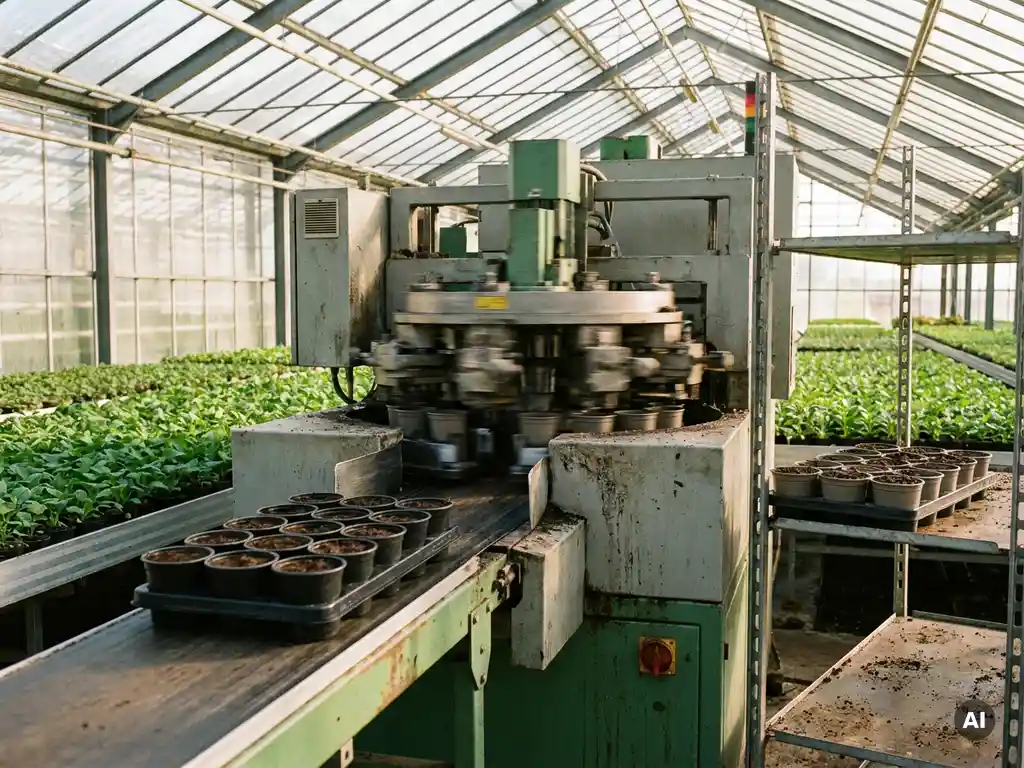
What is the difference between maximum and practical pots-per-hour capacity?
The difference between maximum and practical pots-per-hour capacity is significant: maximum capacity is a theoretical peak figure measured under ideal, controlled conditions, while practical capacity reflects what a machine actually delivers during a real working day. For most operations, practical output runs at 60 to 80 percent of the stated maximum. Understanding this gap helps you make smarter purchasing decisions and set realistic production targets.
This distinction matters most when you are comparing machines on spec sheets or planning staffing and logistics around a new potting line. The sections below break down how maximum figures are measured, what pulls practical output down, and how to calculate what a machine will genuinely produce for your business.
Why does practical capacity fall short of the maximum figure?
Practical capacity falls short of the maximum figure because maximum ratings are measured under optimal, uninterrupted conditions that do not reflect a real production environment. In practice, soil refills, tray changes, plant placement, brief operator adjustments, and minor blockages all interrupt the machine’s rhythm. These small pauses add up quickly across an eight-hour shift and reduce actual throughput considerably.
Think of it like a car’s top speed: the manufacturer can measure 200 km/h on a test track, but your daily commute looks nothing like a test track. A potting machine’s maximum pots-per-hour figure is measured when everything is running perfectly: the right soil mix, the right pot size, a warmed-up machine, and no interruptions. Real-world production introduces variability at every stage.
This is not a flaw in how machines are marketed. Maximum capacity is a useful benchmark for comparing machines against one another. The problem arises when growers use that number directly in production planning without applying a realistic efficiency factor.
How is maximum pots-per-hour capacity actually measured?
Maximum pots-per-hour capacity is measured by running the potting machine continuously at its highest speed setting, using a consistent, free-flowing soil mix and a single standardised pot size, with no stoppages. The machine is typically timed over a short, uninterrupted run, and the cycle count is extrapolated to an hourly figure.
Several conditions are held constant during this measurement:
- A single pot diameter and depth, usually one that suits the machine’s optimal bore size
- A dry, light, and uniform soil mix that flows freely through the filling mechanism
- A fully warmed-up machine with no soil build-up or mechanical resistance
- No operator pauses, refills, or tray changeovers during the timed run
- Stable ambient conditions, temperature and humidity affect soil behaviour
This approach gives a clean, comparable number, but it strips out everything that makes a production day complex. Once you reintroduce real soil mixes, mixed pot sizes, and human-paced workflows, the gap between the spec sheet and the floor becomes clear.
What factors reduce a potting machine’s practical output?
Several factors consistently reduce a potting machine’s practical output below its rated maximum. The most impactful are soil mix composition, pot size variation, operator workflow, and unplanned downtime. Together, these can reduce effective throughput by 20 to 40 percent compared to the maximum figure.
Soil mix and filling consistency
Heavy, wet, or fibrous soil mixes do not flow as freely as the light, uniform mixes used in capacity tests. A mix with high perlite, bark, or fibre content can clog filling mechanisms or cause inconsistent fill weights, forcing operators to slow the machine down or intervene manually. Machines without automatic soil detection are especially vulnerable to this because they cannot self-correct when the soil level in the hopper drops or the mix changes texture.
Pot size changes and operator-side tasks
Switching between pot sizes mid-shift requires reconfiguring bore settings, adjusting conveyor guides, and often reprogramming fill depth. Each changeover takes time. Beyond changeovers, operators must also place plants, remove filled trays, monitor quality, and refill the soil hopper, none of which appears in a maximum capacity figure. The more tasks an operator handles alongside the machine, the lower the effective output per hour.
Unplanned stoppages and maintenance
Even well-maintained machines experience brief stoppages: a pot that jams, a conveyor that needs clearing, or a soil clump that blocks the filling head. Older or lower-specification machines tend to experience these more frequently, particularly with demanding soil mixes. Every minute of unplanned downtime during peak season has a direct cost.
How do you calculate realistic daily pot output from a machine’s specs?
To calculate realistic daily pot output, multiply the machine’s maximum pots-per-hour figure by your planned shift length in hours, then apply an efficiency factor of 65 to 75 percent to account for real-world interruptions. This gives a practical daily output estimate that is far more useful for production planning than the raw maximum figure.
Here is a simple formula:
- Take the maximum pots-per-hour rating (for example, 8,000 pots/hour)
- Multiply by shift length in hours (for example, 8 hours = 64,000 theoretical pots)
- Apply an efficiency factor of 0.65 to 0.75 (64,000 x 0.70 = 44,800 realistic pots per day)
The right efficiency factor depends on your specific situation. If you run a single pot size with a consistent, free-flowing soil mix and a dedicated operator, you may achieve closer to 75 percent. If you switch pot sizes mid-shift, use a heavy or fibrous mix, or have operators handling multiple tasks, 65 percent is a more honest estimate. Use the lower figure for planning and treat anything above it as a buffer.
What’s the difference between the Stolze 3030 and 3030 PRO in terms of real-world output?
Both the Stolze 3030 and the Stolze 3030 PRO are rated to a maximum capacity of 8,000 pots per hour, so the difference is not in peak speed, it is in how consistently each machine maintains output across a full working day. The 3030 PRO is designed to close the gap between maximum and practical capacity through smarter automation.
Stolze 3030: reliable baseline performance
The Stolze 3030 is a robust, user-friendly potting machine with PLC control and a touchscreen interface. It handles pots from 7 to 30 cm and runs single, double, or alternating configurations. For operations with a consistent soil mix and a stable pot size, it delivers strong, dependable output. Its practical efficiency depends heavily on operator attentiveness and soil behaviour.
Stolze 3030 PRO: reduced output variation
The 3030 PRO adds automatic soil detection, which means the machine continuously monitors and adjusts to the soil level in the filling mechanism. This eliminates one of the most common causes of inconsistent fill and unplanned pauses. The fully guided chain improves mechanical stability, reducing vibration and wear. The result is quieter operation, lower maintenance frequency, and more consistent pot quality across a long shift, all of which translate directly into higher practical output over a full day.
For operations running demanding soil mixes, high volumes, or mixed pot sizes, the 3030 PRO’s automation features help sustain a higher effective throughput rate with less operator intervention. The choice between the two comes down to how much variability your production environment introduces.
When should capacity figures be the deciding factor in choosing a potting machine?
Capacity figures should be a deciding factor when your current output is a genuine bottleneck, when you are losing time at the potting stage during peak season, when manual potting is limiting your daily volume, or when you are scaling up production and need to match a specific throughput target. In these situations, the gap between a lower-capacity and higher-capacity machine has a direct commercial impact.
However, capacity should not be the only deciding factor. A machine rated at 8,000 pots per hour that struggles with your specific soil mix will deliver less practical output than a well-matched machine at the same rating. Reliability, ease of use, integration with your existing transport and conveyor systems, and the availability of service support all affect your real-world result more than the headline number.
Capacity figures matter most when you are comparing machines that are otherwise well matched to your operation. Use them as a tie-breaker or a volume-planning tool, not as the sole basis for a decision.
How we help you match machine capacity to your real production needs
At MartinStolze, we do not just hand you a spec sheet and leave you to figure out the rest. We work with you to understand your actual production environment, your soil mix, your pot range, your shift structure, and help you calculate what realistic daily output looks like for your specific situation. Here is what that looks like in practice:
- Honest capacity guidance: We help you apply the right efficiency factor to our machines’ rated output so your production planning is grounded in reality, not marketing figures
- Soil mix compatibility: We assess whether your soil mix suits the standard 3030 or whether the 3030 PRO’s automatic soil detection will make a meaningful difference for your operation
- Full line integration: Both machines connect seamlessly with our conveyor and sorting systems, so capacity is not lost at the handoff between stations
- Rent before you buy: Not ready to commit? We offer rental options, including a trial period, so you can test real-world output in your own facility before making a decision
- Training and support: Our own technicians install, commission, and train your team at our demo facility in De Lier, and remain available for ongoing support
If you are weighing up machine options or want to understand what output you can realistically expect from a Stolze potting machine in your operation, get in touch with our team, we are happy to think it through with you.
Frequently Asked Questions
Can I use a potting machine's maximum capacity figure to compare two different brands fairly?
You can use maximum capacity figures for a rough comparison, but only if both manufacturers measure them under similar conditions. A more reliable approach is to ask each supplier what efficiency factor they recommend for your specific soil mix and pot range, then compare the resulting practical output figures. If possible, ask for references from growers running similar operations to validate real-world performance.
What efficiency factor should I use if I'm running a fully automated potting line with conveyors and sorting systems?
A fully integrated line with conveyors and automated sorting removes many of the manual bottlenecks that drag efficiency down, so you can reasonably apply an efficiency factor at the higher end of the range, around 75 to 80 percent. However, the soil mix and pot size consistency still play a significant role, so don't assume full automation alone gets you to maximum capacity. Test your actual output during the first few weeks and adjust your planning figures accordingly.
How do I know if my soil mix is compatible with a potting machine before I buy?
The best way is to bring a representative sample of your soil mix to the manufacturer's demo facility and run it through the machine under realistic conditions. At MartinStolze, for example, you can test both the 3030 and the 3030 PRO at the De Lier facility before committing. Key indicators of a problematic mix are high moisture content, long fibres, coarse bark, or heavy perlite ratios, all of which can cause inconsistent fills or blockages in standard filling mechanisms.
What's the most common mistake growers make when planning production around a new potting machine?
The most common mistake is using the maximum pots-per-hour figure directly in shift planning without applying an efficiency factor, which leads to missed daily targets and understaffed logistics downstream. A closely related mistake is underestimating how much time pot size changeovers and soil hopper refills consume across a full shift. Always build your staffing, conveyor capacity, and soil supply schedules around your practical output estimate, not the headline number.
Is it worth renting a potting machine before buying to validate real-world output?
Yes, renting before buying is one of the most practical ways to validate whether a machine's output matches your production environment, especially if you run a demanding soil mix or a varied pot range. A trial period in your own facility reveals bottlenecks, operator learning curves, and soil compatibility issues that no spec sheet or demo day can fully replicate. It also gives you concrete throughput data to base your investment decision on, rather than relying on theoretical figures.
How often should a potting machine be serviced to maintain practical output over time?
Service intervals vary by machine model and usage intensity, but as a general rule, daily cleaning of the filling mechanism and hopper, combined with a scheduled maintenance check every season, will prevent most output-degrading issues. Unplanned stoppages caused by soil build-up, worn conveyor components, or filling head blockages are the biggest threats to sustained practical output. Following the manufacturer's maintenance schedule and training operators to spot early warning signs is more cost-effective than reactive repairs during peak season.
At what point does it make financial sense to upgrade from a lower-capacity to a higher-capacity potting machine?
The upgrade makes financial sense when the potting stage is consistently the bottleneck in your production line and when the volume of pots you're losing per shift due to capacity constraints exceeds the annualised cost of a higher-specification machine. A straightforward way to assess this is to calculate the revenue value of the pots you cannot produce during peak weeks, then compare that figure against the machine investment and any efficiency gains from automation features like automatic soil detection. If the payback period is under two to three seasons, the upgrade is typically justified.
Related Articles
- How much topping material does an automatic topping machine use per pot?
- When is a high-capacity potting machine unnecessary for your nursery?
- How many pots can a potting machine process during an eight-hour shift?
- Why do breakdowns always seem to happen at the worst moment?
- Why do standard industrial conveyor belts fail in greenhouses?