

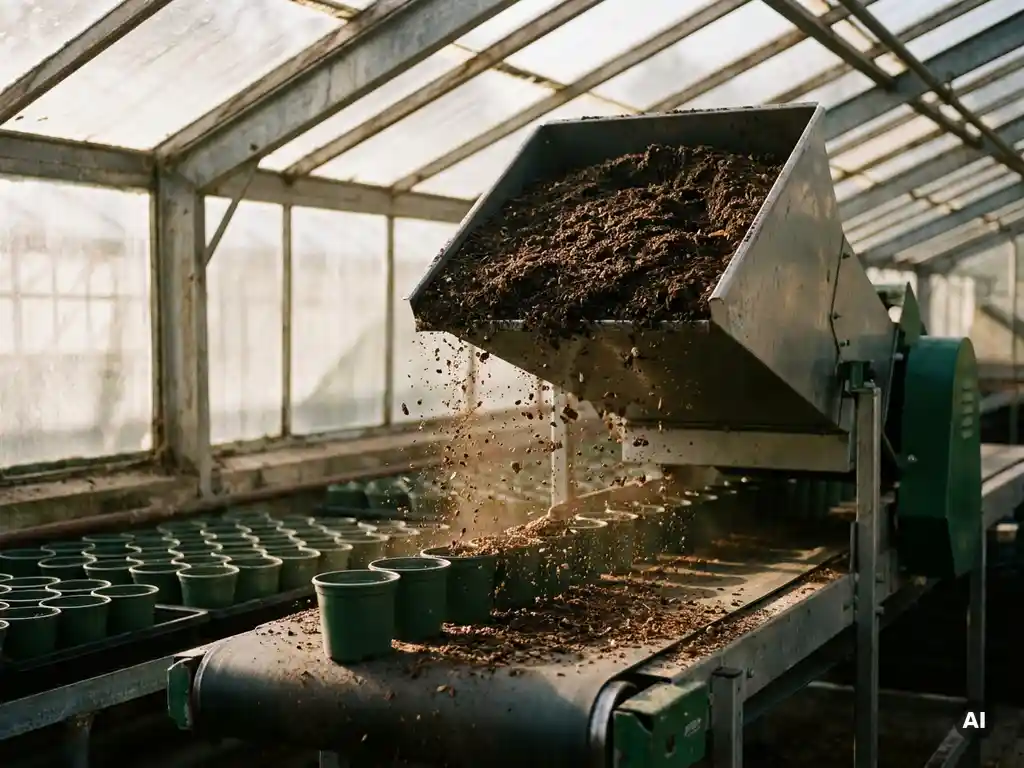
What materials can be applied with a horticultural topping machine?
A horticultural topping machine works best with finely structured, free-flowing growing media such as peat-based mixes, coco coir, and composted bark. These substrates flow consistently through the machine’s dosing mechanism, ensuring an even, controlled layer is applied to each pot. The sections below cover everything from substrate moisture to materials you should avoid entirely.
Which growing media work best in a topping machine?
The growing media that perform best in a topping machine are fine-textured, low-moisture substrates with consistent particle size. Peat-based mixes, coco coir, fine composted bark, and blended potting soils all flow reliably through dosing rollers and conveyor systems without clumping or bridging. These materials share one key quality: they move predictably, which keeps output consistent and minimises downtime.
Peat remains a popular choice because of its light weight and uniform texture. Coco coir is increasingly common in 2026 as growers shift toward more sustainable inputs, and it performs well in topping applications provided moisture levels are kept in check. Fine bark composts work reliably too, though particle size matters significantly. The finer and more uniform the blend, the smoother the machine’s performance will be across a full production run.
When evaluating a growing medium for topping use, consider these qualities:
- Particle size: fine and consistent, ideally under 10 mm
- Moisture content: damp but not wet, crumbling easily in the hand
- Bulk density: light to medium, allowing gravity-assisted flow
- Organic matter: well-composted, not fresh or stringy
Can a topping machine handle coarse or fibrous substrates?
Coarse or fibrous substrates are generally not well-suited to a topping machine. Materials with long fibres, large bark chunks, or irregular particle sizes tend to bridge at the hopper, wrap around rollers, and cause blockages in the dosing mechanism. While some robust machines can handle mildly coarse blends, highly fibrous media such as uncomposted wood fibre or raw straw will cause operational problems.
The issue is not just blockages. Fibrous materials also apply unevenly, meaning some pots receive too little topping while others get too much. In a high-volume production environment, that inconsistency adds up quickly and affects both product quality and throughput speed.
If your growing mix includes coarser components, the practical solution is to screen or sieve the substrate before it enters the machine. Removing particles above a set threshold, typically around 8 to 10 mm, dramatically improves flow and protects the machine’s internal components from unnecessary wear.
How does substrate moisture content affect topping machine performance?
Substrate moisture content has a direct impact on topping machine performance. Media that is too wet will clump together, stick to internal surfaces, and block the dosing system. Media that is too dry becomes dusty, flows unpredictably, and can create uneven application. The ideal moisture level is somewhere in between, often described as “hand-moist”: the substrate holds its shape briefly when squeezed but crumbles apart easily.
Overly wet substrate is the more common problem in practice. When peat or coco coir absorbs excess water, it becomes sticky and dense, which causes it to bridge inside the hopper rather than flowing freely downward. This leads to uneven dosing and frequent manual intervention to break up blockages, both of which slow production significantly.
A simple field test works well: take a handful of the substrate and squeeze it firmly. If water drips out, it is too wet. If it falls apart immediately without holding any shape, it may be too dry for reliable flow. If it holds its form for a moment and then crumbles, the moisture level is likely suitable for machine use.
What’s the difference between topping and potting in terms of material requirements?
Topping and potting have different material requirements because they serve different functions. A potting machine fills the entire pot with growing medium and must handle larger volumes with precise compaction and bore depth control. A topping machine applies only a thin, decorative or protective layer of material to the surface of an already-filled pot, which means it works with smaller quantities and typically requires a finer, more uniform substrate.
Because topping material sits on the surface, visual consistency matters more than it does in a standard potting mix. Growers often use a different, more refined blend for topping, such as fine coco coir or decorative bark, specifically because it will be visible to the end buyer. The topping layer also needs to stay in place during transport and handling, so it should not be too coarse or too loose.
From a machine perspective, potting machines like our Stolze 3030 are built to handle heavier, denser mixes and higher volumes per cycle. Topping machines operate with lighter loads and finer tolerances. Using a standard potting mix as a topping material is possible in some cases, but the results are often less consistent than using a purpose-selected topping substrate.
Which materials should not be used in a topping machine?
Several materials should not be used in a topping machine because they cause mechanical damage, blockages, or inconsistent application. The most problematic include uncomposted wood chips, fresh straw, gravel or stone aggregates, materials with high sand content, and any substrate containing foreign objects such as stones, wire, or plastic fragments.
Here is a practical list of materials to avoid:
- Uncomposted wood fibre or wood chips: fibrous and irregular, prone to bridging and roller wrap
- Fresh straw or hay: long fibres tangle in the mechanism and cause jams
- Gravel or coarse grit: abrasive and too heavy for consistent dosing
- High-sand substrates: excessive wear on internal components and poor flow behaviour
- Contaminated media: stones, roots, or debris damage rollers and sensors
- Frozen or compacted substrate: will not flow freely and can damage dosing parts
Beyond mechanical damage, unsuitable materials also affect the end product. Uneven topping layers reduce the visual quality of the finished plant, which matters particularly in ornamental and pot-plant cultivation where presentation influences buyer decisions.
How MartinStolze helps you get the most from your topping machine
Getting the right substrate into your topping machine is only part of the equation. The machine itself needs to be matched to your specific production line, your growing media, and your throughput targets. That is exactly where we come in.
At MartinStolze, we design and build our machines entirely in-house, which means we understand every component and how it interacts with different substrates. When you work with us, you benefit from:
- Tailored advice on machine configuration based on your specific growing media and pot sizes
- Seamless integration with conveyor systems and complete potting lines
- Hands-on training at our demo and teaching facility in De Lier
- Both purchase and rental options, including trial periods, so you can verify performance before committing
- Support from our own technicians, not third-party contractors
Whether you are setting up a new topping line or optimising an existing one, we are happy to think along with you. Get in touch with our team and we will help you find the right solution for your operation.
Frequently Asked Questions
How do I know if my current substrate is compatible with a topping machine before investing in one?
The quickest way is to run a simple hand-moisture test and check your substrate’s particle size against the recommended threshold of under 10 mm. If your mix passes both checks — crumbling easily when squeezed and free of large chunks or fibres — it is likely compatible. For a more reliable answer, MartinStolze offers trial periods and demo facilities in De Lier where you can test your actual growing media in a real machine before making any commitment.
Can I use the same substrate for both potting and topping, or do I need two separate mixes?
While it is technically possible to use the same substrate for both, it is generally not recommended for best results. Topping machines are built to finer tolerances and favour lighter, more uniform blends, whereas potting mixes are often coarser and denser. If your standard potting mix meets the particle size and moisture requirements, it may work adequately as a topping material, but growers focused on visual presentation — particularly in ornamental cultivation — typically benefit from using a dedicated, more refined topping substrate.
What's the best way to store substrate to keep it at the right moisture level before it goes into the topping machine?
Store your substrate in a covered, sheltered area away from direct sunlight and rain to prevent it from drying out or absorbing excess moisture. Avoid leaving bags open for extended periods, and if possible, bring substrate indoors or under cover the day before a production run so it can stabilise to a consistent temperature and humidity. If the substrate is too wet when you come to use it, spreading it out on a clean surface for a short period before loading can help reduce excess moisture without over-drying it.
How often should a topping machine be cleaned or maintained when running with organic substrates like peat or coco coir?
Organic substrates can leave residue on rollers, hoppers, and dosing components, particularly if moisture levels are on the higher end. A basic clean-down at the end of each production day — removing residual substrate and checking for any buildup around the dosing mechanism — is good practice. More thorough maintenance, including inspection of rollers and sensors for wear, should be scheduled regularly depending on your production volume; your machine supplier should provide specific guidance based on your model and usage intensity.
What should I do if my topping machine starts applying uneven layers mid-run?
Uneven application mid-run is most commonly caused by a change in substrate condition — typically a batch that is wetter, drier, or coarser than what the machine was initially calibrated for. First, check the moisture level of the substrate currently in the hopper using the hand-squeeze test, and inspect the hopper for any bridging or partial blockages. If the substrate checks out, the issue may be mechanical, such as a worn roller or a sensor that needs recalibration, in which case contacting your machine supplier’s technical team is the fastest route to a fix.
Is coco coir genuinely a reliable alternative to peat in a topping machine, or does it require special adjustments?
Coco coir performs very well in topping machines when its moisture content is properly managed, as it tends to absorb and retain water more readily than peat, making it more prone to clumping if stored or handled carelessly. No major mechanical adjustments are typically required, but growers switching from peat to coco coir should monitor moisture levels more closely, especially in humid storage conditions. The finer the coir grade, the more predictably it will flow, so opting for a milled or buffered coco coir product rather than a chunky or raw grade will give you the most consistent results.
Can a topping machine be integrated into an existing automated potting line, or does it need to operate as a standalone unit?
Topping machines can be fully integrated into an existing automated potting line, typically positioned downstream of the potting machine and connected via conveyor systems. The key considerations are matching conveyor speeds, pot spacing, and throughput rates so that the topping machine doses accurately without causing bottlenecks. Working with a supplier like MartinStolze, who designs both topping machines and conveyor systems in-house, makes this integration significantly more straightforward, as machine configurations can be tailored to your specific line layout from the outset.