

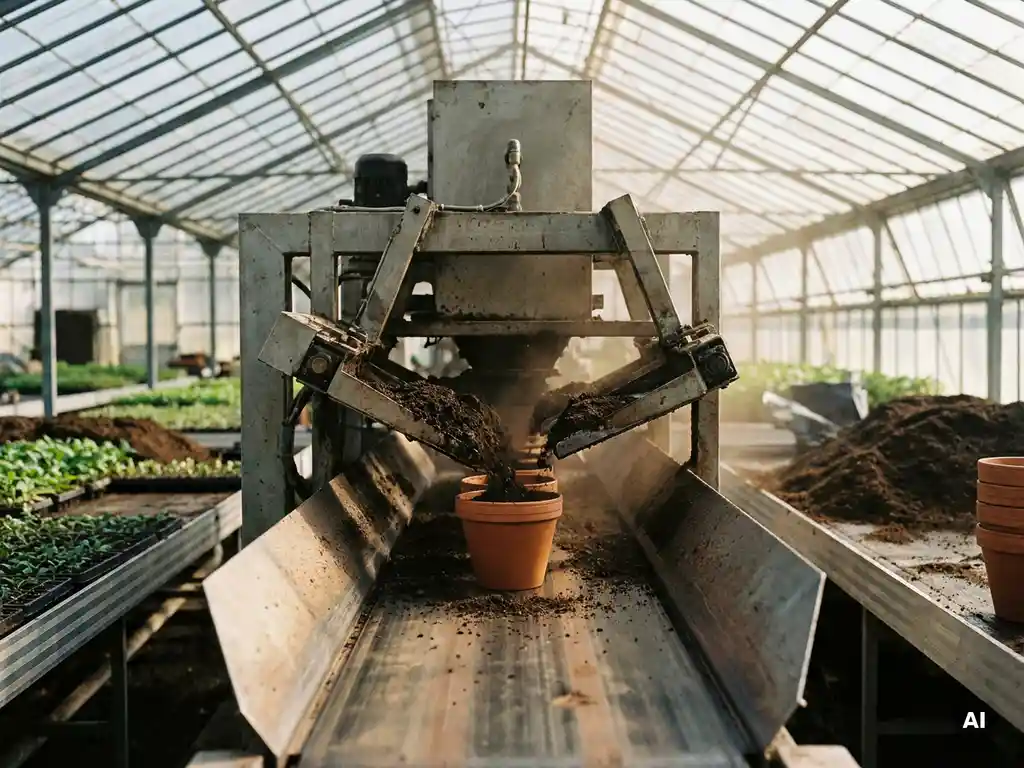
What percentage of maximum potting machine capacity is realistic in daily production?
In daily production, a realistic target is 60 to 75 percent of a potting machine’s theoretical maximum capacity. A machine rated at 8,000 pots per hour will reliably deliver somewhere between 4,800 and 6,000 pots per hour under real working conditions. The gap exists because theoretical figures assume continuous, uninterrupted operation, something no production floor achieves consistently. The sections below unpack the specific factors behind that gap and how growers can close it.
What factors reduce a potting machine’s theoretical capacity?
Several unavoidable operational realities pull actual output below the rated potting machine pots per hour figure. The main culprits are soil refill cycles, pot changeovers, operator breaks, minor jams, and line stoppages caused by downstream equipment. Together, these interruptions typically consume 25 to 40 percent of available production time.
Breaking this down further, the most common capacity reducers are:
- Soil hopper refills: Every time the hopper runs low, the line slows or stops. Frequency depends on hopper size and the volume of substrate used per pot.
- Pot size changeovers: Switching between different pot diameters requires mechanical adjustments and test runs, which can take 10 to 30 minutes depending on machine sophistication.
- Operator pacing: If the downstream workflow, placing trays, moving filled pots, labelling, cannot keep up with the machine, operators throttle the speed to avoid a backlog.
- Minor jams and misfeeds: Even well-maintained machines occasionally misfeed a pot or experience a soil clump that disrupts the cycle. Each event costs seconds, but over a full shift these add up.
- Scheduled breaks: A standard eight-hour shift includes legally required rest periods, which directly reduce active machine time.
Understanding which factor dominates in your own operation is the first step toward closing the gap between rated and actual output.
What is a realistic efficiency percentage for daily potting operations?
A well-run potting operation typically achieves 65 to 75 percent efficiency relative to the machine’s theoretical maximum. Smaller or less automated operations may land closer to 55 to 60 percent, while highly automated lines with optimised soil supply and minimal changeovers can push toward 80 percent. Sustained output above 85 percent is exceptional and usually requires a fully integrated line.
These ranges reflect real-world production experience across professional greenhouse operations. The key insight is that efficiency is not fixed, it is a direct result of process decisions. Growers who invest in soil conveying systems, pre-programmed pot size settings, and well-trained operators consistently outperform those running the same machine with ad hoc workflows.
For planning purposes, using 65 percent as a conservative baseline and 75 percent as an achievable target gives a responsible range for capacity projections without overpromising on output.
How does automation level affect real-world potting output?
The degree of automation is one of the strongest predictors of actual pots per hour in daily production. More automation means fewer manual interventions, shorter stoppages, and more consistent cycle times, all of which push real-world output closer to the theoretical ceiling.
Consider the difference between a basic potting machine and a more advanced model equipped with automatic soil detection, a fully guided chain system, and programmable touchscreen controls. The advanced machine:
- Detects soil levels automatically and adjusts fill depth without operator input, eliminating inconsistent pot density
- Switches between pre-programmed pot size profiles in seconds rather than requiring manual mechanical adjustment
- Runs more quietly and with less vibration, reducing wear-related slowdowns over a full shift
- Provides consistent filling quality that reduces the number of rejected or underweight pots
Each of these features reduces the frequency and duration of interruptions. Over an eight-hour shift, the cumulative effect is significant. Automation does not eliminate downtime entirely, but it converts unpredictable, operator-dependent stoppages into brief, predictable, system-managed pauses, which are far easier to plan around.
Why does soil mix quality impact potting machine throughput?
Soil mix quality directly affects how smoothly substrate moves through the machine’s filling mechanism. A well-structured, consistently mixed substrate flows predictably, fills pots evenly, and rarely causes jams. A poorly conditioned mix, too wet, too dry, too fibrous, or contaminated with clumps, disrupts the filling cycle repeatedly throughout the shift.
The specific problems caused by poor soil mix include:
- Bridging in the hopper: Fibrous or clumped substrate forms arches above the auger, starving the filling mechanism and causing irregular pot weights.
- Auger blockages: Dense, wet substrate can stall the auger motor, requiring the operator to stop the machine and clear the blockage manually.
- Inconsistent fill depth: Variable substrate density means the same auger rotation delivers different soil volumes, leading to pots that are over- or underfilled.
- Increased maintenance frequency: Abrasive or wet mixes accelerate wear on moving parts, shortening service intervals and increasing unplanned downtime.
Growers using heavy peat-based mixes, coir substrates with long fibres, or mixes with added perlite should verify that their machine is specified to handle those materials before assuming the rated pots per hour figure applies to their situation.
How can growers calculate their expected daily pot output?
To estimate realistic daily pot output, multiply the machine’s rated capacity by your expected efficiency percentage and then by the number of productive hours in your shift. This gives a grounded, planning-ready figure rather than a theoretical best case.
The formula is straightforward:
- Start with rated capacity: For example, 8,000 pots per hour.
- Apply your efficiency factor: Use 65 percent as a conservative estimate, or 75 percent if your line is well-optimised. That gives 5,200 to 6,000 pots per hour.
- Determine productive hours: An eight-hour shift with two 15-minute breaks and two soil refill stops of five minutes each leaves roughly 6.8 to 7 productive hours.
- Multiply: At 65 percent efficiency over 7 productive hours: 5,200 × 7 = approximately 36,400 pots per shift. At 75 percent: 6,000 × 7 = approximately 42,000 pots per shift.
Adjust these figures based on your specific pot size (smaller pots generally allow higher throughput), the number of changeovers planned per shift, and the condition of your soil mix. Running this calculation before a busy season gives you a realistic picture of whether your current machine can meet demand, or whether additional capacity is needed.
When should a grower consider upgrading to a higher-capacity machine?
A grower should seriously consider upgrading when the current machine is consistently running at or above 80 percent of its theoretical capacity during peak periods, when demand is growing year on year, or when recurring mechanical issues are causing unplanned downtime during critical production windows.
Specific signals that an upgrade is warranted include:
- You are regularly extending shifts or adding weekend runs to meet order volumes
- Your current machine cannot handle the soil mixes required for new crop varieties
- Maintenance costs are rising and spare parts availability is becoming a concern
- A competitor or peer operation is producing at significantly lower cost per pot due to a more automated line
- You are turning down orders or losing auction slots because output cannot keep pace with demand
Upgrading is not only about raw pots per hour. A newer, more automated machine often delivers a lower cost per pot through reduced labour input, fewer rejects, and less unplanned downtime, even if the rated capacity is similar to the current model. The business case for upgrading is strongest when the gap between what you need and what your machine reliably delivers is consistently more than 20 to 25 percent.
How MartinStolze helps you get the most from your potting line
Closing the gap between theoretical and actual potting machine pots per hour requires the right machine, the right configuration, and the right support. At MartinStolze, we design and build our potting machines entirely in-house, from mechanical engineering and PLC programming through to assembly and installation, which means we understand every factor that affects real-world output.
Here is what we offer growers looking to maximise daily production:
- Stolze 3030 and 3030 PRO: Both machines handle pots from 7 to 30 cm, with a rated capacity of up to 8,000 pots per hour. The 3030 PRO adds automatic soil detection, a fully guided chain for greater stability, and pre-programmable profiles for different pot sizes, all of which directly reduce the interruptions that cost you capacity.
- Integrated line solutions: Our potting machines connect seamlessly with our own conveyor systems, topping machines, tray fillers, and sorting lines, so downstream bottlenecks do not cap your machine’s output.
- Buy or rent: For growers who want to evaluate performance before committing, rental with a trial period is available, so you can verify real-world output in your own operation before making a long-term investment decision.
- On-site support: Our own technicians handle installation, training, and maintenance, keeping your line running at the efficiency levels your planning depends on.
If you want to calculate the realistic output for your specific situation or discuss which configuration suits your soil mix and crop, contact our team directly. We will help you build a production plan grounded in what your line can actually deliver.
Frequently Asked Questions
Can I improve my potting machine's efficiency without buying new equipment?
Yes, significant efficiency gains are achievable through process improvements alone. Start by analysing where your biggest time losses occur — soil refills, changeovers, or downstream bottlenecks — and address those first. Adding a soil conveying system, pre-staging pots by size, and cross-training operators to handle minor jams quickly can push efficiency from 60 percent toward 75 percent without any capital investment in a new machine.
How does pot size affect the actual pots per hour I can expect?
Smaller pots generally allow higher throughput because they use less substrate per cycle and take up less space on the conveyor, allowing faster line speeds. However, very small pots can also increase the risk of misfeeds and require more precise mechanical settings. When planning output for a mixed-size production day, calculate each pot size run separately using its own efficiency factor rather than applying a single average figure.
What is the most common mistake growers make when planning potting capacity?
The most common mistake is using the machine's theoretical rated capacity as the planning baseline rather than the realistic adjusted figure. This leads to underestimating how many shifts or machines are needed to meet seasonal demand, which can result in missed orders or costly overtime. Always build your production plan around 65 to 75 percent of rated capacity, and factor in the number of pot size changeovers planned per shift.
How do I know if my downstream workflow is the bottleneck limiting my potting output?
A clear sign is when your operators are regularly throttling the machine speed to prevent filled pots from piling up at the end of the line. If the potting machine is capable of running faster but the team handling tray placement, labelling, or transport cannot keep pace, the bottleneck is downstream, not the machine itself. Mapping the full line flow and timing each stage will quickly reveal where the constraint sits, and integrating conveyor or sorting solutions is often the most effective fix.
How often should a potting machine be serviced to maintain its real-world output?
Most professional potting machines benefit from a basic inspection and lubrication check every 200 to 250 operating hours, with a more thorough service including auger and chain inspection at least once per season. Running a machine with worn or poorly adjusted components increases the frequency of minor jams and inconsistent fills, both of which erode daily output. Keeping a simple log of stoppages and their causes makes it easier to spot developing issues before they become unplanned downtime.
Is renting a potting machine a practical option for peak-season demand?
Renting can be an excellent solution for operations that face a sharp seasonal peak but do not have year-round demand to justify a second machine. It allows you to validate real-world output in your own production environment before committing to a purchase, and it avoids tying up capital in equipment that sits idle for months. When evaluating a rental, run it through a full representative shift with your actual soil mix and pot sizes to get an accurate picture of what it will deliver in practice.
What should I check before assuming a machine's rated capacity applies to my soil mix?
Check the machine manufacturer's specifications for substrate type compatibility, particularly around fibre length, moisture content range, and particle size. Heavy peat-based mixes, long-fibre coir, and mixes with a high perlite content all behave differently in the hopper and auger compared to standard potting compost. If your mix falls outside the typical range, ask the manufacturer directly whether the rated pots per hour figure was tested with a comparable substrate, or request a trial to measure actual output with your specific material.
Related Articles
- How does material particle size affect topping machine performance?
- How many pots per hour can a modern potting machine handle?
- Can automating your potting process reduce staff pressure significantly?
- What is the difference between a fixed and mobile conveyor belt in horticulture?
- What is a conveyor belt in horticulture?