

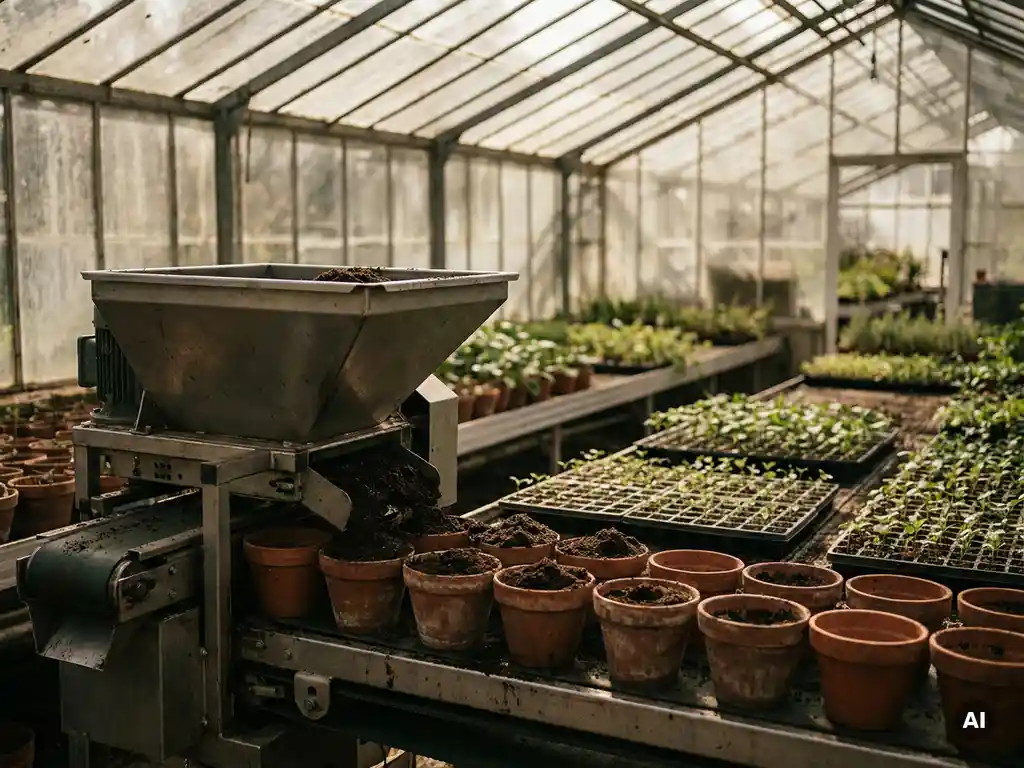
What potting machine capacity do you need if your nursery plans to grow?
Plan your potting machine capacity based on your peak daily output, not your average. As a rule of thumb, a nursery potting 5,000 to 8,000 pots per hour at peak demand needs a machine rated at or above that ceiling, running a machine at its absolute limit every day accelerates wear and leaves no room for growth. If your nursery is expanding, build in a buffer of at least 20 to 30 percent above your current peak. The questions below walk through every factor that shapes the right capacity decision.
How do you calculate the potting capacity your nursery actually needs?
To calculate the potting machine capacity you need, divide your target daily pot output by the number of productive hours in your shift, then add a 20 to 30 percent buffer for downtime, changeovers, and seasonal surges. For example, if your nursery needs to pot 40,000 plants in an eight-hour day, your baseline requirement is 5,000 pots per hour, meaning you should target a machine rated for at least 6,000 to 6,500 pots per hour.
Start with three numbers: your peak season daily target, your realistic working hours per day, and your expected efficiency rate. No machine runs at 100 percent continuously. Changeovers between pot sizes, soil refills, and short stoppages typically reduce effective output by 10 to 20 percent. Once you have a realistic hourly figure, check whether that number fits comfortably within the machine’s rated capacity range, not at its upper limit.
Also factor in pot size. Machines rated for 8,000 pots per hour typically achieve that figure with smaller pots in the 7 to 9 cm range. Larger pots, such as 17 to 30 cm, will reduce throughput. Make sure the specification you compare against reflects the pot sizes you actually use most.
What happens when a potting machine can’t keep up with demand?
When a potting machine cannot keep up with demand, the immediate result is a bottleneck that slows the entire production line. Staff wait on the machine rather than working productively, transport systems back up, and deadlines, especially auction deadlines, become difficult to meet. Over time, the pressure to compensate by running the machine harder increases breakdown risk at exactly the worst moments.
The downstream effects are often underestimated. A single hour of lost potting capacity during peak season can mean thousands of plants that miss their delivery window. Nurseries frequently respond by extending shifts or adding manual labor, which drives up costs and reintroduces the inconsistency that automation was meant to eliminate. Pot fill quality also suffers when operators rush, leading to uneven soil density and variable plant quality at the point of sale.
Capacity shortfalls also put pressure on your transport and conveyor systems, which are designed to flow at a set throughput. A machine running at its limit disrupts the rhythm of the entire line rather than just one station.
Should you buy a potting machine sized for today or for future growth?
Buy for where your nursery will realistically be in three to five years, not for today’s output. A potting machine is a long-term investment with a lifespan well beyond a single season, and undersizing it forces a premature replacement cycle. If credible growth plans exist, the cost difference between a machine that meets today’s needs and one that handles tomorrow’s volume is almost always smaller than the cost of replacing a machine too soon.
That said, oversizing has its own risks. A machine running well below its rated capacity every day is not necessarily a problem, but if your growth projections are uncertain, committing to a high-capacity machine may tie up capital unnecessarily. In those cases, a phased approach makes sense: start with a machine that comfortably handles current peak demand with a reasonable buffer, and revisit capacity when the growth materializes.
One practical middle ground is renting a higher-capacity machine during peak seasons to test whether your operation genuinely needs that throughput before committing to a purchase. This is covered in more detail in the final section below.
What’s the difference between a standard and a high-capacity potting machine?
The key difference between a standard and a high-capacity potting machine lies in throughput, automation level, and how the machine handles demanding conditions. A standard machine handles moderate volumes reliably, while a high-capacity machine is engineered to sustain peak output continuously, with features that reduce manual intervention and maintain fill consistency at speed.
Standard potting machines
Standard machines are well suited to nurseries with moderate and relatively predictable output. They handle a range of pot sizes, offer straightforward operation, and represent a lower entry cost. The trade-off is that at high throughput, fill consistency can vary, and the machine may require more frequent manual adjustments.
High-capacity potting machines
High-capacity machines, such as the Stolze 3030 PRO, are built for sustained, high-volume operation. They include features like automatic soil detection for precise and consistent fill levels, a fully guided chain for greater mechanical stability, programmable settings for different pot sizes and soil types, and quieter operation that reduces wear over long shifts. These machines are designed to run at up to 8,000 pots per hour without sacrificing fill quality, which matters when consistent pot density directly affects plant quality and auction value.
How does your soil mix affect the potting machine you need?
Your soil mix is one of the most important factors in choosing a potting machine, and it is frequently overlooked. Heavy, wet, or chunky soil mixes with bark, perlite, or coarse fiber create significantly more mechanical resistance than fine, dry potting compost. A machine not engineered for demanding mixes will clog, jam, or deliver inconsistent fill, often at the worst possible moment during peak season.
When evaluating machines, ask specifically whether the model has been tested with your type of soil mix. Key factors to consider include the auger design, the soil feed system, and whether the machine has automatic detection to compensate for variation in soil density. Without automatic soil detection, operators must manually adjust fill settings when soil moisture or composition changes, which introduces inconsistency and slows throughput.
If your nursery uses multiple soil mixes for different crops or pot sizes, look for a machine that allows you to program and save settings for each mix. This eliminates guesswork during changeovers and keeps fill quality consistent across different production runs.
When does it make sense to rent instead of buy a potting machine?
Renting a potting machine makes sense when your volume is highly seasonal, when you are evaluating a higher-capacity model before committing to a purchase, or when you are a newer operation that has not yet established a stable annual throughput. Renting removes the upfront capital commitment and lets you match machine capacity precisely to a known, time-limited demand peak.
There are three situations where renting is particularly practical:
- Seasonal peaks: If 70 percent of your annual potting volume happens in a six-week window, owning a high-capacity machine that sits idle for most of the year may not be cost-effective.
- Trial before purchase: Renting a specific model for a season gives you real-world data on whether its capacity and features match your operation before you commit to buying.
- Bridging a gap: If your current machine is being serviced or has broken down, short-term rental keeps production running without interruption.
The main limitation of renting is availability during peak periods, the machines most in demand are also the hardest to secure at short notice. Planning rental agreements well in advance of your busy season avoids this problem.
How MartinStolze helps you choose the right potting machine capacity
We help nurseries find the right potting machine capacity through a combination of hands-on expertise, a flexible product range, and genuine support from the first conversation to installation and beyond. Rather than recommending the most expensive option, we work through your actual production numbers, pot sizes, and soil mix to identify the configuration that fits your operation today and scales with your growth.
- Stolze 3030 and 3030 PRO: Both machines handle pots from 7 to 30 cm, with capacity up to 8,000 pots per hour. The PRO adds automatic soil detection, a fully guided chain, and programmable touchscreen settings for demanding, high-volume environments.
- Complete line integration: Our potting machines connect seamlessly with our transport systems, topping machines, tray fillers, and sorting lines for a fully automated production flow.
- Buy or rent: Both options are available, including a trial period, so you can test capacity in your own operation before committing.
- In-house production and support: We design, build, and install every machine ourselves, and our own technicians handle training and maintenance from our facility in De Lier.
If you are ready to work out the right capacity for your nursery, get in touch with us and we will help you build a solution that matches your ambitions.
Frequently Asked Questions
How often should a potting machine be serviced to maintain its rated capacity?
A potting machine should undergo a full preventive maintenance check at least once a year, ideally before your peak season begins, with lighter inspections every few weeks during heavy use. Key components to monitor include the auger, soil feed system, chain, and fill sensors, as wear on these parts directly affects throughput and fill consistency. Keeping a maintenance log helps you spot patterns early and schedule servicing during downtime rather than losing production hours at the worst possible moment.
Can one potting machine handle multiple pot sizes in a single day, and how does switching affect output?
Yes, most modern potting machines can handle a range of pot sizes, but every changeover between sizes costs time and temporarily reduces your effective daily output. On machines without programmable settings, operators must manually readjust fill volumes and conveyor speeds, which can take 15 to 30 minutes per switch and introduce inconsistency. Machines with programmable touchscreen settings, like the Stolze 3030 PRO, allow you to save presets for each pot size and soil mix, reducing changeover time significantly and keeping fill quality consistent across different production runs.
What are the most common mistakes nurseries make when sizing a potting machine?
The most common mistake is sizing based on average daily output rather than peak demand, which leaves the machine running at or beyond its limit during the busiest weeks of the season. A close second is ignoring the impact of soil mix and pot size on actual throughput, since a machine rated for 8,000 pots per hour with small pots and fine compost may deliver considerably less with larger pots or a chunky bark-heavy mix. Failing to build in a capacity buffer for downtime, changeovers, and year-on-year growth is the third mistake, and it often forces a premature and costly machine replacement.
How do I know if my current potting machine is genuinely at capacity or just being operated inefficiently?
Start by tracking your actual output per hour across several shifts and comparing it against the machine's rated capacity for your specific pot size and soil mix. If you are consistently achieving 85 percent or more of the rated capacity and still struggling to meet daily targets, the machine is likely genuinely undersized. If output is well below rated capacity, the bottleneck is more likely operational, such as slow soil refills, frequent manual adjustments, or staff workflow issues, which can often be resolved without investing in a new machine.
What should I ask a supplier before buying or renting a potting machine?
Ask for throughput figures specific to the pot sizes and soil mix you actually use, not just the headline maximum capacity figure, which is typically measured under ideal conditions with small pots and fine compost. Find out whether the machine has been tested with mixes similar to yours, what the realistic changeover time is between pot sizes, and what support is available if the machine goes down during peak season. It is also worth asking whether a trial period or rental option is available, so you can validate real-world performance in your own operation before making a long-term commitment.
Is it worth investing in a fully integrated potting line rather than a standalone machine?
For nurseries operating at high volume or running multiple shifts, a fully integrated line that connects the potting machine with transport conveyors, topping machines, and sorting systems almost always delivers a better return than a standalone machine surrounded by manual handling steps. Manual handling between stations reintroduces the inconsistency and labor cost that automation is designed to eliminate, and it typically becomes the new bottleneck as potting speed increases. If your current setup involves staff moving trays or plants between an automated potting station and a manual next step, that gap is worth evaluating as part of any capacity upgrade conversation.
How long does it typically take to recoup the investment in a higher-capacity potting machine?
Payback period depends on your volume, labor costs, and how much the upgrade reduces manual handling or overtime, but many nurseries operating at high seasonal volume see a return within two to four growing seasons. The calculation should include not just the machine cost but the value of reduced labor hours, fewer quality rejects due to inconsistent fill, and the ability to meet auction or delivery deadlines that would otherwise be missed. Getting a clear picture of your current cost per pot, including labor, rework, and downtime, gives you the most accurate baseline for comparing it against the all-in cost of a new machine.
Related Articles
- Can a topping machine apply an even layer to every pot?
- How do manufacturers calculate potting machine pots per hour?
- How do you calculate the number of production hours needed for a large crop batch?
- Does running pots in multiple rows increase hourly production?
- What does a fully automated potting line actually look like?