

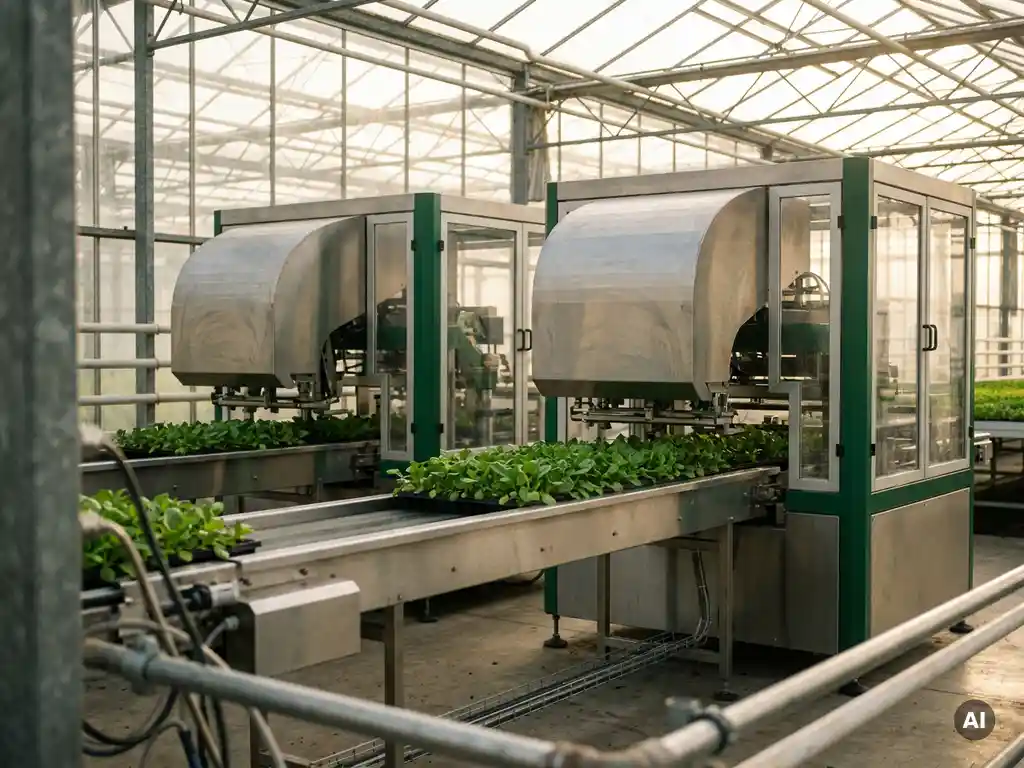
What should you look for when comparing professional topping machines?
When comparing professional potting machines, the most important factors are capacity, soil mix compatibility, automation features, and integration with your existing production line. A professional machine should handle your peak-season volumes without compromising fill consistency, work reliably with your specific growing medium, and fit into a broader automated workflow. The sections below unpack each of these decision points in detail.
What features actually separate professional potting machines from basic models?
Professional potting machines stand apart from basic models through advanced control systems, consistent fill accuracy, and the ability to handle a wide range of pot sizes and soil types without manual adjustment. Where basic machines rely on fixed mechanical settings, professional models use PLC controls and touchscreen interfaces that let you program and store settings for different pot sizes, fill depths, and rotation speeds.
The practical difference shows up during busy production runs. A professional machine maintains the same fill density from the first pot to the ten-thousandth, which matters enormously when you are supplying a consistent product to auction or retail. Features like automatic soil detection prevent underfilled or overfilled pots, while a fully guided chain system reduces vibration, noise, and wear over time. These are not luxury additions – they directly affect your reject rate, your labour costs, and the reliability of your output when seasonal pressure is at its highest.
- PLC control with touchscreen: Store and recall programs for different pot sizes and fill configurations
- Automatic soil detection: Ensures consistent fill volume without manual monitoring
- Wide pot size range: Professional machines typically handle pots from 7 cm up to 30 cm
- Guided chain systems: Reduce mechanical wear and improve pot stability during filling
- Single, double, and alternating run modes: Adapt output to different tray formats and production layouts
How does potting machine capacity affect your daily output?
Potting machine capacity directly determines how many pots you can process per shift, which sets the ceiling on your entire production throughput. A machine rated at 8,000 pots per hour gives you the headroom to meet peak-season demand without overtime, additional staff, or backlogs building up before the auction deadline.
Capacity is not just a number on a specification sheet. It only delivers its full value when the rest of your line keeps pace, soil supply, transport, and sorting all need to match the machine’s output rate. If your potting machine can run at 8,000 pots per hour but your conveyor system or soil feed cannot keep up, you will never reach that figure in practice. When planning your investment, work backwards from your busiest day of the year and make sure every part of the line is sized to match.
It is also worth considering whether you need that full capacity every day. If your volumes fluctuate significantly between seasons, a machine with adjustable speed settings gives you the flexibility to run at a lower rate during quieter periods without sacrificing efficiency or putting unnecessary wear on the equipment.
What soil mix types can professional potting machines handle?
Professional potting machines are designed to handle a broad range of growing media, including standard peat-based mixes, coir substrates, bark mixes, and blends containing perlite or sand. The key is that the machine’s soil feed mechanism and auger system are robust enough to cope with varying densities, moisture levels, and particle sizes without jamming or producing inconsistent fills.
This is where cheaper machines frequently fall short. A light-duty model may work well with a fine, dry peat mix but struggle with a heavier, wetter substrate or a chunky bark blend. The result is blockages, uneven fills, and downtime at exactly the moment you cannot afford it. Professional machines use more powerful drive systems and better-engineered soil channels to maintain steady flow regardless of the mix.
If you use a specific or unusual growing medium, it is worth discussing this with your supplier before purchasing. A reputable manufacturer will test your mix or advise on the right configuration, so you know the machine will perform reliably with your actual materials from day one.
Should you buy or rent a potting machine?
Whether to buy or rent a potting machine depends on your production volume, how frequently you need the machine, and your appetite for capital investment. Buying makes sense when potting is a year-round or high-frequency activity and you want full control over the machine’s configuration and availability. Renting is a practical option for seasonal growers, businesses testing a new production setup, or anyone who wants to evaluate a specific model before committing.
Renting also lowers the barrier for first-time buyers who are uncertain about which machine best fits their workflow. A trial period lets you run the machine with your own soil mix, your own pot sizes, and your own team before making a long-term decision. This removes much of the investment risk that comes with switching from manual potting or upgrading from an older machine.
From a financial perspective, ownership typically becomes more cost-effective once the machine is running for a significant portion of the year. If you are potting intensively across multiple seasons, the per-unit cost of ownership falls well below rental rates over time. For occasional or short-season use, rental keeps capital free for other parts of your operation.
How does a potting machine integrate with the rest of your production line?
A potting machine integrates with the rest of your production line through compatible conveyor systems, tray fillers, topping machines, and sorting equipment that connect upstream and downstream of the potting station. The goal is a continuous flow where pots move automatically from soil filling through to transport and dispatch, with minimal manual handling at any stage.
Integration works best when the potting machine and surrounding equipment come from a supplier who designs them to work together. Machines built to compatible speeds, heights, and control protocols connect without custom engineering or workarounds. When components are sourced from different manufacturers, you often encounter mismatched conveyor heights, incompatible control systems, or speed differences that create bottlenecks.
A well-integrated line also supports ergonomic working conditions. When pots flow automatically from the potting machine onto transport conveyors, staff are freed from repetitive lifting and carrying, reducing physical strain and allowing them to focus on quality checks and plant care instead.
What after-sales support should you expect from a potting machine supplier?
From a professional potting machine supplier, you should expect installation support, operator training, readily available spare parts, and responsive technical assistance when something goes wrong. After-sales service is not an optional extra – it is part of the value of the machine, particularly during peak production when downtime has a direct financial impact.
Training is especially important when a machine has programmable settings and multiple operating modes. A supplier who offers hands-on training at a demonstration facility, rather than just a manual, gives your team the confidence to use the machine to its full potential from the start. Ongoing access to technical support, whether by phone, remote diagnostics, or on-site visits from the supplier’s own engineers, ensures that problems are resolved quickly rather than waiting days for a third-party technician.
Ask specifically whether the supplier’s service team is in-house or outsourced. In-house engineers who know the machine inside out will almost always resolve issues faster and more accurately than a contracted service partner working from documentation.
How MartinStolze supports your potting operation
We design and build our potting machines entirely in-house, from engineering and programming through to assembly and installation. Our flagship models, the Stolze 3030 and the Stolze 3030 PRO, cover pot sizes from 7 to 30 cm and reach capacities of up to 8,000 pots per hour. The 3030 PRO adds automatic soil detection, a fully guided chain, and quieter operation with reduced maintenance needs.
- Complete line integration: Our potting machines connect seamlessly with our own conveyors, topping machines, tray fillers, and sorting lines
- Flexible investment options: Both purchase and rental are available, including trial periods for new buyers
- In-house service team: Our own engineers handle installation, training, and technical support
- Hands-on training: We offer practical operator training at our demo and training facility in De Lier
- Soil mix guidance: We help you select the right configuration for your specific growing medium before you commit
Whether you are potting ornamental plants, pot plants, or vegetable seedlings at scale, we are here to help you find the right setup for your operation. Get in touch with our team to discuss your requirements or arrange a demonstration.
Frequently Asked Questions
How do I know which potting machine capacity is right for my operation?
Start by calculating your peak-day output requirement — the maximum number of pots you need to process in a single shift during your busiest season. Add a buffer of at least 20–30% to that figure to account for brief stoppages, soil refills, and line adjustments. From there, choose a machine whose rated capacity comfortably exceeds that number, and make sure your conveyor, soil supply, and sorting equipment are all sized to match — otherwise the machine's full capacity will never be realised in practice.
What happens if my soil mix is too wet or too chunky for the machine?
Overly wet or coarse substrates are one of the most common causes of blockages, inconsistent fills, and unplanned downtime on lighter-duty machines. Professional potting machines use more powerful drive systems and wider soil channels specifically to handle varying moisture levels and particle sizes, but it is still worth discussing your exact mix with your supplier before purchasing. A reputable manufacturer will either test your substrate directly or recommend the correct auger and feed configuration so the machine performs reliably with your actual growing medium from day one.
Can a potting machine handle multiple pot sizes in the same production run?
Yes — professional potting machines with PLC controls allow you to store and recall separate programs for different pot sizes, fill depths, and conveyor speeds, making it straightforward to switch between formats during a shift. The changeover time depends on the machine and the size difference involved, but on a well-configured professional model it is typically a matter of minutes rather than a lengthy manual reset. If you regularly run several different pot sizes, confirm with your supplier how many programs can be stored and how the pot guides or chain settings are adjusted between runs.
What are the most common mistakes growers make when buying their first potting machine?
The most frequent mistake is focusing solely on the potting machine itself without planning the full production line around it — a high-capacity machine paired with an undersized conveyor or slow soil feed will create bottlenecks that cancel out the efficiency gain. A second common error is underestimating peak-season demand and buying a machine that is already at its ceiling on the busiest days of the year, leaving no headroom for growth. Finally, many first-time buyers overlook after-sales support, only to find that sourcing spare parts or getting technical help takes far longer than expected when a problem arises mid-season.
How long does installation and operator training typically take for a professional potting machine?
For a standalone potting machine, installation is typically completed within a day, though integrating it into a full automated line with conveyors and sorting equipment will take longer depending on the complexity of the setup. Operator training with a hands-on session at a supplier's demonstration facility usually takes one day and is enough for most teams to run the machine confidently, including programming new pot sizes and responding to common alerts. Investing in proper training upfront pays back quickly — operators who understand the machine's full range of settings make fewer errors and keep the line running closer to its rated capacity.
Is it possible to expand or upgrade a potting machine as my business grows?
Many professional potting machines are designed with scalability in mind, meaning you can add downstream equipment — such as topping machines, transport conveyors, or automated sorting lines — as your volumes increase without replacing the potting unit itself. Some models also support software or hardware upgrades, such as adding automatic soil detection to a base model, which can extend the machine's useful life significantly. When evaluating a machine, ask your supplier explicitly what upgrade paths are available and whether the control system is compatible with additional automation modules you might want to add later.
What maintenance routine should I follow to keep a professional potting machine running reliably?
Daily maintenance typically involves clearing soil residue from the auger, feed channels, and conveyor surfaces, as compacted substrate is the leading cause of jams and fill inconsistencies over time. Weekly checks should cover chain tension, lubrication points, and wear on any components that contact the pots directly. Beyond that, follow the manufacturer's scheduled service intervals for drive systems and sensors — and keep a stock of the most commonly replaced wear parts on hand so that a minor issue during peak season does not turn into a costly delay waiting for delivery.
Related Articles
- How do you prevent wasting substrate when topping thousands of pots?
- How do soil mix properties affect potting machine performance?
- How many pots per hour can a modern potting machine handle?
- When does manual potting become too slow for your nursery?
- How does a touchscreen-controlled potting machine simplify daily use?