
When should a nursery invest in a conveyor belt system?
For many nurseries, the moment they consider a conveyor belt system arrives not as a planned decision but as a reaction to daily frustration. Plants are moving too slowly, staff are exhausted, and bottlenecks are eating into production time. Understanding when that frustration signals a genuine need for investment can save a nursery significant time, money, and physical strain.
This guide answers the most common questions nursery managers ask when exploring conveyor belt horticulture solutions. Whether you run a small ornamental nursery or a large-scale distribution centre, these answers will help you make a confident, well-informed decision.
What signs show a nursery is ready for a conveyor belt system?
A nursery is ready for a conveyor belt system when manual plant transport consumes a significant portion of daily labour hours, staff are covering excessive distances on foot, or bottlenecks in the production flow are causing visible delays. If any of these patterns are consistent rather than occasional, the operational cost of not automating is already high.
The clearest signal is physical strain on your team. When workers spend a large part of their shift pushing trolleys back and forth across a greenhouse, fatigue sets in quickly, and absenteeism follows. A second signal is inconsistent throughput: if your potting machine, sorting line, or packing station regularly sits idle while waiting for plants to arrive, the bottleneck is in transport, not the equipment itself. A third signal is growth. When a nursery expands its floor space or production volume, manual transport simply cannot scale at the same pace.
How does a conveyor belt system work in a greenhouse environment?
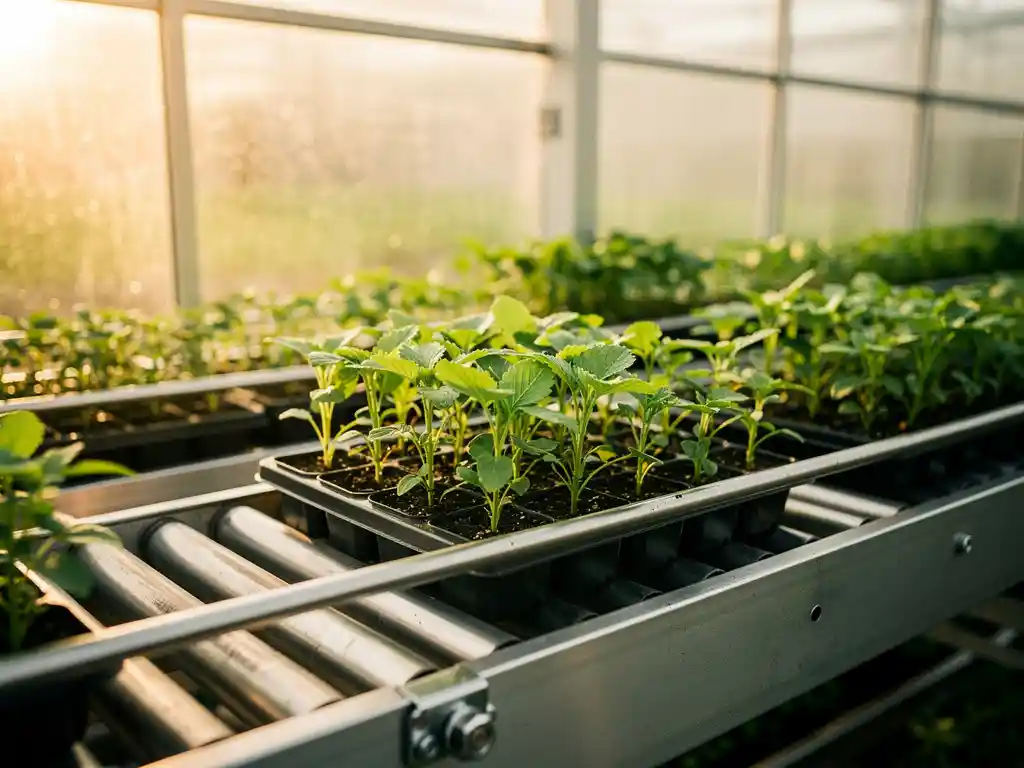
A conveyor belt system in a greenhouse moves plants, pots, trays, or substrate continuously along a fixed or mobile track, connecting different stations in the production process. Rather than relying on workers to carry or push loads between locations, the belt handles the movement automatically, keeping the workflow steady and reducing unnecessary handling.
In a greenhouse setting, conveyor systems must cope with moisture, soil, and variable temperatures. This is why purpose-built horticultural conveyor belts are constructed from materials that resist corrosion and contamination. A well-designed system can link a potting machine directly to a buffer table and then on to a spacing robot or packing station, creating a continuous production line with minimal manual intervention. We design our conveyor systems specifically for these conditions, ensuring that every component performs reliably in the demanding environment of a working greenhouse.
What’s the difference between fixed and mobile conveyor belt systems?
Fixed conveyor belt systems are permanently installed along a set route in the greenhouse and are best suited to nurseries with a stable, high-volume production layout. Mobile conveyor belt systems are freestanding and repositionable, making them ideal for operations that change their layout seasonally or want flexibility across different growing areas.
Fixed systems
Fixed systems deliver maximum throughput efficiency when your production line is consistent. They integrate directly with other machinery, such as potting lines, irrigation systems, and sorting equipment. Installation requires planning but results in a seamless, automated flow that requires minimal daily adjustment.
Mobile systems
Mobile systems, such as the EasyMax and Wevab ranges, offer a practical entry point for nurseries that are not yet ready to commit to a full fixed installation or that operate in spaces where the layout changes regularly. They can be repositioned quickly, used across multiple greenhouse sections, and scaled up over time. For many growers, starting with a mobile solution is the most practical way to experience the benefits of automation before investing in a permanent setup.
When does a conveyor belt system pay for itself in a nursery?
A conveyor belt system typically pays for itself when labour savings, reduced absenteeism, and productivity gains outweigh the investment cost. In high-volume nurseries where multiple workers are dedicated to manual transport, this crossover point can arrive within one to two growing seasons, depending on system complexity and operational scale.
The calculation is straightforward: count the hours currently spent on manual transport, multiply by your hourly labour cost, and compare that figure to the annualised cost of the system. What many nurseries underestimate is the indirect cost of bottlenecks. When a potting machine or packing line is waiting for plants, that idle time has a real cost too. Reducing physical strain also lowers the risk of injury-related absence, which carries its own financial and operational consequences. The return on investment becomes compelling quickly once all these factors are included.
Should a nursery rent or buy a conveyor belt system?
Renting is the better choice when a nursery wants to test automation before committing, needs a short-term solution for a peak season, or is unsure which system configuration best fits its operation. Buying makes more sense when the need is structural, the layout is stable, and the nursery is ready to integrate the system into its long-term production setup.
We offer rental as a deliberate, low-threshold option for nurseries that are exploring automation for the first time. Renting allows you to experience the operational impact of a conveyor system without the full capital commitment, and it gives your team time to understand how automation changes daily workflows. If the rental period confirms the value, transitioning to ownership is a natural next step. For established operations with a clear, ongoing need, purchasing delivers better long-term value and allows for full customisation and integration with existing machinery.
What should a nursery look for when choosing a conveyor belt supplier?
When choosing a conveyor belt supplier for a nursery, look for a supplier with direct horticultural experience, in-house production capability, and the ability to handle installation and service with its own team. A supplier who understands greenhouse conditions, crop-handling requirements, and production flow will deliver a solution that truly fits your operation.
Avoid suppliers who adapt general industrial conveyor systems for horticultural use. The specific demands of a greenhouse, including moisture resistance, gentle plant handling, and integration with potting and spacing equipment, require purpose-built solutions. Key questions to ask any supplier include: Do you manufacture your own systems? Can you provide references from comparable nurseries? Do your own engineers handle installation and maintenance? A supplier who answers yes to all three is far more likely to deliver a system that performs reliably over the long term and can be adapted as your operation grows.
Frequently Asked Questions
Can a conveyor belt system handle different pot sizes and plant types without constant reconfiguration?
Most purpose-built horticultural conveyor systems are designed to accommodate a range of pot sizes, tray formats, and plant heights with minimal adjustment. Belt width, side guides, and speed settings can typically be adapted to suit different crops or product lines. If your nursery grows a diverse range of species or switches between product types seasonally, discuss this with your supplier upfront so the system is configured with the necessary flexibility built in from the start.
How much space does a conveyor belt system actually require in a greenhouse?
Space requirements vary significantly depending on whether you choose a fixed or mobile system and how it is routed through your production area. Mobile systems like the EasyMax are compact and designed to fit within standard greenhouse aisle widths, while fixed installations are planned around your existing layout to minimise disruption to growing space. The best approach is to have a supplier conduct an on-site assessment, as an experienced horticultural conveyor specialist can often identify routing solutions that nursery managers overlook when planning independently.
What happens to production if the conveyor belt breaks down or needs maintenance?
Downtime risk is a legitimate concern and one of the strongest reasons to choose a supplier who handles servicing with their own engineers rather than outsourcing it. Purpose-built horticultural systems with quality components and regular preventive maintenance have very low unplanned downtime rates. It is also worth asking your supplier about spare parts availability and response times before you commit, as a supplier who stocks critical parts locally and can dispatch a technician quickly makes a significant difference to how quickly any issue is resolved.
Do we need to retrain our staff significantly when introducing a conveyor belt system?
The operational learning curve for most horticultural conveyor systems is relatively short, particularly for mobile systems that are designed with simplicity in mind. Staff typically adapt quickly because the core change is removing physically demanding transport tasks rather than adding complex new responsibilities. A good supplier will include hands-on training as part of the installation process, and starting with a rental period is an effective way to let your team build confidence with the technology before it becomes a permanent part of your workflow.
Can a conveyor system be integrated with our existing potting machine or spacing robot?
Yes, and this is one of the most valuable aspects of a well-designed conveyor installation. Connecting your conveyor directly to a potting machine, spacing robot, or packing station eliminates the manual handoffs between production steps that typically cause the most significant bottlenecks. The key is to work with a supplier who has direct experience integrating conveyor systems with the specific machinery brands and models you already use, as this ensures compatibility and a smooth, continuous production flow rather than a patchwork of disconnected equipment.
Is a conveyor belt system a practical option for smaller nurseries, or is it only cost-effective at large scale?
Conveyor systems are increasingly accessible to smaller nurseries, largely because mobile and modular options have lowered the entry point significantly compared to full fixed installations. A small ornamental nursery with even two or three workers spending a meaningful portion of their day on manual plant transport can see a genuine return on a compact mobile system. Starting with a single belt section that addresses your most painful bottleneck, rather than trying to automate everything at once, is a sensible and cost-effective approach for smaller operations.
What are the most common mistakes nurseries make when implementing a conveyor belt system for the first time?
The most common mistake is underestimating the importance of layout planning before installation, which can result in a system that moves plants efficiently along one stretch but creates new bottlenecks at connection points or buffer zones. A second frequent error is choosing a system based on purchase price alone without factoring in the supplier's service capability, spare parts availability, and horticultural expertise. Finally, some nurseries implement automation without involving the staff who will use it daily, which slows adoption and reduces the operational gains the system was designed to deliver.
Related Articles
- How many pots can a potting machine process during an eight-hour shift?
- What should you look for when replacing an outdated potting machine?
- What does a fully automated potting line actually look like?
- How does poor internal transport affect greenhouse output?
- How do ergonomic solutions reduce sick leave in horticulture?