
When should you use single-row versus double-row potting?
Use single-row potting when you have lower volumes, smaller operations, or limited floor space. Use double-row potting when you need higher throughput, are working with uniform pot sizes at scale, or need to maximise output per operator. The right configuration depends on your daily volume targets, pot size range, and how your potting line is set up.
For most professional growers, the decision comes down to matching machine output to actual operational demand. Oversizing your setup creates unnecessary cost; undersizing it creates bottlenecks at exactly the wrong moments. The sections below break down each key consideration to help you make the right call.
What’s the difference between single-row and double-row potting?
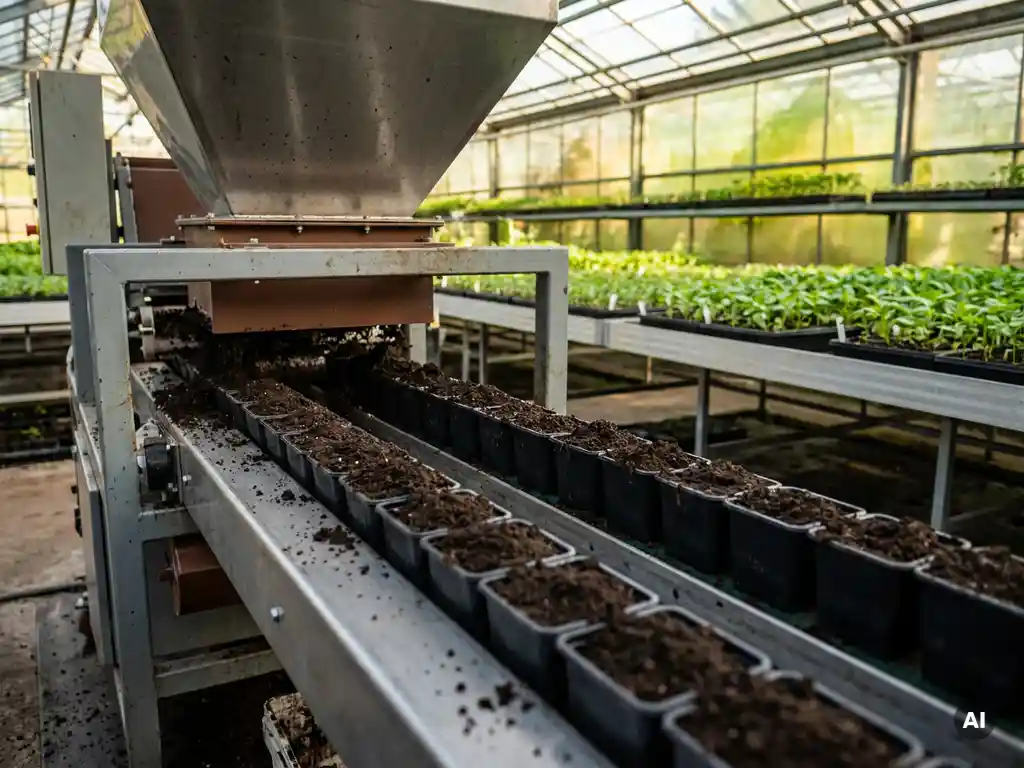
Single-row potting fills one row of pots in each cycle, while double-row potting fills two rows simultaneously. The core difference is throughput: double-row machines process significantly more pots per hour using the same cycle speed, because each pass through the filling and boring mechanism produces twice the output.
Beyond raw numbers, the two configurations also differ in how they handle soil distribution, pot spacing, and conveyor synchronisation. In a single-row setup, the machine focuses all filling pressure on one row, which can be an advantage when working with delicate root structures or very small pot sizes that require precise placement. Double-row setups divide that same filling action across two simultaneous positions, which demands a more consistent soil feed rate and a conveyor system wide enough to handle side-by-side pots moving in tandem.
Some machines, including the Stolze 3030, can operate in single-row, double-row, or alternating mode, giving growers the flexibility to switch configurations based on what they are running that day.
Which potting configuration handles higher volumes better?
Double-row potting handles higher volumes significantly better than single-row. By filling two rows per cycle, a double-row configuration can reach up to 8,000 pots per hour, roughly doubling the output of a comparable single-row setup running at the same cycle speed. For operations with high daily targets, double-row is the more efficient choice.
The efficiency gain is not just about raw pots per hour. With double-row potting, you are also achieving more output per operator, per square metre of floor space used by the machine, and per unit of soil consumed in the process. At scale, those marginal gains add up meaningfully across a full growing season.
That said, achieving maximum pots per hour in double-row mode depends on a consistent soil supply. If your soil feed is irregular or your mix is difficult to work with, double-row operation can amplify inconsistencies. A machine with automatic soil detection, like the Stolze 3030 PRO, compensates for this by adjusting fill levels dynamically, maintaining consistent pot density even at high output rates.
Does pot size affect whether single-row or double-row is better?
Yes, pot size directly affects which configuration is more practical. Larger pots, typically above 17 cm, take up more lateral space on the conveyor and may not fit comfortably side by side in a double-row setup. Smaller pots, from 7 to around 13 cm, are well suited to double-row operation because their compact footprint allows two rows to run in parallel without crowding.
When working with a wide range of pot sizes across the same day or week, a machine that can switch between single-row and double-row operation gives you much more flexibility. You can run double-row for the smaller, high-volume sizes in the morning and switch to single-row for larger containers in the afternoon without reconfiguring the entire line.
Growers who specialise in one pot size range and run it consistently at high volume are the clearest candidates for a fixed double-row setup. Those with diverse assortments benefit more from a flexible machine that adapts to what is on the schedule.
When does a single-row machine make more sense than double-row?
A single-row machine makes more sense when your daily volume is moderate, your pot sizes are large, your floor space is limited, or your soil mix is particularly heavy or irregular. In each of these scenarios, the added complexity of double-row operation introduces more risk than benefit.
For smaller nurseries or operations that pot in shorter runs with frequent changeovers, single-row machines are easier to set up, easier to clean, and simpler to maintain. The reduced mechanical complexity also means fewer points of potential failure during peak season, when downtime is most costly.
Single-row setups also work better when the potting line feeds into a manual handling step immediately after filling. If workers are placing pots by hand after the machine, a single row is easier to keep pace with than a double stream of pots coming off the conveyor simultaneously.
Can a potting machine switch between single-row and double-row?
Yes, some potting machines can switch between single-row and double-row operation. The Stolze 3030, for example, runs single-row, double-row, or alternating-row configurations, and settings for each mode can be programmed and saved via the touchscreen so operators can switch between them quickly without manual recalibration each time.
This flexibility is particularly valuable for growers with a varied assortment. Rather than investing in two separate machines or compromising with a fixed configuration that does not suit every product, a switchable machine lets you optimise output for whatever you are running. Programmed presets mean the transition between modes takes minutes rather than hours, which matters when you are working through multiple batches in a single shift.
Not all machines offer this capability, so if operational flexibility is a priority, it is worth confirming whether the machine you are evaluating supports multiple row configurations before purchasing.
How does row configuration affect integration with conveyor lines?
Row configuration has a direct impact on how a potting machine integrates with the rest of your conveyor and transport lines. Double-row operation requires a wider conveyor belt and a transport system capable of handling two parallel streams of pots at the output speed generated by the machine. Single-row operation is simpler to integrate and compatible with narrower conveyor setups.
The spacing, speed, and synchronisation of the conveyor must match the potting machine’s output rate. If the conveyor cannot keep up with a double-row machine running at full capacity, pots will back up at the exit point, creating a bottleneck that negates the throughput advantage of double-row potting entirely.
When designing a complete potting line, it is worth planning the conveyor configuration and the potting machine configuration together rather than separately. The two systems need to be matched in width, speed, and capacity to function as a single efficient line rather than two pieces of equipment working against each other.
How MartinStolze helps you choose the right potting configuration
Choosing between single-row and double-row potting is not just a technical question. It involves your assortment, your daily targets, your floor layout, and how your potting line connects to the rest of your operation. We help growers work through exactly these questions before making any investment.
- Flexible machines: The Stolze 3030 and 3030 PRO run single-row, double-row, and alternating-row configurations, with programmable presets for different pot sizes from 7 to 30 cm.
- Up to 8,000 pots per hour: In double-row mode, our machines reach maximum output without sacrificing fill consistency, thanks to automatic soil detection on the PRO model.
- Full line integration: Our potting machines are designed to connect seamlessly with our own conveyor systems, so row configuration and transport capacity are matched from the start.
- Try before you commit: Both buying and renting are available, including trial periods, so you can validate the configuration in your own operation before making a long-term decision.
- Support from our own technicians: From installation to operator training at our demo facility in De Lier, we stay involved after the machine is running.
If you are weighing up single-row versus double-row for your operation, get in touch with us and we will help you find the configuration that fits your volumes, your assortment, and your line.
Frequently Asked Questions
How do I know if my current conveyor system is compatible with double-row potting?
Start by checking your conveyor belt width — it needs to accommodate two rows of your largest pot size running side by side, plus clearance between them. You should also verify that your conveyor speed can match the output rate of a double-row machine at full capacity, typically up to 8,000 pots per hour. If you are unsure, consult the machine supplier before purchasing; mismatched conveyor and potting machine specs are one of the most common and costly integration mistakes.
What happens to fill consistency when switching from single-row to double-row mid-season?
Fill consistency can drop temporarily when switching configurations if your soil feed rate is not adjusted to match the increased demand of double-row operation. Double-row potting consumes soil at roughly twice the rate, so your soil hopper and feed mechanism need to keep pace. Machines with automatic soil detection, like the Stolze 3030 PRO, compensate dynamically, but on standard machines you may need to manually recalibrate your fill settings after switching modes.
Is double-row potting worth it if I only run high volumes a few months of the year?
It depends on whether the machine you choose can also operate efficiently in single-row mode during quieter periods. A fixed double-row machine running below capacity for most of the year is rarely cost-effective. However, a switchable machine like the Stolze 3030 lets you run double-row during peak season and single-row during lower-volume periods, making it a practical investment even for operations with seasonal demand spikes.
Can I run different pot sizes in the same double-row pass?
No — double-row potting requires both rows to use the same pot size, since the machine fills and bores both rows simultaneously in a single pass. Mixing pot sizes within the same double-row cycle would result in inconsistent fill depths and misaligned boring. If your schedule includes multiple pot sizes in the same shift, a machine with programmable presets lets you switch configurations quickly between batches rather than trying to run mixed sizes simultaneously.
What are the most common mistakes growers make when choosing between single-row and double-row potting?
The most frequent mistake is choosing based on maximum theoretical output rather than actual daily volume targets, which leads to oversized setups that add cost without adding real benefit. A close second is failing to plan conveyor integration alongside the potting machine, resulting in bottlenecks that cancel out any throughput gains from double-row operation. Choosing a configuration that cannot adapt to your pot size range is another common pitfall — particularly for growers with diverse assortments who lock themselves into a fixed setup.
How long does it take to switch a compatible machine between single-row and double-row mode?
On machines with programmable presets, such as the Stolze 3030, switching between row configurations typically takes just a few minutes once the presets have been set up for each mode. The initial programming takes longer, but once saved, operators can recall settings via the touchscreen without manual recalibration. This makes mid-shift changeovers practical, which is especially useful for operations running different pot sizes across the same working day.
Should I rent or buy a potting machine to test which row configuration suits my operation?
Renting first is a low-risk way to validate whether single-row or double-row operation genuinely fits your volumes, soil type, and line layout before committing to a purchase. Running the machine in your own environment reveals practical challenges — like soil feed irregularities or conveyor mismatches — that are difficult to predict from specs alone. Suppliers like MartinStolze offer both rental and trial options specifically to help growers make a confident, informed decision before any long-term investment.