

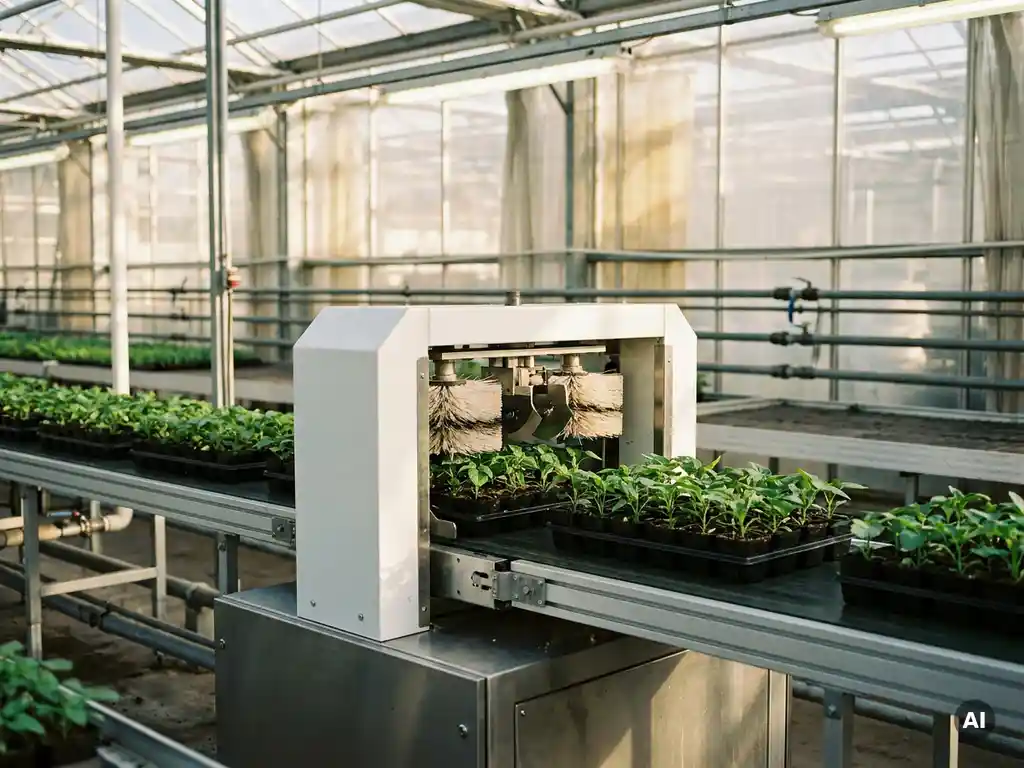
Where should a topping machine be positioned in a production line?
A topping machine should be positioned directly after the potting machine in the production line, close enough to apply a layer of cover soil immediately after pots are filled. This sequential placement ensures a smooth, uninterrupted flow and prevents filled pots from accumulating without their protective top layer. The sections below unpack each key positioning decision in detail.
What factors determine the ideal position of a potting machine?
The ideal position of a potting machine in a production line is determined by three core factors: the direction and source of soil supply, the available floor space, and the flow of pots from infeed to outfeed. Getting these three elements aligned before installation prevents costly rearrangements and ensures the entire line runs efficiently from day one.
Beyond those fundamentals, consider where your workforce naturally congregates. Operators need clear sightlines across the potting station, and any quality checks or manual interventions should be reachable without crossing active conveyor paths. The potting machine is the heartbeat of the line, so every upstream and downstream element should be arranged around it rather than the other way around.
Finally, think about maintenance access. A potting machine that is wedged tightly against a wall or another machine is harder to service, which means downtime stretches longer than it needs to. Building in clearance from the start pays dividends every time a technician needs to reach the back of the unit.
Where in the line should soil supply connect to the potting machine?
Soil supply should connect to the potting machine from the rear or side, depending on the machine model, in a way that does not obstruct the main pot flow running front to back. The feed point must be positioned so that the soil hopper or conveyor delivers a consistent, gravity-assisted flow directly into the filling mechanism without bridging or interruption.
In practice, most professional greenhouse setups route a soil transport conveyor along the wall or overhead, dropping material into the machine’s hopper from above or behind. This keeps the central working area clear for pot handling and operator movement. If your soil mix contains perlite, bark, or other coarse materials, the feed angle matters even more, as steep drops can cause separation in the mix and lead to inconsistent pot density.
Always plan for a buffer volume in the hopper. A supply line that feeds exactly at the rate the machine consumes leaves no margin for brief stoppages upstream. A hopper with a few minutes of reserve capacity keeps the potting machine running even when the soil conveyor pauses momentarily.
How does pot infeed direction affect production line layout?
Pot infeed direction determines the entire orientation of the production line. If pots enter the potting machine from the left, the line naturally flows left to right, and all downstream equipment, including the topping machine, conveyors, and sorting stations, must follow that same direction. Reversing infeed direction mid-line creates bottlenecks and forces operators to work against the natural flow.
Before committing to an infeed direction, map the full path from pot storage or tray loading all the way to the final output point, whether that is a greenhouse bench, a transport trolley, or a dispatch area. The shortest, most linear path with the fewest turns is almost always the most efficient. Sharp 90-degree turns slow down conveyors and increase the risk of pots tipping, especially with lighter substrates that shift during movement.
Also consider where your team stands. Right-handed operators generally find it more comfortable to work with flow moving from left to right, while left-handed configurations suit other team setups. Matching the infeed direction to your team’s natural movement reduces fatigue over a long shift.
What should come directly after the potting machine on the line?
Directly after the potting machine, you should place the topping machine. The topping machine applies a layer of cover soil or bark immediately after pots are filled, which protects the substrate, improves presentation, and, in many crops, helps with moisture retention. Placing it immediately downstream ensures no pot reaches the next handling stage without its top layer.
After the topping machine, the typical sequence is a short buffer conveyor followed by a quality check station or a labelling point. This buffer gives operators a moment to inspect pots and remove any that are underfilled, overfilled, or misaligned before they move further down the line. Catching rejects early is far more efficient than sorting them at the end.
From there, pots typically move to a spacing or distribution conveyor that spreads them to the correct bench density, or they feed directly into a transport system for onward movement within the greenhouse. The exact sequence depends on your crop and your facility layout, but the potting machine followed immediately by the topping machine is a consistent best practice across professional potting operations.
How much space does a potting machine need around it?
A potting machine needs a minimum of one metre of clear space on each side that an operator or technician needs to access, and at least 80 centimetres at the rear for soil supply connections and maintenance. The front working zone, where operators load empty pots and monitor filling quality, should have at least 1.5 metres of unobstructed floor space.
These are minimum clearances. In a busy production environment where multiple people work around the machine simultaneously, wider clearances reduce collision risk and make it easier to move pots, tools, and trolleys without interrupting the line. If your facility allows it, planning for 1.5 to 2 metres on each operator side is a comfortable working standard.
Overhead space matters too. Soil supply conveyors, lighting rigs, and irrigation lines often run above the potting station. Make sure there is enough vertical clearance to install and service those elements without requiring the potting machine to be moved each time.
Should a potting machine be fixed or movable in the production line?
Whether a potting machine should be fixed or movable depends on how many different crops or pot sizes you handle and how frequently your line configuration changes. For operations with a single crop and a stable layout, a fixed installation is more stable, easier to connect to soil supply, and generally more precise. For nurseries that regularly switch between crops or share floor space across seasons, a movable setup on castors offers valuable flexibility.
A fixed machine can be bolted down and aligned once, which eliminates the small positional variations that accumulate every time a movable machine is repositioned. This consistency matters when you are running at high capacity, because even a few millimetres of misalignment between the potting machine and the downstream conveyor can cause pots to tip or jam.
That said, a well-designed movable machine with locking castors and quick-connect soil supply fittings can come very close to the stability of a fixed unit. The key is investing in proper docking points on the floor so the machine returns to exactly the same position every time it is moved back into place.
How MartinStolze helps you get the line layout right
Positioning a potting machine correctly is not just a technical exercise. It shapes how your team works every day, how quickly you can hit peak capacity, and how easy the line is to maintain. We have been designing and installing complete potting lines since 1991, and we know that the best layouts come from looking at the whole picture, not just the machine in isolation.
- Complete line integration: Our potting machines connect seamlessly with our own conveyors, topping machines, and sorting systems, so every element is designed to work together from the start.
- Custom layout advice: We visit your facility, map your floor plan, and advise on the optimal position for each machine based on your soil supply, pot infeed direction, and available space.
- Installation and commissioning: Our own technicians handle installation, alignment, and first-run testing, so the line is producing at full capacity as quickly as possible.
- Flexible entry options: Not ready to commit to a permanent installation? We offer rental options so you can run the machine in your own environment before making a long-term decision.
If you are planning a new potting line or reconsidering your current layout, we are happy to think through the options with you. Get in touch with our team and we will help you find the configuration that fits your operation.
Frequently Asked Questions
Can I retrofit my existing production line to improve potting machine positioning without a full redesign?
Yes, in many cases targeted adjustments are possible without rebuilding the entire line. Common retrofit options include repositioning the soil supply conveyor, adding a short buffer conveyor between machines, or installing floor docking points to improve movable machine alignment. A site visit from a specialist is the most efficient way to identify which changes will deliver the biggest improvement with the least disruption to your operation.
What happens if the topping machine is placed further downstream rather than directly after the potting machine?
Placing the topping machine further downstream means filled pots travel through handling stages without their protective top layer, which increases the risk of substrate spillage, surface disturbance, and inconsistent presentation. It also makes it harder to catch underfilled pots before they receive their topping, complicating the rejection process. For both crop quality and operational efficiency, the immediate downstream position is strongly recommended.
How do I determine the right hopper buffer capacity for my potting machine?
A practical starting point is calculating your machine's soil consumption rate in litres per minute and then sizing the hopper to hold at least three to five minutes of reserve at peak output. This buffer absorbs brief pauses in the upstream soil supply without stopping the potting machine. If your soil conveyor is prone to interruptions or your mix includes slow-flowing materials like perlite or coarse bark, erring toward the larger end of that range is advisable.
What are the most common layout mistakes nurseries make when installing a potting line for the first time?
The most frequent mistakes are planning the layout around available floor space rather than optimal flow, underestimating maintenance clearance requirements, and failing to map the full pot path from storage to final output before committing to an infeed direction. Another common error is positioning the potting machine too close to a wall to save space, only to find that servicing the rear of the unit requires partially dismantling the setup. Sketching the complete line flow on paper, or better yet with a specialist, before any equipment is moved into place prevents most of these issues.
How does switching between different pot sizes affect the positioning and setup of the potting machine?
Switching pot sizes typically requires adjusting the filling volume, conveyor width, and sometimes the height of downstream equipment to match the new pot dimensions. If your operation handles multiple sizes regularly, this is a strong argument for a movable machine with proper floor docking points and quick-change settings, so reconfiguration time is minimised. Documenting the exact machine position and settings for each pot size means your team can switch configurations quickly and consistently without relying on guesswork.
Is it possible to run a potting line efficiently in a greenhouse with limited or irregular floor space?
Yes, though it requires more careful planning than a standard rectangular layout. In constrained spaces, L-shaped or U-shaped line configurations with gentle-curve conveyors can maintain good flow while fitting around structural obstacles. The key is to avoid sharp 90-degree turns where possible and to ensure the potting machine itself still has adequate clearance on all access sides. Working with a supplier who offers custom layout advice for your specific floor plan is particularly valuable in these situations.
What should I check during the first production run after installing or repositioning a potting machine?
During the first run, monitor pot fill consistency across the first batch to confirm the soil supply feed angle and hopper level are producing even density. Check that pots transfer smoothly onto the downstream conveyor without tipping or jamming at the handover point, as this is where small misalignments become visible under load. Also verify that operators can comfortably reach all adjustment points and quality check positions without crossing active conveyor paths, and make any ergonomic corrections before moving to full-capacity production.
Related Articles
- How do you choose a topping machine for a high-volume nursery?
- How does pot spacing influence achievable pots per hour?
- Which production step determines your actual pots per hour?
- Does running pots in multiple rows increase hourly production?
- Is renting a potting machine a smart option before buying one?