
Where to start with greenhouse efficiency when choices feel overwhelming
Find the Biggest Labor Drain First
The best starting point is wherever your people spend the most hours on work that does not need their skills. Track it for a week or two rather than trusting your gut, because the biggest drain is often not the one that feels most annoying.
Walk the production process from end to end and note where people are moving, lifting, carrying, or waiting. Ask your team leaders where overtime builds up and where temporary staff are brought in during peak weeks. Those answers usually point straight at the tasks that cost the most money and cause the most absenteeism.
Pay attention to physically heavy work in particular. Repetitive lifting and carrying lead to sick leave and staff turnover, and both quietly eat into margins. A task that looks cheap on paper can be expensive once you add up recruitment, training, and replacement costs.
Why Internal Transport Is the Smartest Entry Point
Internal transport is the smartest place to begin because it touches almost every step of the process, delivers fast savings, and carries less risk than automating complex growing or handling tasks.
Think about how much of a typical day goes into moving trays, pots, and carts from one place to another. That movement adds no value to the plant, yet it takes up a surprising share of the workforce. Automating it frees people for work that genuinely needs human judgment, such as quality checks, crop care, and packing.
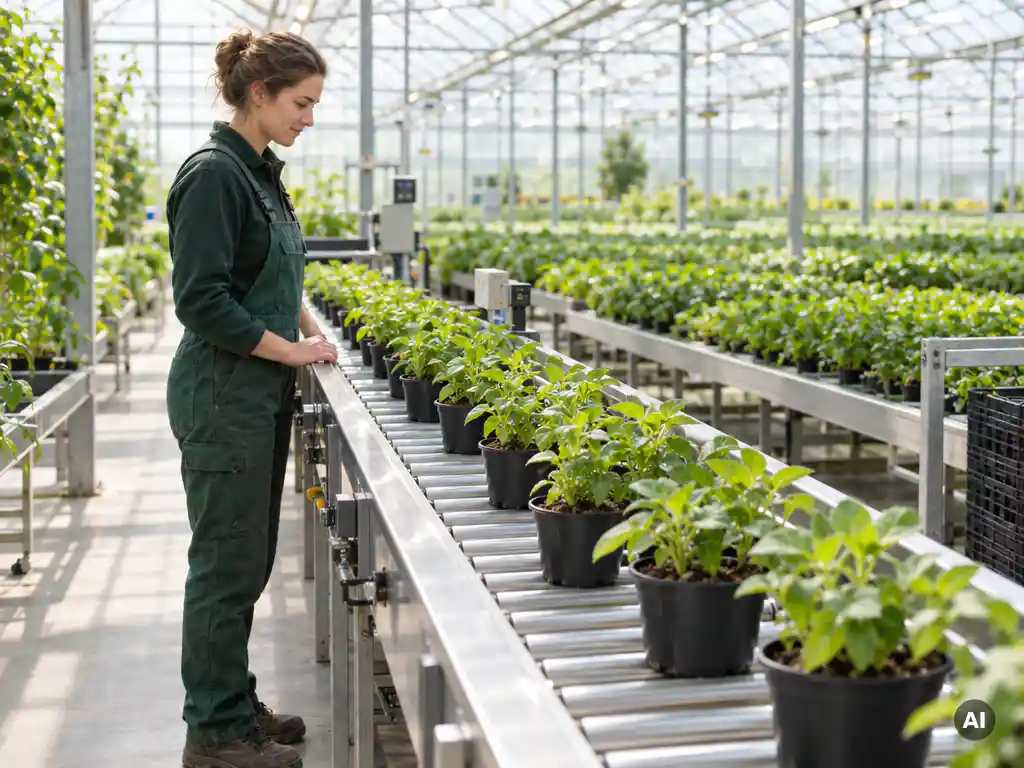
Transport also works as a foundation. Once plants move automatically between stations, adding a potting machine, a watering station, or a weighing and packing point becomes much easier. A well-designed set of conveyor belts becomes the backbone that other upgrades plug into, which is why starting here tends to improve overall greenhouse efficiency more than starting with a single standalone machine.
Start Small With Mobile Belts or Rental
You can start small by using a mobile conveyor belt or by renting equipment for a busy period, which lets you see the real effect on your own workflow before committing to a larger investment.
Mobile belts are flexible by design. They can be moved between locations, used for different crops, and adjusted as your layout changes. That makes them a low-threshold way to test whether automation fits the way you work, without rebuilding anything.
Rental goes one step further. Running a belt through a seasonal peak shows you how much time and labor it actually saves, with real numbers from your own operation instead of a brochure. If the results are good, you can grow toward fixed systems with confidence. If something needs adjusting, you learn that cheaply.
Common Automation Mistakes That Waste Budget
The most expensive mistakes come from buying too much, too soon, or from buying machines without thinking about how they fit together. Most of them are easy to avoid once you know what to look for.
- Automating a process that is not yet stable. If the workflow changes every season, fix the process first, then automate it.
- Buying from several suppliers without coordination. Machines that do not connect well create gaps, manual workarounds, and finger-pointing when something breaks.
- Skipping the layout check. A machine that does not fit your space or your product flow ends up working below its potential.
- Ignoring the team. Staff who are involved early spot practical problems and use the new setup properly. Staff who are not often work around it.
- Chasing the most advanced option. The right solution is the one that removes your biggest drain, not the one with the longest feature list.
A single partner who handles hardware, software, and installation reduces many of these risks at once. Fewer handovers mean fewer surprises and a smoother start-up.
What a Staged Approach Can Deliver
A staged approach lets you build savings step by step, with each stage paying for the thinking behind the next. Done well, the cumulative effect can be dramatic.
A typical path looks like this: begin with a mobile belt or rental unit on your biggest bottleneck, learn from the results, then move to fixed transport lines, and finally add machines such as potting or watering stations to the same system. Each step builds on the last, so nothing you buy is wasted. Growers who follow this route often find that the same output needs far fewer people. In one case, a customer went from 26 to 6 FTE for the same output.
Results like that depend on your own situation, of course, and the best way to find out what is realistic for your greenhouse is to talk it through. If you are unsure where your own first step should be, feel free to get in touch with us. We are happy to think along, look at your process, and help you pick a starting point that fits your business and your budget.
Frequently Asked Questions
How do I actually measure where my biggest labor drain is?
Start by tracking hours for one to two weeks at each step of your process, such as moving trays, potting, watering, and packing. Combine simple time sheets with input from your team leaders about where overtime builds up and where temporary staff are needed. A basic spreadsheet is enough: list each task, the number of people involved, and the hours spent, then rank the tasks by total time and physical strain.
How do I know if my process is stable enough to automate?
A good test is whether your workflow, crop mix, and tray or pot formats have stayed largely the same for at least a full season. If you still change layouts, container sizes, or routes regularly, document and standardize the process first. Starting with a mobile belt is a useful middle step, because it can be repositioned while you refine the workflow.
What should I look at when choosing between a mobile belt, rental, and a fixed conveyor system?
Consider how often the layout changes, how seasonal your peak is, and how certain you are about the workflow. Rental or a mobile belt suits testing and seasonal peaks, while a fixed system makes sense once you have proven the savings and your product flow is settled. Also check the available space, the product dimensions, and whether the belt can later connect to potting or watering machines.
How can I get my team on board with automation?
Involve team leaders and operators from the start by asking where they lose the most time and which tasks are the most physically demanding. Explain that the goal is to move people from lifting and carrying to higher-value work like quality checks and crop care. Let them test a mobile or rental belt first, so they can give practical feedback before a larger investment is made.
What numbers should I collect during a rental or trial period to judge the results?
Record the hours spent and the number of people needed for the same task before and during the trial, along with output per hour. Also note overtime, temporary staff use, and any feedback on physical strain from your team. Comparing these figures over a comparable peak period gives you a realistic basis for a purchase decision.
Is it better to buy all machines from one supplier?
In most cases, working with a single partner for hardware, software, and installation reduces risk, because machines are designed to connect and there is one point of contact if something goes wrong. Buying from several suppliers can work, but it often creates interface gaps and manual workarounds. If you do use multiple suppliers, agree in advance on how the systems will integrate.
What are the next steps if I am not sure where to start?
Begin with a short internal audit of your biggest labor drain, then sketch your current product flow and available space. Bring that information to a supplier who can look at your process and suggest a realistic first stage. A conversation at this point is usually free of obligation and helps you avoid buying more than you need.