

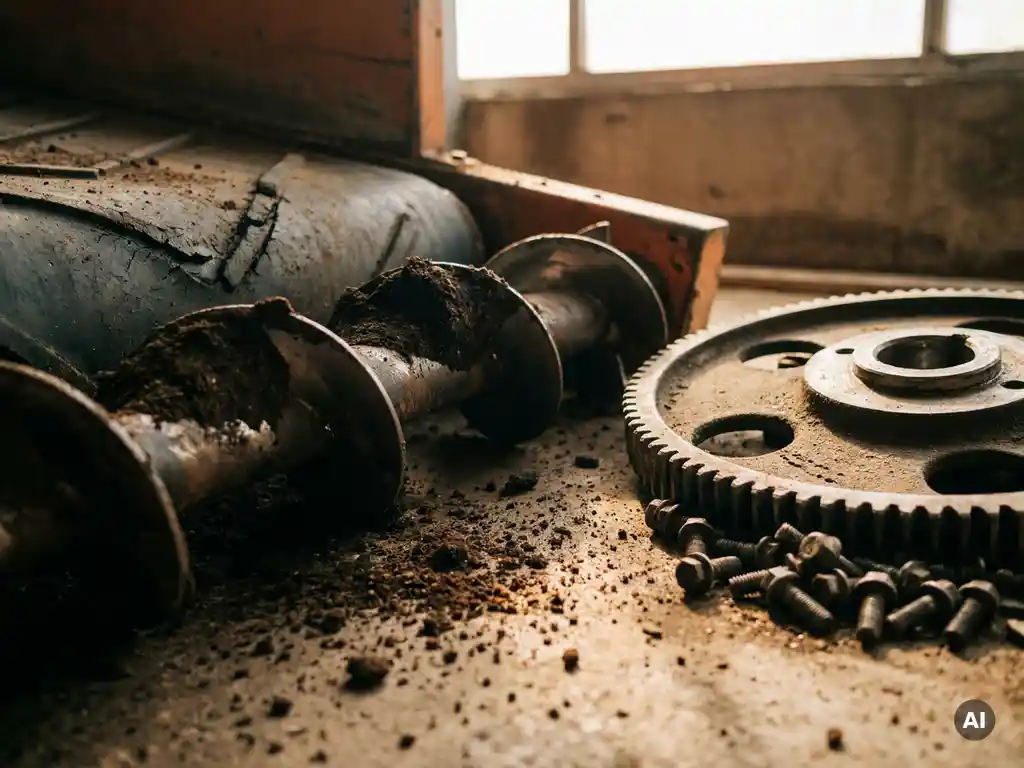
Which parts of a topping machine experience the most wear?
The parts of a potting machine that experience the most wear are the chain system, the soil dosing unit, and the filling nozzles or augers. These components are in constant contact with abrasive growing media, moving at high speed through every production cycle. Understanding where wear concentrates helps growers plan maintenance before a breakdown disrupts a critical potting run.
Potting machines operate under demanding conditions: continuous movement, heavy soil loads, and the relentless pressure of seasonal peaks. The sections below answer the most common questions growers ask about wear, replacement intervals, and the warning signs that should never be ignored.
Which components take the most punishment during potting?
The chain system, soil dosing unit, filling augers, and pot guides take the most punishment on a potting machine. These parts are exposed to abrasive soil, constant mechanical stress, and high cycle counts simultaneously. Because they operate without pause during a production run, even minor degradation compounds quickly into measurable performance loss.
Breaking this down by component helps clarify the risk each one carries:
- Chain system: Drives pot transport and timing. Exposed to soil, moisture, and continuous tension.
- Soil dosing unit and augers: Handle abrasive growing media thousands of times per hour, leading to gradual erosion of contact surfaces.
- Filling nozzles: Direct soil into pots at high speed, making them vulnerable to impact wear and clogging.
- Pot guides and rails: Align pots during transport and absorb lateral forces, particularly when pot sizes change frequently.
- Drive belts and bearings: Support the entire mechanical load and degrade with heat, misalignment, and inadequate lubrication.
Growers who run high volumes or work with heavy, peat-rich mixes will notice wear in these areas faster than those using lighter substrates at lower throughput.
Why does the chain system wear out faster than other parts?
The chain system wears faster because it operates under continuous tension while being exposed to soil, moisture, and fertilizer residue throughout every production shift. This combination accelerates both mechanical fatigue and corrosion. Unlike a component that only engages at certain points in the cycle, the chain is always moving and always under load.
Soil particles act as an abrasive, working their way into chain links and pins where they grind away lubrication and metal over time. Moisture from irrigation systems or wet growing media speeds up oxidation. If the chain runs even slightly misaligned, wear becomes uneven and the entire system loses timing accuracy, which directly affects pot fill consistency.
Regular lubrication and tension checks are the most effective way to extend chain life. A chain that stretches beyond its tolerance will skip, cause pot misalignment, or trigger stoppages at the worst possible moment during a peak season run.
What causes the soil dosing unit to clog or degrade?
The soil dosing unit clogs or degrades primarily because of incompatible or overly wet growing media, fibrous materials, and the gradual erosion of auger and dosing surfaces. When the substrate contains long peat fibers, bark chunks, or excessive moisture, it resists smooth flow and wraps around rotating components instead of passing through cleanly.
Degradation of the dosing unit surfaces is a slower process but equally damaging. Abrasive sand or perlite in the mix gradually wears down the auger flights and dosing chamber walls. Over time, this changes the volume of soil delivered per cycle, leading to underfilled or overfilled pots that fail quality checks at the grading stage.
Running a machine with a substrate it was not configured for is one of the most common causes of premature dosing unit failure. Machines designed with robust auger geometry and adjustable dosing parameters handle a wider range of mixes without clogging. Matching the machine specification to the actual growing media in use is therefore not just a performance decision but a maintenance one.
How often should wear parts on a potting machine be replaced?
Wear parts on a potting machine should be inspected at the start of every season and replaced based on measured condition rather than a fixed calendar schedule. High-volume operations may need to replace chain links, auger components, and nozzles annually, while lower-throughput growers may extend these intervals to two or three seasons with proper maintenance.
A practical maintenance rhythm looks like this:
- Before each season: Full inspection of chain tension, auger wear, nozzle condition, and belt integrity.
- Every 500 operating hours: Lubricate the chain and bearings, check alignment, clear the dosing unit of residue.
- Annually or after heavy use: Replace worn chain links, inspect auger flights for erosion, test dosing accuracy against original specification.
- Immediately after a fault or stoppage: Investigate the root cause before resuming production to avoid cascading damage.
Keeping a log of operating hours and maintenance actions makes it far easier to predict when parts are approaching end of life, rather than discovering failure mid-run.
What signs indicate a potting machine needs immediate attention?
A potting machine needs immediate attention when it produces inconsistent fill levels, makes unusual noise, drops pots during transport, or experiences repeated stoppages. These symptoms indicate that a wear-related failure is already underway and that continuing to run the machine risks more serious mechanical damage or a complete production halt.
Watch specifically for these warning signs:
- Uneven pot fill: Pots coming off the line with too little or too much soil point to auger wear or a dosing unit that has lost calibration.
- Chain skipping or slipping: Indicates stretch beyond tolerance or a broken link that will worsen with every cycle.
- Unusual vibration or noise: Often signals bearing failure, misalignment, or a foreign object in the dosing chamber.
- Pots falling or misaligning: Worn pot guides or rails that no longer hold position reliably.
- Increased power draw: A motor working harder than usual suggests mechanical resistance caused by wear or obstruction.
Any of these signs during a peak production period should trigger an immediate stop-and-inspect, not a “run until the shift ends” decision.
Does machine design affect how quickly parts wear out?
Yes, machine design has a significant impact on wear rates. Machines built with fully guided chain systems, robust auger geometry, and quality drive components wear more slowly and more predictably than entry-level machines with simpler construction. The design choices made during engineering directly determine how well a machine handles abrasive media, continuous load, and the inevitable variation in growing conditions.
Key design factors that reduce wear include:
- Fully guided chain: Reduces lateral movement and keeps timing consistent, which lowers stress on links and pins.
- Automatic soil detection: Ensures the dosing unit only activates when a pot is correctly positioned, preventing unnecessary cycles and reducing wear on filling components.
- Touchscreen programmability: Allows precise configuration for different pot sizes and soil types, reducing the stress caused by running a machine outside its optimal parameters.
- Quality materials in contact zones: Hardened surfaces in the dosing chamber and auger flights resist abrasion far longer than standard mild steel.
Growers who invest in a well-engineered machine often find that total cost of ownership over five to ten years is lower than a cheaper alternative that requires frequent part replacement and causes more downtime.
How MartinStolze supports you with potting machine wear and maintenance
Managing wear on a potting machine is much easier when the machine is built to last and backed by people who know it inside out. At MartinStolze, we design and manufacture our potting machines entirely in-house, which means we control every aspect of component quality, from the chain system to the dosing unit. Our Stolze 3030 and 3030 PRO are engineered specifically to handle the demanding conditions of professional pot plant cultivation:
- Fully guided chain system for reduced lateral stress and longer chain life
- Automatic soil detection on the 3030 PRO that minimises unnecessary dosing cycles
- Robust auger and dosing unit design suited to a wide range of growing media, including heavy or fibrous mixes
- Touchscreen programming that lets you match machine settings precisely to your substrate and pot size
- In-house trained technicians who install, maintain, and support your machine throughout its working life
- Both purchase and rental options available, including a trial period to reduce investment risk
If you are noticing wear on your current machine or want to understand which configuration suits your growing operation best, we are happy to advise. Get in touch with our team and we will help you find the right solution.
Frequently Asked Questions
Can I use the same potting machine settings for different growing media without increasing wear?
Running the same settings across different substrates is one of the fastest ways to accelerate wear on your dosing unit and auger flights. Each growing medium has a different density, moisture content, and particle size, all of which affect how the machine doses and transports soil. Adjusting your machine’s dosing parameters and speed settings to match each specific substrate not only reduces wear but also improves fill consistency and reduces the risk of clogging.
What is the most common mistake growers make when maintaining a potting machine?
The most common mistake is reactive maintenance — waiting until something breaks before taking action. Growers often continue running a machine through warning signs like unusual noise, uneven fills, or chain slipping, assuming they can address it after the busy season. This approach almost always results in more extensive damage, higher repair costs, and the worst-case scenario: a breakdown during peak production when downtime is most costly.
How do I know if my chain has stretched too far and needs replacing?
The clearest indicator of excessive chain stretch is inconsistent pot positioning — pots arriving slightly off-centre under the filling nozzle or the chain visibly skipping over the drive sprocket. You can also measure chain elongation directly using a chain wear gauge or by counting links over a fixed span and comparing against the manufacturer’s original specification. If elongation exceeds the tolerance stated in your machine’s manual, replacement should not be deferred, as a stretched chain accelerates wear on sprockets and timing components simultaneously.
Is it worth stocking spare wear parts on-site, and which ones should I prioritise?
Yes, holding a small inventory of critical wear parts on-site is strongly recommended, particularly for operations running through seasonal peaks where supplier lead times could cause costly delays. Prioritise chain links or a short chain section, spare auger components, filling nozzles, and drive belts, as these are the parts most likely to fail unexpectedly and the hardest to source quickly in an emergency. Having these on hand means a minor failure can be resolved in hours rather than days.
How does wet or overly moist growing media specifically affect machine wear compared to drier substrates?
Wet growing media significantly increases wear in two ways: it adds weight that puts extra load on the chain, drive belts, and bearings, and it promotes corrosion on metal contact surfaces that would otherwise remain dry. Fibrous wet mixes are also far more likely to wrap around auger flights and clog dosing chambers, increasing the mechanical stress on the motor and dosing unit with every cycle. Where possible, using growing media within the moisture range specified for your machine will meaningfully extend the service life of its most vulnerable components.
At what point does it make more financial sense to replace a potting machine rather than continuing to repair it?
A useful rule of thumb is to compare your annual repair and downtime costs against the cost of a new or rental machine over the same period. If you are replacing major components such as the chain system, auger unit, or drive components more than once per season, or if unplanned stoppages are regularly disrupting production schedules, the total cost of ownership of your current machine may already exceed that of a modern replacement. A conversation with your machine supplier about a trial or rental option can make this comparison much easier without requiring a full upfront investment.
Can regular cleaning alone significantly extend the life of wear components?
Regular cleaning makes a meaningful difference, particularly for the dosing unit, filling nozzles, and chain system, where accumulated soil residue accelerates abrasion and corrosion between maintenance intervals. Clearing the dosing chamber of compacted media after each shift, rinsing soil from the chain, and keeping the pot guide rails free of debris all reduce the rate at which contact surfaces degrade. However, cleaning should complement — not replace — a structured lubrication and inspection schedule, as some forms of wear occur internally in bearings and chain links where cleaning alone has no effect.