

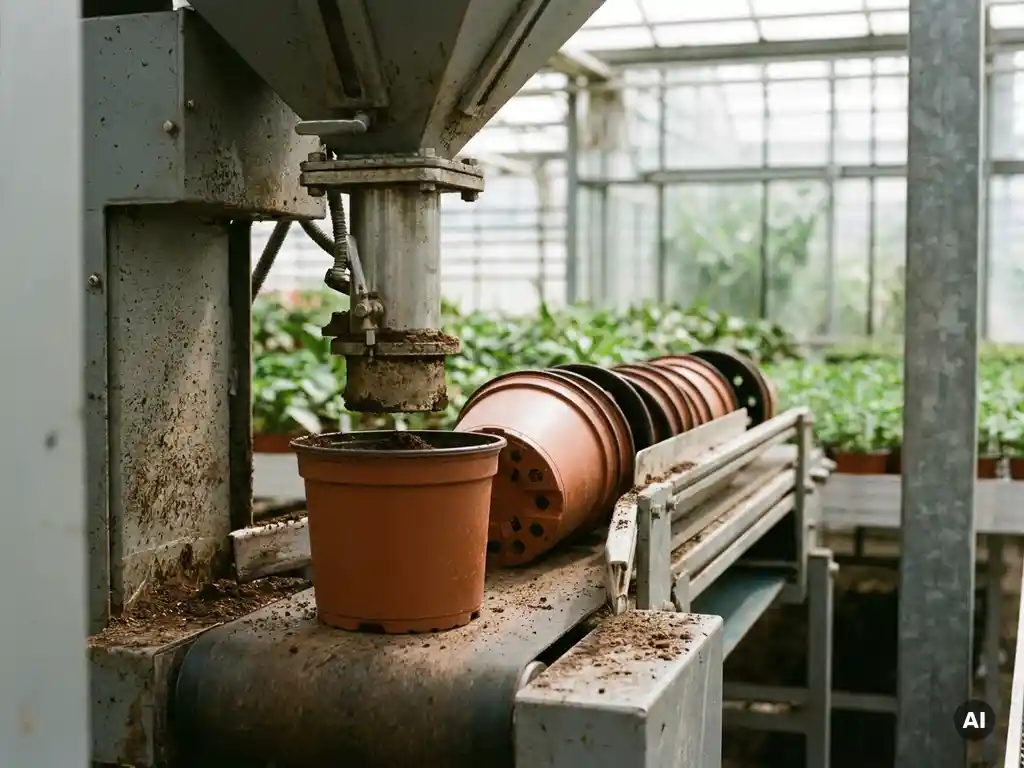
Which production step determines your actual pots per hour?
The production step that determines your actual pots per hour is whichever step in your line runs slowest, your bottleneck. In most potting operations, that bottleneck is either soil filling speed, pot supply consistency, or the transport system connecting those two. Understanding which step limits your output is the first move toward closing the gap between your machine’s rated capacity and what you actually produce. The questions below break down exactly how each part of the line contributes, or holds things back.
What actually limits your potting line’s output?
Your potting line’s output is limited by its slowest step. No matter how fast your potting machine can fill and press soil, the entire line can only move as quickly as its most constrained point allows. This is the classic bottleneck principle: one slow step upstream or downstream caps the throughput of every other step in the chain.
In practice, the most common culprits are soil filling speed, pot infeed reliability, and transport capacity. But the bottleneck is not always where you expect it. A machine rated at 8,000 pots per hour can be held back by a pot stacker that jams every twenty minutes, or by a conveyor that cannot keep pace with the outfeed. Identifying the real constraint requires looking at the whole line, not just the machine at its center.
How does soil filling speed affect pots per hour?
Soil filling speed directly sets the upper limit for your pots per hour. If the soil auger or filling mechanism cannot deliver the right volume of soil consistently and quickly enough, the machine slows its cycle, and every pot behind it waits. The filling step is often the first place growers look when output drops, and for good reason.
The challenge is that soil filling speed is not just a mechanical setting. It is also a function of your soil mix. Heavy, wet, or fibrous mixes move through a filling mechanism more slowly and inconsistently than lighter, drier mixes. A machine that handles standard potting soil at full rated speed may struggle with a peat-heavy or bark-rich mix, leading to underfilled pots, stoppages for manual correction, or automatic slowdowns triggered by sensors.
This is where automatic soil detection becomes a practical advantage. Rather than running at a fixed speed regardless of what the soil is doing, a machine with automatic soil detection adjusts fill volume in real time, keeping each pot consistent and keeping the line moving. Inconsistent filling is not just a quality problem; it is a throughput problem, because corrections and rejects cost time.
Does pot supply or transport speed slow down production?
Yes, pot supply reliability and transport speed are among the most underestimated bottlenecks in a potting line. A machine can only fill pots that arrive correctly positioned and on time. If the pot infeed jams, stacks incorrectly, or delivers pots at an irregular pace, the filling step stalls even if the machine itself is fully capable.
On the outfeed side, transport speed matters equally. If the conveyor belts carrying filled pots away from the machine cannot keep up with the filling rate, pots back up, the machine is forced to pause, and your actual output drops well below rated capacity. This is a common issue in lines where the potting machine has been upgraded but the surrounding infrastructure has not.
Pot supply and transport are often treated as secondary to the machine itself, but in a well-balanced line they must be sized and calibrated to match the machine’s throughput. A mismatch of even 10 to 15 percent between filling speed and transport speed will compound over a full production shift into a significant loss of output.
What’s the difference between rated capacity and real capacity?
Rated capacity is the maximum number of pots per hour a machine can produce under ideal conditions. Real capacity is what you actually achieve during a production shift, accounting for stoppages, changeovers, soil inconsistencies, and operator interventions. The gap between the two is almost always larger than growers expect.
Rated capacity figures assume continuous operation: consistent soil, perfectly timed pot supply, no jams, no size changes, and no pauses for maintenance. In a real production environment, none of those conditions hold perfectly throughout a shift. Every interruption, however brief, reduces your effective output per hour when averaged across the day.
The practical implication is that comparing machines on rated capacity alone is misleading. A machine rated at 8,000 pots per hour that runs reliably with minimal stoppages will consistently outperform a machine rated at the same speed that requires frequent adjustment. Reliability, ease of changeover, and the quality of soil handling all feed directly into real capacity, not just the number on the specification sheet.
How can you calculate your current production bottleneck?
To calculate your current production bottleneck, measure the actual throughput rate of each step in your line separately, then compare them. The step with the lowest throughput rate is your bottleneck. This does not require complex tools, a stopwatch, a counter, and thirty minutes of observation at each station will reveal the constraint.
Work through the line systematically:
- Count the number of pots leaving the pot infeed per minute over a ten-minute window.
- Count the number of pots filled and leaving the potting machine per minute over the same window.
- Count the number of pots arriving at the end of your transport system per minute.
- Compare the three figures. The lowest number identifies your bottleneck step.
Repeat this measurement at different points in the day and under different soil conditions. Bottlenecks can shift depending on soil moisture, pot size, or operator fatigue. A bottleneck that only appears during peak hours or after a size changeover is still a bottleneck, it just requires a different solution than one that is constant throughout the shift.
Should you upgrade your potting machine or optimize the line first?
Optimize the line first, then upgrade the machine if the machine itself is the bottleneck. Upgrading a potting machine when the real constraint is pot supply or transport speed will not improve your output, it will only move the bottleneck somewhere else while adding cost. The machine upgrade only pays off when the machine is genuinely the slowest step in a well-balanced line.
Start by running the bottleneck calculation described above. If the analysis shows that your transport speed, pot infeed, or operator workflow is the limiting factor, address those first. Often, relatively modest adjustments, recalibrating conveyor speed, improving pot stacker reliability, or reorganizing the outfeed area, can unlock significant throughput gains without any capital investment in new machinery.
If the machine itself is the constraint, either because its filling mechanism cannot handle your soil mix, or because its maximum speed is genuinely lower than what your line could otherwise support, then upgrading becomes the logical next step. At that point, the investment in a higher-capacity or more capable machine will translate directly into improved real output, because the rest of the line is already able to support it.
How MartinStolze helps you maximize pots per hour
We design and build potting lines with throughput balance in mind from the start. Rather than selling a machine in isolation, we look at your entire production process, soil mix, pot sizes, shift length, and downstream handling, to identify where the real constraint sits and how to resolve it. Our approach covers:
- Integrated line design: Our potting machines are built to work seamlessly with our own conveyor systems and transport solutions, so infeed and outfeed speeds are matched from the outset.
- Automatic soil detection: The Stolze 3030 PRO adjusts fill volume in real time, keeping output consistent even when soil mix conditions vary across the shift.
- Touchscreen programming: Pre-programmed settings for different pot sizes and soil types reduce changeover time, one of the most common sources of lost pots per hour in mixed-production environments.
- Rental option with trial period: Not ready to commit to a full purchase? You can rent first, test the machine in your actual production environment, and make the upgrade decision based on real results.
- On-site support from our own engineers: From installation through training, our team in De Lier supports you directly, no third-party service chain.
If you want to know exactly where your line is losing pots per hour and what the most effective next step looks like for your operation, get in touch with us and we will work through it with you.
Frequently Asked Questions
How often should I re-measure my bottleneck once I've identified and fixed it?
Re-measure your bottleneck after every significant change to your line — a new pot size, a different soil mix, a conveyor adjustment, or a shift in production volume. As a general rule, a quick throughput check at each station once per week during normal operations will catch new constraints before they compound into major output losses. Bottlenecks tend to shift rather than disappear, so ongoing measurement is part of running a high-performing line, not a one-time exercise.
What are the most common mistakes growers make when trying to increase pots per hour?
The most common mistake is upgrading the potting machine without first diagnosing where the real constraint is. If your bottleneck is a slow conveyor or an unreliable pot stacker, a faster machine simply moves the problem downstream and adds unnecessary cost. A close second is running the machine at maximum speed without accounting for soil mix variability, which leads to underfilled pots, sensor-triggered slowdowns, and more stoppages than a slightly reduced but stable speed would cause.
How much does soil moisture actually affect my pots per hour in practice?
Soil moisture can have a surprisingly large impact — heavy, wet mixes can reduce effective filling speed by 15 to 25 percent compared to a drier, lighter mix, depending on your machine and auger setup. Beyond slowing fill cycles, overly wet soil tends to bridge or clump inside the filling mechanism, causing inconsistent fill volumes that trigger sensor corrections or manual interventions. If you notice output dropping across a shift without any mechanical changes, checking soil moisture is one of the fastest diagnostic steps you can take.
Is there a target ratio I should aim for between infeed speed, filling speed, and transport speed?
Ideally, your pot infeed and outfeed transport should each run at 10 to 15 percent above your potting machine's target filling speed, giving you a small buffer that absorbs minor fluctuations without causing backups or stalls. A perfectly matched ratio with zero buffer sounds efficient but leaves no room for the natural variation in pot delivery timing or conveyor load. Building in that margin is what separates a line that runs at rated capacity in theory from one that consistently approaches it in practice.
Can changeover time between pot sizes really make a meaningful difference to daily output?
Yes — in mixed-production environments, changeover time is one of the most underestimated sources of lost output. A changeover that takes 20 minutes, done three times in a shift, costs you an hour of production time before you account for the re-stabilisation period after each switch. Machines with pre-programmed settings for different pot sizes and soil types can cut that time significantly, and when you multiply the savings across a full production week, the cumulative impact on total pots produced is substantial.
What should I look for when evaluating whether a potting machine is genuinely reliable versus just fast on paper?
Look beyond the rated pots-per-hour figure and ask for data on mean time between stoppages, average changeover duration, and how the machine performs with heavier or more fibrous soil mixes — not just standard potting soil. Ask whether the supplier can offer a trial or rental period in your actual production environment, because performance in a showroom or under ideal test conditions rarely reflects what you'll see during a full production shift. References from growers running similar soil mixes and pot sizes are also far more informative than specification sheets alone.
At what point does it make sense to bring in outside expertise to analyse my potting line?
If you have already run the basic bottleneck measurement, made adjustments to your infeed and transport setup, and are still seeing a consistent gap between rated and real capacity, that is a good signal to bring in outside expertise. It is also worth doing proactively when you are planning a capacity increase or adding new pot sizes, since a line audit before the investment is far less costly than discovering a mismatch after the fact. An experienced line designer can often identify constraints that are invisible from inside the operation, particularly in how individual components interact under full production load.
Related Articles
- What percentage of maximum potting machine capacity is realistic in daily production?
- What happens when your potting machine capacity exceeds the rest of your line?
- How does a potting machine fill pots consistently every time?
- What is a conveyor belt in horticulture?
- What does a complete conveyor line look like in a packing center?