

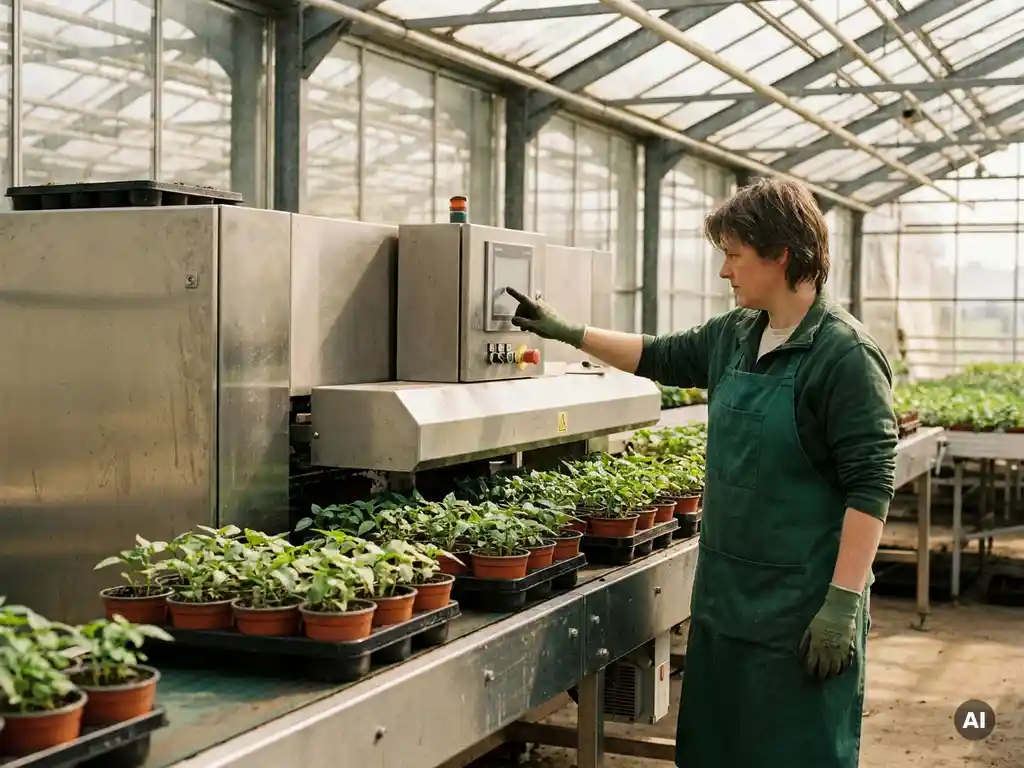
Why can two nurseries using the same potting machine achieve different output?
Two nurseries running the same potting machine can achieve very different output because machine performance depends far more on the environment around the machine than on the machine itself. Factors like soil mix consistency, operator setup, downstream transport flow, and maintenance routines all directly influence how many pots per hour a machine can realistically deliver. The sections below unpack each of these variables so you can identify exactly where your setup may be leaving capacity on the table.
What factors inside a nursery affect potting machine output?
Potting machine output in pots per hour is shaped by four core variables: the quality and consistency of the soil mix being fed into the machine, how well the operator configures and monitors the machine, whether downstream transport can keep pace with the machine’s speed, and how consistently the machine is maintained. A weakness in any one of these areas creates a bottleneck that limits total throughput regardless of the machine’s rated capacity.
This matters because two nurseries with identical machines can sit at opposite ends of the output spectrum simply because one has optimised these surrounding factors and the other has not. The machine sets the ceiling; your nursery environment determines how close you get to it.
How does soil mix quality affect potting speed?
Soil mix quality directly affects potting speed because inconsistent or poorly prepared growing media cause irregular filling, machine jams, and unplanned stoppages. A mix that is too wet clumps and blocks the soil feed; a mix that is too dry flows unevenly and produces underfilled pots. Either problem forces the operator to stop and correct, cutting deeply into the machine’s effective pots per hour.
Particle size and mix composition matter just as much as moisture content. A mix with large uncomposted chunks or fibrous material can catch on augers and filling mechanisms, causing wear and repeated interruptions. Nurseries that screen and pre-condition their growing media before it reaches the machine consistently achieve smoother, more predictable filling cycles.
Consistency across batches is equally important. If one delivery of substrate behaves differently from the last, the machine settings that worked perfectly yesterday will produce variable pot density today. Standardising your substrate supplier and storage conditions is one of the most straightforward ways to protect your output rate.
Why does operator setup make such a big difference in output?
Operator setup makes a significant difference in output because even a well-designed potting machine requires correct configuration for each pot size, soil type, and drilling depth to run at its rated capacity. An operator who sets auger speed, conveyor pace, and filling volume correctly for the day’s specific job will consistently outperform one working with default or approximate settings.
On machines with touchscreen controls, pre-programmed menus for different pot sizes and soil types eliminate much of the guesswork. An experienced operator who has built and saved these programmes can switch between jobs quickly and accurately, minimising the trial-and-error time that eats into productive hours. An operator who has not been trained to use these features will rely on manual adjustment, which is slower and less precise.
Monitoring during a run is equally important. Small deviations in pot fill level or conveyor rhythm can compound quickly at high speed. An attentive operator catches and corrects these early; an inattentive one discovers the problem only after a significant number of inconsistent pots have passed through.
What role does downstream transport play in potting capacity?
Downstream transport plays a critical role in potting capacity because if the conveyor system after the machine cannot move filled pots away fast enough, the machine is forced to slow down or stop entirely. The potting machine is only as fast as the slowest link in the line that follows it.
This is a frequently underestimated bottleneck. A nursery may invest in a machine rated at 8,000 pots per hour but pair it with a transport system designed for a lower throughput. The result is a machine that runs at a fraction of its potential, not because of any fault in the machine itself, but because filled pots have nowhere to go.
Buffer tables between the potting machine and the next stage in the line help absorb short interruptions without forcing the machine to stop. Conveyor systems that are matched in speed and capacity to the potting machine allow the entire line to run at its designed pace. When planning or upgrading a potting line, the transport system should be sized to the machine’s maximum output, not to the nursery’s current average throughput.
How do maintenance habits affect long-term potting output?
Maintenance habits have a compounding effect on long-term potting output. A machine that receives consistent, scheduled maintenance holds its performance close to its rated capacity over years of use. A machine that is serviced only when something breaks accumulates small inefficiencies that gradually reduce output and increase the risk of costly unplanned downtime during peak season.
Worn auger blades fill pots less accurately and put more load on the motor. Dirty sensors misread fill levels and trigger unnecessary pauses. Loose conveyor components cause vibration that slows the line and accelerates wear elsewhere. None of these issues is dramatic in isolation, but together they can reduce effective pots per hour meaningfully over a single growing season.
Preventive maintenance also protects the operator. A machine in good condition is more predictable and easier to run consistently. Operators working with a well-maintained machine spend less time troubleshooting and more time producing.
Should a nursery rent or buy a potting machine to test its setup first?
Renting a potting machine before buying is a practical way to test your specific nursery setup before committing to a purchase. It lets you verify how your soil mix performs in the machine, how quickly your operators learn the controls, and whether your downstream transport can handle the output, all with real production volumes rather than estimates.
This is particularly valuable for nurseries upgrading from manual potting or replacing an older machine. The variables discussed throughout this article, soil mix behaviour, operator skill, transport capacity, are difficult to predict accurately without running the machine in your own environment. A rental period removes that uncertainty and gives you concrete data on the pots per hour you can realistically achieve before you invest.
For nurseries that experience strong seasonal peaks, rental also offers a flexible way to add capacity during high-demand periods without a permanent capital commitment.
How MartinStolze helps you get the most from your potting line
We have spent more than three decades helping nurseries close the gap between a machine’s rated capacity and its real-world output. Our approach is practical and hands-on:
- Machine and line matching: We help you select the right configuration of potting machine and conveyor system for your specific pot sizes, soil mix, and production volumes so downstream transport never becomes your bottleneck.
- Operator training: We train your team in our own demo and training facility in De Lier, covering machine setup, programme configuration, and daily maintenance routines.
- Rent before you buy: Both the Stolze 3030 and the Stolze 3030 PRO are available to rent, giving you the opportunity to validate your setup in real production conditions before committing to a purchase.
- Full in-house production and service: Because we design, build, and service our machines ourselves, our own technicians can support you quickly when you need it, during installation and throughout the machine’s working life.
- Integrated automation: Our potting machines connect seamlessly with our own transport systems, so you can build or expand a complete, matched potting line from a single supplier.
If you want to find out what output your nursery setup can realistically achieve, get in touch with us and we will look at your situation together.
Frequently Asked Questions
How do I know if my current downstream transport is the bottleneck limiting my potting output?
The clearest sign is a build-up of filled pots immediately after the potting machine, forcing the machine to pause or slow down during a run. Time how long it takes for filled pots to clear the exit conveyor at your machine's maximum speed — if pots are queuing rather than moving freely, your transport capacity is undersized. Matching conveyor speed and buffer table capacity to your machine's rated output, rather than your current average throughput, is the fix.
What is the ideal moisture level for potting soil to avoid jams and inconsistent filling?
As a practical rule, growing media should be moist enough to hold its shape when squeezed in your hand but dry enough to break apart without leaving water on your palm — often described as 'field capacity.' Below this, the mix flows too freely and produces underfilled pots; above it, the mix clumps and blocks the soil feed mechanism. Always check moisture level after storage, not just at delivery, since substrate can dry out or absorb humidity depending on how and where it is stored.
How long does it typically take an operator to become fully proficient on a modern potting machine?
Most operators can handle basic machine operation after one to two days of hands-on training, but reaching full proficiency — including saving and managing pre-programmed settings for different pot sizes and soil types — typically takes two to four weeks of regular use. Structured training in a dedicated facility, like the MartinStolze demo centre in De Lier, accelerates this significantly by removing the pressure of live production. Investing in proper initial training pays back quickly in reduced setup time and fewer costly adjustments during production runs.
Can I improve my potting output without upgrading the machine itself?
Yes — in many cases, significant output gains are achievable purely through environmental improvements before any machine upgrade is considered. Screening and pre-conditioning your soil mix, training operators to use pre-programmed settings, upgrading or speeding up downstream conveyors, and introducing a preventive maintenance schedule are all changes that can meaningfully close the gap between your current output and your machine's rated capacity. It is worth auditing these four areas first, since the bottleneck is often not the machine itself.
What should a preventive maintenance schedule for a potting machine actually include?
A practical schedule covers daily, weekly, and seasonal tasks. Daily checks should include cleaning soil residue from sensors and filling mechanisms, inspecting conveyor belts for tension and wear, and confirming auger blades show no visible damage. Weekly tasks should include lubricating moving parts per the manufacturer's guidance and checking that all fasteners and conveyor components are secure. Before each peak season, a full inspection of auger blades, sensors, and drive components by a qualified technician helps ensure the machine enters its busiest period at full capacity.
What are the most common mistakes nurseries make when first setting up a potting line?
The three most common mistakes are undersizing the transport system relative to the machine's output, skipping operator training in favour of learning on the job, and failing to standardise the soil mix before it reaches the machine. A fourth, less obvious mistake is configuring the machine using default settings rather than dialling in settings specific to each pot size and soil type — this alone can cause a significant drop in both speed and fill consistency. Addressing all four before the first full production run saves considerable time and frustration.
Is renting a potting machine a realistic option for a nursery with only one short peak season per year?
Renting is often the most cost-effective option precisely for nurseries with a single concentrated peak season, since it avoids a large capital commitment for a machine that would otherwise sit idle for most of the year. It also allows you to scale rental duration and machine specification to the season's actual demand rather than forecasting years in advance. For nurseries considering a future purchase, a rental period during peak season provides real production data — pots per hour, soil mix performance, operator learning curve — that makes the eventual buying decision far more informed.
Related Articles
- How do you design an efficient potting and topping line?
- How do sensors help control an automatic topping machine?
- Can a potting machine handle different substrate types without adjusting?
- What role does a potting machine play in a full production line?
- How do you train staff to operate a new potting machine quickly?