
Why do greenhouses use conveyor belts?
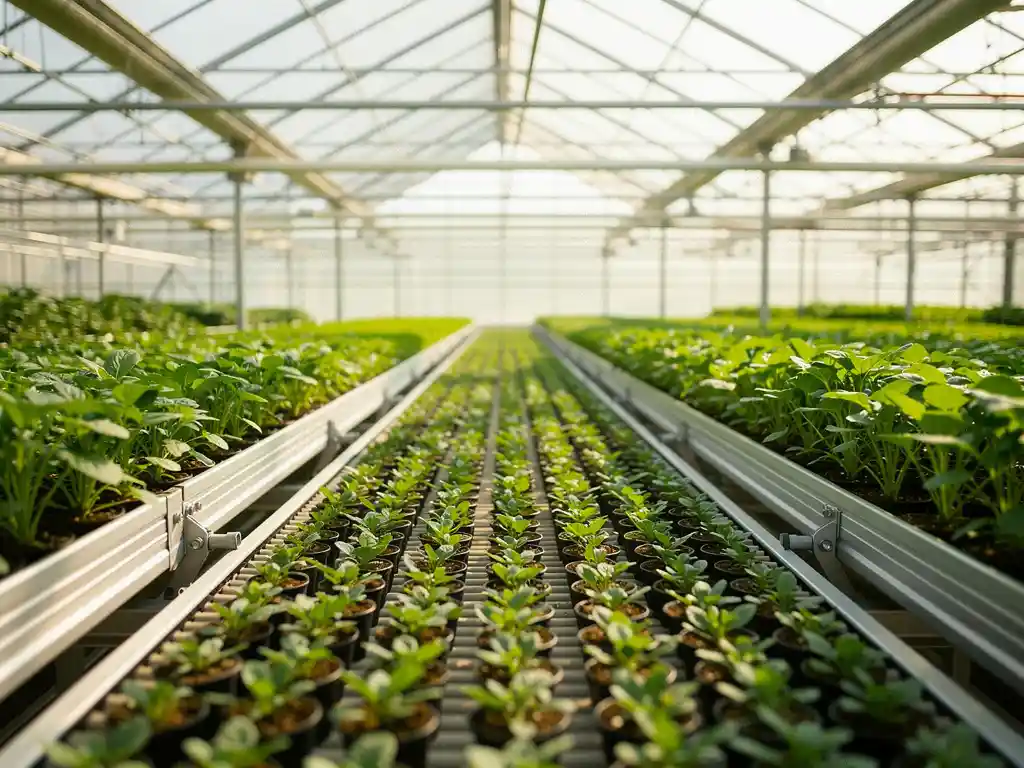
Greenhouses are complex, high-throughput environments where efficiency and ergonomics matter enormously. Whether you are growing ornamental plants, vegetables, or fruit crops, the way you move products through your facility has a direct impact on labor costs, staff well-being, and overall productivity. Conveyor belts in horticulture have become one of the most practical tools growers rely on to keep operations running smoothly, and understanding why can help you make smarter decisions for your business.
This article answers the most common questions growers and operations managers ask about greenhouse conveyor systems, from the problems they solve to how to choose the right one for your situation.
What problems do conveyor belts solve in horticulture?
Conveyor belts in horticulture solve three core problems: excessive manual labor, physical strain on workers, and disrupted product flow. Without automated transport, staff spend large parts of their working day moving plants, pots, or trays from one station to the next, covering significant distances each shift while carrying heavy loads.
The physical consequences are real. Repetitive lifting and carrying lead to musculoskeletal complaints, increased sick leave, and higher staff turnover. At the same time, manual transport creates bottlenecks. When one station works faster than another, queues build up, other workers have to wait, and the entire production line slows down. A well-designed conveyor system eliminates these gaps by creating a continuous, controlled flow of product through the greenhouse or processing area.
There is also the question of consistency. Manual handling introduces variation in speed and care, which can affect product quality. Automated transport keeps products moving at a steady pace, reducing handling damage and improving throughput predictability.
What types of conveyor belts are used in greenhouses?
Greenhouses use several types of conveyor belts depending on the task, the crop, and the layout of the facility. The main categories are mobile conveyor belts, fixed conveyor belts, buffer belts, roller conveyors, floor-level belts, and elevator belts for height transitions.
Mobile conveyor belts
Mobile systems are flexible and can be repositioned as the workflow demands. They are particularly useful in growing areas where rows change seasonally or where the same belt needs to serve different functions at different times. Models like our EasyMax and Wevab are designed specifically for this kind of flexible deployment in horticultural settings.
Fixed and integrated conveyor systems
Fixed belts form the backbone of permanent processing lines in packing stations and distribution centers. They connect potting machines, sorting lines, weighing stations, and dispatch areas into one continuous flow. Buffer belts add an important layer of flexibility by absorbing speed differences between stations, preventing jams, and keeping the line moving even when one step momentarily slows down. Roller conveyors handle heavier loads or larger trays efficiently, while elevator belts allow products to move between different levels within a facility.
How does a greenhouse conveyor belt system work?
A greenhouse conveyor belt system works by linking individual transport components into a continuous flow line that moves products from one workstation to the next without manual intervention. Each belt section feeds into the next, with buffer zones absorbing any differences in processing speed between stations.
In practice, a typical system might start at a potting machine, carry freshly potted plants along a fixed belt to a spacing or labeling station, then continue to a loading area or growing section. Elevator belts handle any height changes along the route. Sensors and speed controls can be added to synchronize the pace across the entire line, ensuring no single station becomes a bottleneck.
The real power of a well-designed system comes from the integration of components. Because all belt types are mutually compatible, you can combine mobile and fixed sections, add weighing scales or work tables at specific points, and adapt the layout as your operation grows. We engineer each installation in detail to match the specific layout and workflow of the customer’s facility, and our technicians handle installation, commissioning, and ongoing maintenance.
Should you buy or rent a greenhouse conveyor system?
Whether to buy or rent a greenhouse conveyor system depends on your timeline, budget, and certainty about your requirements. Buying makes sense when you have a clear, stable workflow and want a permanent, fully customized solution. Renting is the smarter choice when you want to test a system before committing, when you have a temporary peak-season need, or when capital investment needs to be kept low in the short term.
Renting also gives you the opportunity to experience how automated transport changes your workflow in practice. Many growers discover during a rental period that they want a different configuration or additional components than they originally anticipated. Starting with a rental removes the risk of an expensive mismatch between the system and your actual operational needs. We offer rental as a low-threshold entry point for precisely this reason, allowing you to build confidence before making a long-term investment.
How do you choose the right conveyor belt for your greenhouse?
Choosing the right conveyor belt for your greenhouse starts with understanding your product, your layout, and your workflow. The key factors to evaluate are the type and weight of what you are transporting, the distances and height differences involved, whether you need flexibility or a fixed, permanent line, and how the conveyor needs to integrate with other equipment.
Consider the environment carefully. Greenhouses are humid, often muddy, and expose equipment to water, soil, and fertilizers. The conveyor materials and construction must be robust enough to handle these conditions reliably over years of continuous use. This is why purpose-built horticultural conveyor belts perform significantly better in practice than repurposed industrial equipment that was not designed with these conditions in mind.
Think about scalability, too. A system that meets your current needs but cannot be extended as your business grows will cost you more in the long run. Modular systems that allow you to add sections, buffer belts, or additional workstations over time offer much better long-term value. It is also worth involving your team in the decision, since the people who work with the system daily will quickly identify practical requirements that are easy to overlook from a management perspective.
If you are unsure where to start, speaking with a specialist who understands the specific demands of conveyor belt horticulture applications is always the most efficient first step. The right partner will assess your situation, propose a solution that fits your actual workflow, and back it up with proper installation and service support.
Frequently Asked Questions
How long does it typically take to install a greenhouse conveyor system?
Installation time depends on the complexity and scale of the system. A straightforward mobile setup can be operational within a day, while a fully integrated fixed conveyor line with elevator belts, buffer zones, and workstations may take several days to a week. Working with a specialist who handles installation and commissioning end-to-end significantly reduces downtime and ensures the system is correctly configured from day one.
What maintenance does a greenhouse conveyor belt require?
Greenhouse conveyor belts require regular cleaning to remove soil, fertilizer residue, and moisture buildup, as these can accelerate wear on belts and drive components. Routine checks on belt tension, rollers, and motor alignment should be scheduled at consistent intervals. Purpose-built horticultural conveyors are designed to withstand the harsh greenhouse environment, but preventive maintenance is still essential to maximize lifespan and avoid unexpected downtime during peak production periods.
Can a conveyor system be adapted if my greenhouse layout changes?
Yes, modular conveyor systems are specifically designed with this flexibility in mind. Mobile belt sections can be repositioned as needed, and fixed systems built on modular components can be extended, reconfigured, or supplemented with additional buffer belts or workstations as your operation evolves. When evaluating systems, it is worth confirming upfront that all components are mutually compatible so that future expansions do not require replacing existing infrastructure.
What is the biggest mistake growers make when investing in a conveyor system?
The most common mistake is underestimating the importance of workflow analysis before purchasing. Many growers select a system based on price or a single feature without mapping out the full product flow from start to finish, which often results in bottlenecks simply shifting to a different point in the line rather than being eliminated. Involving your team in the planning process and consulting a specialist familiar with horticultural operations helps ensure the system addresses your actual workflow rather than just part of it.
Are conveyor systems only worthwhile for large greenhouse operations?
Not at all. While large-scale operations see dramatic gains in throughput and labor savings, smaller growers benefit significantly from reduced physical strain on their workforce, more predictable product flow, and lower long-term labor costs. Renting a system is a particularly accessible entry point for smaller operations, allowing you to experience the productivity gains firsthand without a major upfront capital commitment.
How do I calculate whether a conveyor system will pay for itself?
Start by estimating the hours your team currently spends on manual transport per week, then multiply that by your average labor cost. Factor in indirect costs such as sick leave related to physical strain, product damage from manual handling, and lost throughput due to bottlenecks. Compare these figures against the total cost of the conveyor system, including installation and maintenance, and most operations find the return on investment is achieved within one to three growing seasons.
What should I ask a conveyor supplier before committing to a system?
Key questions to ask include: Is the system purpose-built for horticultural conditions, or is it adapted from general industrial use? Are all components mutually compatible for future expansion? Does the supplier handle installation, commissioning, and ongoing maintenance, or will you need to source that separately? Can you rent before you buy? A supplier who can answer these questions clearly and offer references from comparable greenhouse operations is a strong indicator that they understand the specific demands of your environment.