

Why greenhouse efficiency depends on ergonomic and low strain workflows
The Hidden Cost of Physically Demanding Greenhouse Tasks
Physically heavy work costs more than it appears on the payroll, because strain quietly drives absence, turnover, and slower output. Every pot lifted by hand and every tray carried across the greenhouse adds up over a shift.
The visible costs are easy to spot: sick leave, temporary agency workers during peaks, and vacancies that stay open for months. The less visible costs matter just as much. Tired employees work more slowly, handle plants less carefully, and are more likely to make errors that lead to damaged crops or rework.
There is also a recruitment effect. Nurseries known for demanding, repetitive manual work struggle to attract and keep people, especially younger workers who have plenty of other options. A workplace that protects its people’s bodies becomes a more attractive employer, and that stability feeds directly into consistent production quality.
How Low-Strain Workflows Raise Output per Employee
Low-strain workflows raise output per employee because people spend their energy on value-adding tasks instead of moving materials around. When the physical burden drops, pace stays steady from the first hour to the last.
Think about a typical packing or potting task. If an employee has to walk, lift, and reposition trays repeatedly, a large share of the day goes to transport rather than to the plants themselves. Redesign the workflow so that products arrive at a comfortable working height and leave automatically, and the same person can focus on the task that actually requires human skill.
Consistency is the second benefit. Manual workflows tend to slow down in the afternoon as fatigue builds, and output becomes uneven across the week. Ergonomic setups smooth out those dips, which makes planning easier and reduces the need to build in extra capacity just to cover tired hours.
Where Internal Transport Automation Makes the Biggest Difference
Internal transport automation makes the biggest difference wherever products move repeatedly between workstations, such as potting, watering, sorting, and packing. These are the stretches where the most manual carrying happens and where automation removes the most strain.
Moving products between workstations
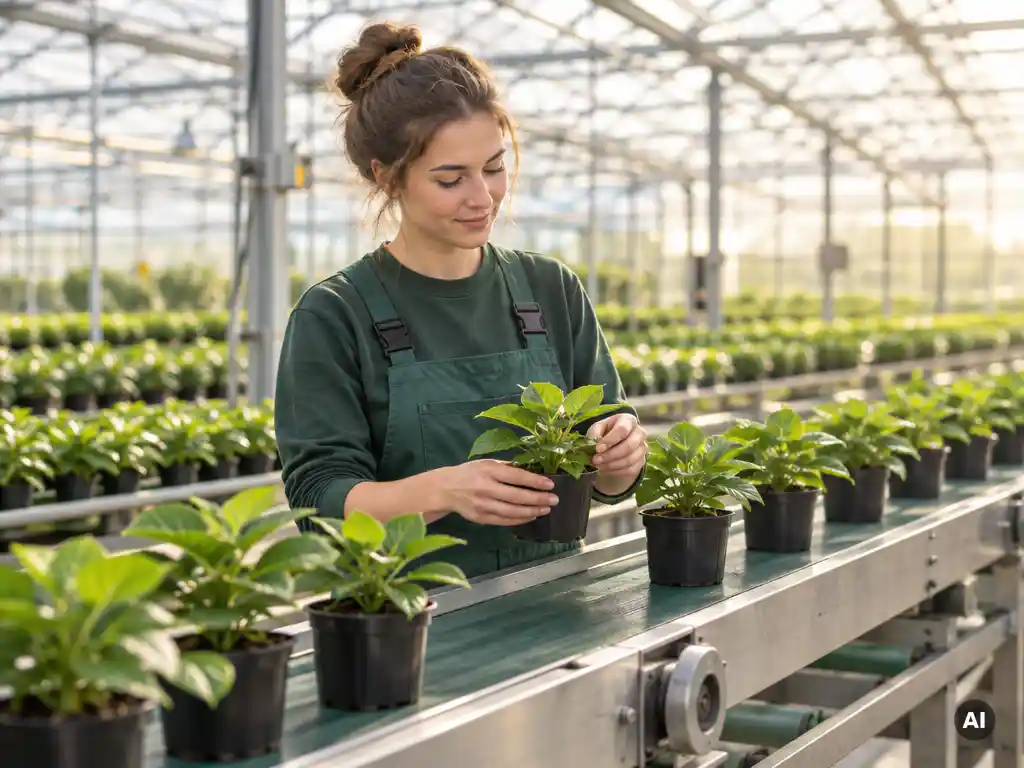
Conveyor systems carry plants from one step to the next without anyone lifting or pushing a cart. Transport belts can be combined with work tables, scales, and lighting, so a complete processing line takes shape around the people who work on it. Buffer tables add flexibility by absorbing differences in speed between stations, which prevents bottlenecks from forming.
Handling repetitive tasks
Potting machines and automated watering stations take over some of the most monotonous and physically repetitive jobs. Staff then shift toward inspection, quality control, and other tasks where judgment matters. We build these machines in our own workshop in De Lier, and because they are designed to work together, they fit into a single coherent flow rather than a patchwork of separate tools.
Starting Small: A Step-by-Step Route to Automation
The most practical way into automation is to start with one bottleneck, test a flexible solution, and expand once the benefits are proven. There is no need to redesign the whole nursery in one go.
A common first step is a mobile conveyor belt placed at the busiest point in the process. It can be moved, adjusted, and reused across different tasks, which keeps the initial commitment low. Renting equipment during a peak season is another low-risk way to see how a change affects daily routines before deciding on a permanent investment.
From there, growers can add buffer tables, connect additional workstations, and gradually build toward fixed, integrated systems. This staged approach lets the team adapt at a comfortable pace, and it lets the business learn which improvements pay off most. Our experience over more than three decades in horticulture shows that growers who build up step by step usually end up with systems that match their operation exactly. If you are unsure where your own first step should be, get in touch with us and we will think it through with you.
Measuring Efficiency Gains Beyond Labor Hours
Real efficiency gains show up in more than saved labor hours, so a good evaluation looks at quality, reliability, and workforce health as well. Counting hours alone misses much of the value.
Useful indicators to track include:
- Output per employee: how much product one person handles per shift, before and after the change.
- Absenteeism and turnover: fewer strain-related sick days and longer employee tenure.
- Error and damage rates: fewer broken plants, mislabeled trays, or rework cycles.
- Throughput consistency: how stable the pace stays across the day and the season.
- Reliance on temporary labor: how much agency support is still needed during peaks.
Looking at these measures together gives a more honest picture of what better ergonomics delivers. Some growers have reduced their workforce dramatically for the same output once the full line was automated, and the resulting savings in wages, training, and absence tend to build year after year. In 2026, with labor remaining one of the tightest constraints in horticulture, nurseries that treat ergonomics as a core part of their efficiency strategy are well placed to stay competitive. A first conversation with our team can help turn that strategy into a concrete plan.
Frequently Asked Questions
How do I identify the best first bottleneck to tackle in my greenhouse?
Start by observing one full workday and note where employees spend the most time lifting, carrying, or repositioning trays rather than working on the plants themselves. The station with the most repeated manual transport, or the one where work piles up, is usually your best starting point. Ask your team as well, since they often know exactly which tasks cause the most strain and delay.
How can I measure my current baseline before introducing automation?
Record a few simple numbers for 2-4 weeks: output per employee per shift, strain-related sick days, error or damage rates, and how many agency hours you use during peaks. Keep the measurements consistent so you can compare them fairly after the change. A basic spreadsheet is enough, as long as you track the same indicators before and after.
Is renting a mobile conveyor a realistic way to test automation?
Yes, renting during a busy season is a low-risk way to see how a change affects daily routines without a permanent investment. Place the mobile belt at your busiest workstation and track output and fatigue levels over a few weeks. If the results are positive, you will have real data to justify expanding to fixed or integrated systems.
How do I get my team on board with new equipment?
Involve employees early by asking where they feel the most strain and letting them test the setup before it is finalized. Explain that the goal is to remove heavy, repetitive tasks so they can focus on inspection, quality control, and other skilled work. Offering a short training period and gathering feedback after the first weeks helps build trust and surfaces adjustments quickly.
What are common mistakes when automating internal transport?
A frequent mistake is automating one station without considering the stations before and after it, which simply moves the bottleneck elsewhere. Another is ignoring working height and layout, so people still bend or reach awkwardly. Buffer tables and a flow that is designed as a whole help avoid both problems.
What if my greenhouse layout is tight or irregular?
Flexible, mobile solutions are well suited to limited or irregular spaces because they can be moved and adjusted as needed. Conveyor lines can be built in custom lengths and combined with work tables to fit your floor plan. Sharing a simple sketch or photos of your space with a supplier is a good way to explore what is feasible before committing.
How long does it take to see a return on a low-strain workflow investment?
This depends on the size of the change and how labor-intensive the process was, but gains in consistency and reduced fatigue are often noticeable within the first weeks. Savings from lower absenteeism, less temporary labor, and fewer errors typically build up over the following seasons. Tracking several indicators, not just labor hours, gives the most accurate view of your payback.