
Why greenhouse efficiency gains often start with internal transport
Where Hidden Labor Hours Disappear
Hidden labor hours disappear in the small, repetitive movements between process steps: carrying trays to a potting station, pushing carts to the packing area, waiting for the next batch to arrive. None of these moments look expensive on their own, but together they can eat up a surprising share of the working day.
The challenge is that this kind of work is hard to see. A team that spends half its time moving product rather than handling it will still look busy, and everyone will feel the pressure of the workload. Only when you map the route a pot takes from potting to dispatch does it become clear how many hands touch it along the way, and how many of those touches add no value to the plant.
There is a human cost too. Heavy lifting and constant walking contribute to fatigue, sick leave, and turnover, which is a real problem when vacancies already stay open for months. Reducing the physical load of internal transport does not just save hours; it makes the job more attractive and easier to staff.
How Automated Transport Lifts Output
Automated transport lifts output by keeping product moving at a steady, predictable pace, so skilled people can focus on handling plants rather than moving them. Conveyors, buffer tables, and roller tracks take over the carrying, and the whole line runs at the rhythm of the work instead of the rhythm of whoever is available.
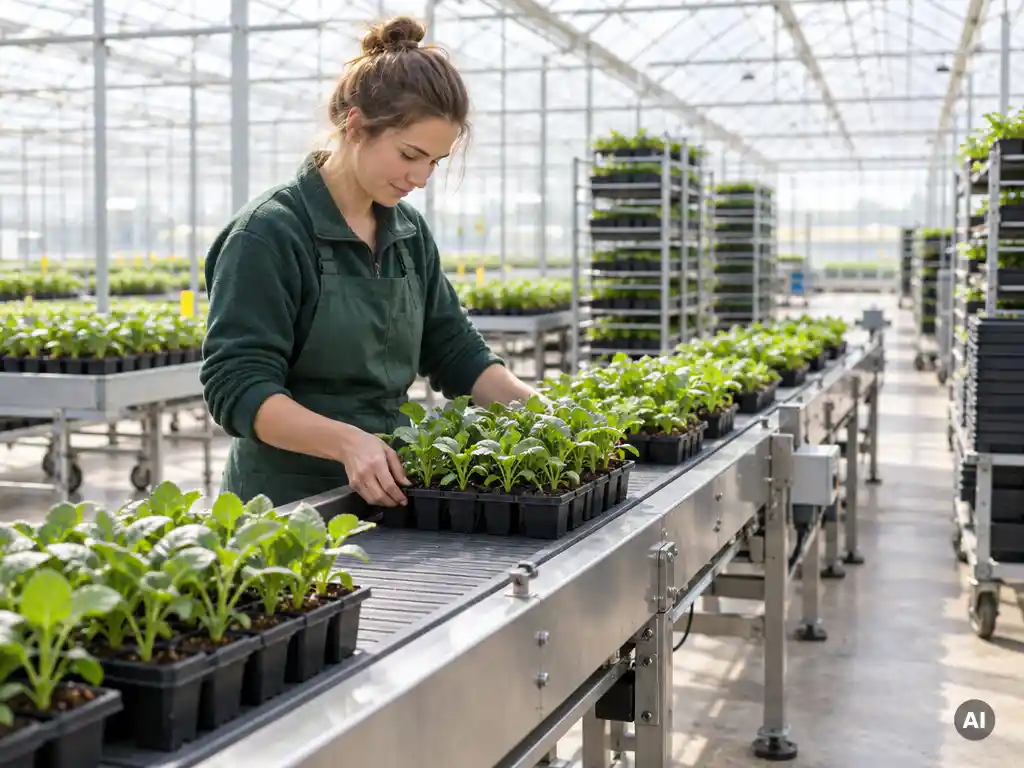
Consider what a typical potting or packing line looks like once transport is automated. Pots arrive at each station at a consistent rate, workers stay in place, and a buffer table absorbs small differences in speed between steps. Bottlenecks shrink, idle waiting drops, and the same team can handle more volume without working harder.
Because well-designed systems can be combined with work tables, scales, and lighting, they also support quality. Plants are handled less, damage is reduced, and each station can be set up ergonomically. With our conveyor range, we have seen growers get the same output with a far smaller crew simply by letting machines handle the transport. Some have gone from 26 FTE down to 6 for the same production, which shows just how much of the old workload was movement rather than craft.
Starting Small With Mobile Conveyors
The easiest way to start automating internal transport is with a mobile conveyor, a flexible unit that can be placed where the pressure is highest and moved when needs change. It lowers the barrier to entry because there is no need to redesign the whole greenhouse before seeing results.
Why a Step-by-Step Approach Works
Many growers hesitate because automation sounds like a large, fixed investment. A phased approach removes much of that uncertainty. You begin with one problem area, perhaps a peak-season packing line, and learn how the equipment behaves in your own conditions before committing further.
Renting is a useful way to take that first step. Trying a mobile conveyor during a busy period shows quickly whether it saves the hours you expected, and it gives your team time to get comfortable with the new way of working. If it proves its value, the move toward fixed systems feels like a natural next stage rather than a leap.
Growing Into Fixed Systems
Once the benefits are clear, the setup can grow with the business. Mobile units can be complemented by fixed conveyors, roller tracks, potting machines, and watering stations that connect into a continuous flow. Each addition builds on what is already working, so the investment follows the results instead of running ahead of them.
Common Pitfalls When Automating Transport
The most common pitfall is automating a single machine without considering the flow around it, which simply moves the bottleneck to the next step. A fast conveyor feeding a slow station only creates a pile-up, so the design needs to look at the whole route, not one isolated point.
Another trap is buying equipment from several suppliers and leaving the integration to chance. Hardware, software, and installation that do not talk to each other lead to delays, workarounds, and finger-pointing when something fails. Working with a single partner who handles everything from advice to installation keeps the project coherent and reduces the risk of disruption.
Finally, many projects stumble on people rather than technology. If staff are not involved early, new equipment can feel like a threat instead of a relief. Explaining that the goal is to remove heavy, repetitive tasks and letting the team test the setup usually turn skepticism into support. Practical layout questions, like available space, floor conditions, and product variety, are also worth settling before anything is installed.
Building a Future-Proof Greenhouse Flow
A future-proof greenhouse flow is one that can scale up, change direction, and absorb seasonal peaks without needing to rebuild everything. Modular equipment is the key, because components that combine easily let you adapt as crops, volumes, and labor availability shift over the years.
With wages still rising in 2026 and the labor market showing little sign of loosening, relying on manual transport looks increasingly risky. Competitors who automate can produce faster and at lower cost, which puts pressure on margins for everyone else. Treating internal transport as a strategic part of greenhouse efficiency, rather than an afterthought, is one of the most reliable ways to stay competitive.
If you are weighing where to begin, a conversation about your current process is often the most useful first step. Our team is happy to look at your situation and suggest a realistic starting point, so feel free to get in touch with us and talk through the options.
Frequently Asked Questions
How do I measure how much time my team actually spends on internal transport?
Start with a simple time-and-motion study: follow one batch of pots from potting to dispatch and note every time someone lifts, carries, pushes, or waits. Record how many people touch the product and how long each movement takes over a typical day. Even a one-week log with a stopwatch or a basic spreadsheet will usually reveal which steps consume the most hours and where a conveyor would pay off first.
How do I decide where to place my first mobile conveyor?
Look for the point where the workload peaks or where people spend the most time carrying rather than handling plants, such as a packing line in peak season or the route from the potting station to the buffer area. Choose a spot where you can easily measure the before-and-after result, for example hours per 1,000 pots. Starting with one clearly defined problem area makes it easy to judge whether the investment is worthwhile.
What should I check before installing a conveyor system in my greenhouse?
Settle the practical details first: available space, floor conditions and slopes, power supply, the range of pot and tray sizes you handle, and the path workers and carts need to keep clear. Sketch the whole product route rather than only the spot where the conveyor will stand. Sharing this information with your supplier up front helps avoid costly adjustments after installation.
How can I avoid simply moving the bottleneck to another step?
Map the capacity of each step in the process before adding equipment, and aim for a balanced flow rather than the fastest possible conveyor. Buffer tables are a practical tool here, as they absorb small speed differences between stations. After the first installation, watch where product starts to pile up or where people wait, and address that next step in the chain.
How do I get my team on board with automated transport?
Involve staff from the start and explain that the goal is to remove heavy, repetitive work, not to replace skilled people. Let employees test a mobile conveyor and give feedback on the height, speed, and station layout. When they see that the new setup reduces physical strain, skepticism usually turns into support.
Is it worth renting a mobile conveyor before buying one?
Yes, renting is a low-risk way to test whether the equipment saves the hours you expect under your own conditions. Plan the trial for a busy period so the effect is clearly visible, and track labor hours before and during the trial. If the results are good, you can confidently expand to fixed conveyors, roller tracks, or other connected equipment.
Can I combine conveyors with other equipment like work tables, scales, or potting machines?
Yes, modular systems are designed to be combined, so a conveyor can connect with work tables, scales, lighting, watering stations, and potting machines into one continuous flow. Combining them also improves ergonomics and plant quality because workers stay in place and plants are handled less. It is best to plan the full flow with one partner so hardware and installation work together smoothly, even if you build it up in phases.